Dataset

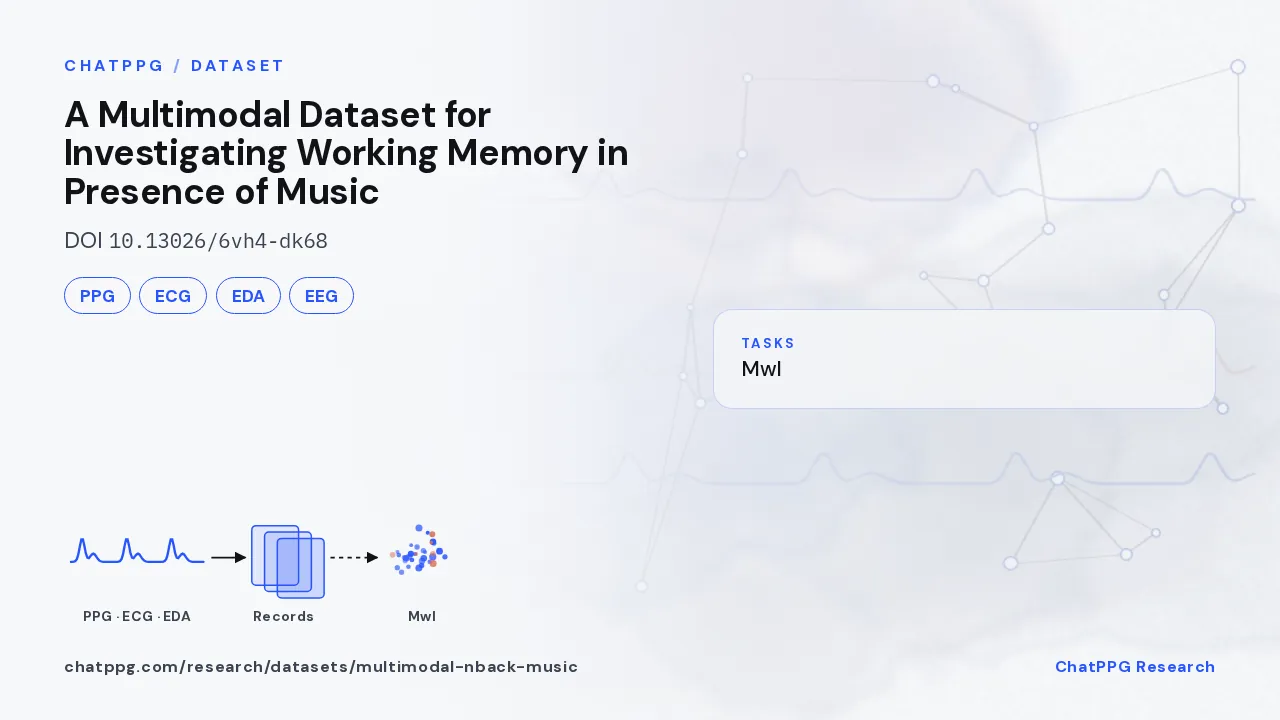
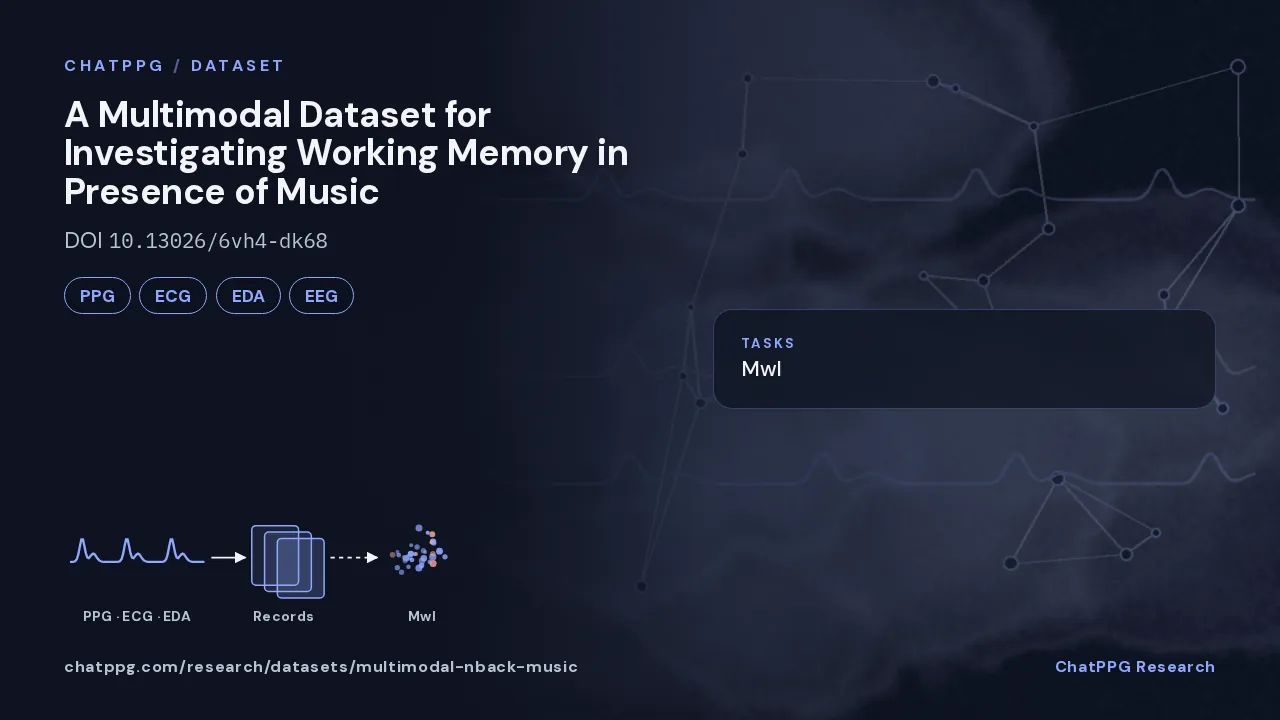
A Multimodal Dataset for Investigating Working Memory in Presence of Music

This dataset accompanies a study of whether music can regulate cognitive arousal and performance during a working memory task. Participants did 1-back and 3-back tasks with calming music in the first session and exciting music in the second, with 22 trials per block. Physiological signals and behavioural data were recorded throughout.

Published
PhysioNet, 2025
Cohort
11 participants
Task

n-back (1-back and 3-back) with calming vs exciting music

At a glance
Type
Dataset
Host
Not reported
Licence
Not reported
Access
Not reported
Subjects
Not reported
PPG sites
WristFinger
Setting
Lab
Wrist
Yes
Raw waveforms
Yes
Updated
Nov 16, 2026

Original description

We present the accompanying dataset to the study "A Multimodal Dataset for Investigating Working Memory in Presenceof Music". The experiment is conducted with the aim of investigating the viability of music as an intervention to regulate cognitive arousal and performance states. We recorded the multimodal physiological signals and behavioral data during a working memory task called the n-back task while the background music was playing. We requested the participants to provide the music, and two types of music were employed with the calming and exciting content. The calming music was played during the first session of the experiment, and the exciting music was presented during the second session. Each session includes an equal number of 1-back and 3-back task blocks, where 22 trials are presentedwithin each task block. A total number of 16 task blocks are implemented in each session (8 blocks of 1-back task and 8 blocks of 3-back task). In this experiment,11 participants/subjects originally participated, while we removed participants/subjects with small modalities. The recorded signals are skin conductance (SC), electrocardiogram (ECG), skin surface temperature (SKT), respiration, photoplethysmography (PPG), functional near-infrared spectroscopy (fNIRS), electromyogram (EMG), de-identified facial expression scores, sequence of correct/incorrect responses, and reaction time.
Verbatim fromPhysioNet· Licence: Open Data Commons Attribution License v1.0

A Multimodal Dataset for Investigating Working Memory in Presence of Music: ChatPPG research summary card

Key numbers

1
Reference labels
MWL

How it works

How A Multimodal Dataset for Investigating Working Memory in Presence of Music works: Devices & body sites → Signals recorded → TasksDevices & body sites: Empatica E4 (Empatica · Wrist); Muse S EEG headband (Interaxon · Head). PPG sites: Wrist, Finger. Signals recorded: A Multimodal Dataset for Investigating Working Memory in Presence of Music, signals PPG, ECG, IMU, EDA, Respiration, Temperature. Tasks: Mental workload.Devices & body sitesEmpatica E4: Empatica · WristEmpatica E4Empatica · WristMuse S EEG headband: Interaxon · HeadMuse S EEG headbandInteraxon · HeadPPG sites: Wrist, FingerPPG sitesWrist, FingerSignals recordedA Multimodal Dataset for…PPGECGxyzIMUEDARespirationTemperatureTasksMental workloadMental workload

No model in the hub reports results on this dataset yet.

Reference labels
mwl
Device roles
Study wearable (IMU) · Clinical reference (ECG)

Devices· 2

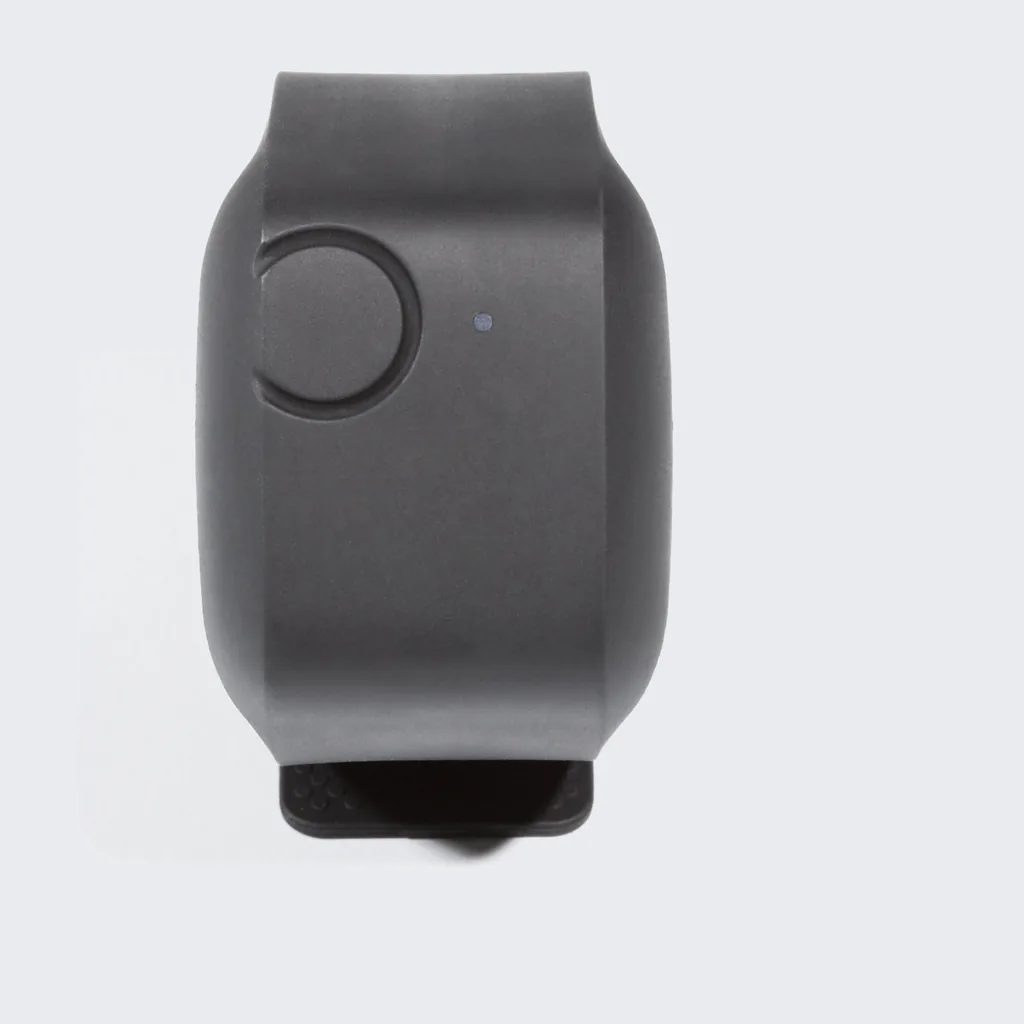
Full photo credits and licences are on each device page. An icon means we have no openly licensed or manufacturer-cleared photo of that exact device yet.

FAQ

What signals does A Multimodal Dataset for Investigating Working Memory in Presence of Music include?

A Multimodal Dataset for Investigating Working Memory in Presence of Music includes PPG, ECG, EDA, EEG, respiration, skin temperature and accelerometer data. Raw waveforms are included.

What can A Multimodal Dataset for Investigating Working Memory in Presence of Music be used for?

Research tasks it supports: mental workload assessment. Reference labels: mental workload.

How do I get A Multimodal Dataset for Investigating Working Memory in Presence of Music, and what is its licence?

It is available from https://physionet.org/content/multimodal-nback-music/1.0.0/. No licence is recorded for it here, so check the terms on the source page before you use it.

Was A Multimodal Dataset for Investigating Working Memory in Presence of Music recorded with a wrist-worn device?

Yes. Its record lists wrist-worn recording.

Cite this dataset

Cite this dataset with the fields recorded here. Check it against the publisher before submitting.

A Multimodal Dataset for Investigating Working Memory in Presence of Music [Data set]. (n.d.). https://doi.org/10.13026/6vh4-dk68
@misc{multimodalnbackmmultimodal,
  title         = {{A Multimodal Dataset for Investigating Working Memory in Presence of Music}},
  doi           = {10.13026/6vh4-dk68}
}

Cite the ChatPPG record

Cite the dated snapshot 2026-10 for a fixed, reproducible version. Please also cite the original publications listed above.

APA

ChatPPG. (2026). A Multimodal Dataset for Investigating Working Memory in Presence of Music: dataset record (Version 2026-10) [Data set]. ChatPPG Research Hub. https://chatppg.com/research/datasets/multimodal-nback-music

BibTeX
@misc{chatppg_dataset_multimodal_nback_music,
  author       = {{ChatPPG}},
  title        = {{A Multimodal Dataset for Investigating Working Memory in Presence of Music: dataset record}},
  year         = {2026},
  month        = nov,
  version      = {2026-10},
  howpublished = {\url{https://chatppg.com/research/datasets/multimodal-nback-music}},
  note         = {ChatPPG Research Hub, Snapshot 2026-10, https://chatppg.com/research/snapshots/2026-10}
}
CITATION.cff
cff-version: 1.2.0
message: "If you use this resource, please cite it as below."
type: dataset
title: "A Multimodal Dataset for Investigating Working Memory in Presence of Music: dataset record"
authors:
  - name: "ChatPPG"
url: "https://chatppg.com/research/datasets/multimodal-nback-music"
repository-artifact: "https://chatppg.com/research/snapshots/2026-10"
version: "2026-10"
date-released: "2026-11-16"

History

  1. Record updated