Capillary refill time: normal values, how to test it, and a shoe that measures it
Capillary refill time: normal values by age, how to do the capillary refill test, what a delayed result means, and wearables that measure it.
Reviewed by Sameer Sontakey, Co-founder and Chief AI & Algorithms Officer at Sensor Bio. ChatPPG is independent and device-neutral; it is not a Sensor Bio product.
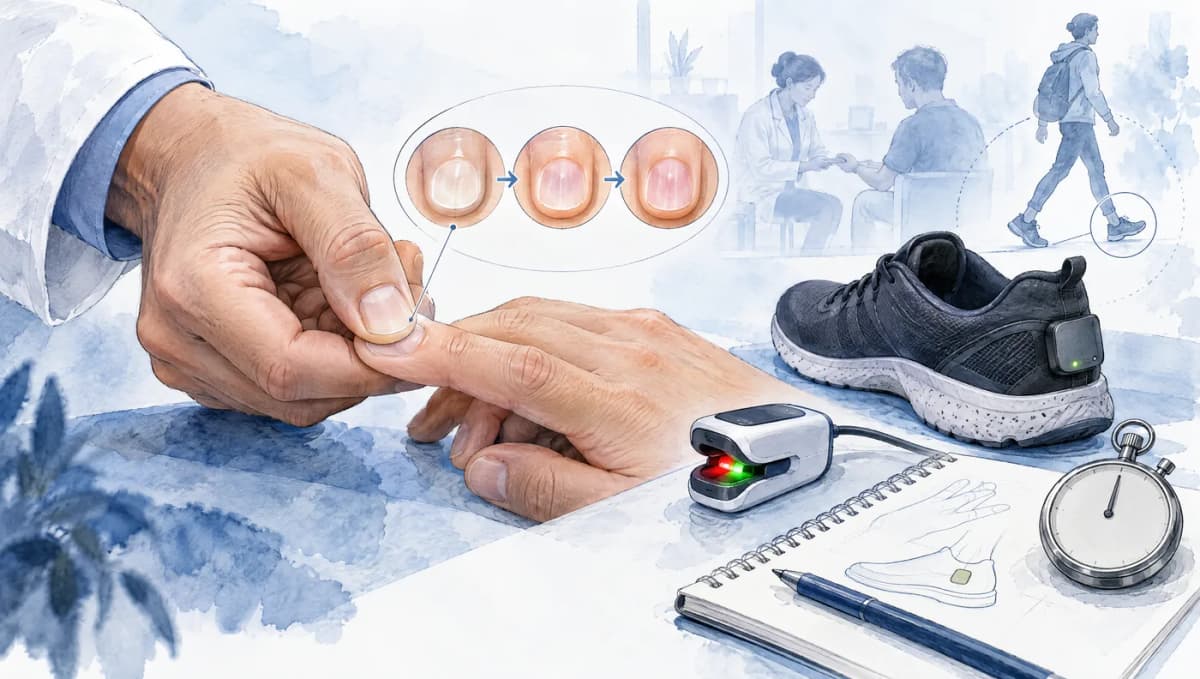
Short answer: Capillary refill time (CRT) is the number of seconds it takes for pressed, blanched skin on a fingertip to turn pink again. In children past their first week, 2 seconds or less is normal and 3 seconds or more is abnormal. A slow refill points to poor blood flow to the skin. It is a screening sign, not a diagnosis.
Clinicians have used the test for decades because it needs nothing but a thumb and a watch. It is also subjective, sensitive to temperature, and easy to do inconsistently. That is why researchers keep trying to automate it, from pulse oximeter sensors to a recent smart shoe that times refill with every step. This guide covers normal values, how to check capillary refill properly, what a delayed result can mean, and where wearables fit.
This article is educational and is not medical advice. If someone seems seriously unwell, seek care right away.
What capillary refill time measures
Pressing on skin squeezes blood out of the small vessels underneath, which is why the area goes pale. When you let go, blood flows back in and the color returns. The time that takes reflects how well blood is reaching the skin, which clinicians call peripheral perfusion.
Clinicians use CRT as a quick read on peripheral perfusion and circulation, especially when they suspect dehydration, sepsis, shock or hypothermia. The CapWear paper from ISWC '26 opens with the same list (Lee et al., 2026, DOI 10.1145/3830727.3834814).
What CRT does not measure is blood pressure. A clinical guide for general practitioners by Fleming and colleagues notes there is no evidence for a relationship between CRT and blood pressure in children, so it should not be used as a stand-in for a blood pressure reading. There is limited evidence linking it to arterial blood flow and other invasive cardiovascular measures (Fleming et al., 2016, DOI 10.3399/bjgp16X687925).
Normal capillary refill time by age
Normal values depend on age, body site, sex and temperature. The figures below come from a pediatric systematic review, the clinical guide built on it, and a study of healthy adult volunteers.
| Group | Site | Normal | Abnormal or upper limit | Source |
|---|---|---|---|---|
| Newborns, first 7 days | Finger | Longer than older infants | Upper limit of normal 5 to 7 s | Fleming et al., 2016 |
| Infants and children over 7 days | Finger | 2 s or less | 3 s or more is abnormal; 2 to 3 s is borderline | Fleming et al., 2016 |
| Children over 7 days | Chest or foot | 4 s or less | Upper limit about 4 s | Fleming et al., 2015 (ADC) |
| Children and adult men | Finger | Medians 0.7 to 1.0 s | About 2 s | Schriger and Baraff, 1988 |
| Adult women | Finger | Median 1.2 s | About 2.9 s | Schriger and Baraff, 1988 |
| Elderly adults | Finger | Medians 1.5 to 1.8 s | About 4.5 s | Schriger and Baraff, 1988 |
For children, the 2015 systematic review in Archives of Disease in Childhood pooled 21 studies on 1,915 children and found the upper limit of normal in children over 7 days is about 2 s on a finger and 4 s on the chest or foot, whether or not the child has a fever. It recommended treating 3 s or more as abnormal (Fleming et al., 2015, DOI 10.1136/archdischild-2014-307079). The companion practice guide adds that some healthy children can reach 2.5 s and that there is no evidence CRT varies much with age after the newborn period (Fleming et al., 2016, DOI 10.3399/bjgp16X687925).
For adults, the familiar "2-second rule" has weaker support. Schriger and Baraff measured refill in 100 healthy children, 104 adults and 100 elderly volunteers. Applying a 2 s cutoff produced false positives in 4.0% of children and adult men, 13.7% of adult women and 29.0% of elderly volunteers, so they proposed upper limits of 2.9 s for adult women and 4.5 s for the elderly (Schriger and Baraff, 1988, DOI 10.1016/S0196-0644(88)80675-9).
Temperature matters too. In the same study, 20 adults dipped a hand in 14 °C water for a minute and their median refill time rose from 1.3 s to 2.9 s (Schriger and Baraff, 1988, DOI 10.1016/S0196-0644(88)80675-9). A cold hand can look "delayed" in a perfectly healthy person.
How to check capillary refill
The capillary refill test is simple, but small changes in method shift the result. The practice guide recommends this approach for children, and it works as a consistent routine for anyone (Fleming et al., 2016, DOI 10.3399/bjgp16X687925):
- Use a fingertip, ideally the pad of the finger.
- Press with moderate pressure for 5 seconds.
- Check in a room at about 20 to 25 °C. If the person just came in from the cold or heat, give the skin time to adjust.
- Release and count the seconds, with a watch or timer, until the skin returns to its usual color.
- Write down the actual number, such as "2 seconds or less" or "4 seconds", rather than "normal" or "slow".
Using a timer improves agreement between observers, and longer pressing and room temperatures outside 20 to 25 °C both lengthen the measured time (Fleming et al., 2015, DOI 10.1136/archdischild-2014-307079). If a result is unexpectedly long, repeat it carefully before reading too much into it.
What a delayed capillary refill time is a sign of
A slow refill means blood is returning to the skin more slowly than expected. Common reasons include:
- Dehydration, one of the classic reasons to run the test.
- Sepsis and septic shock.
- Shock in general, when the circulation can't keep the skin supplied.
- Cold. Hypothermia, or just cold hands, slows refill without any illness.
- How it was measured. Pressing longer, or testing the foot or chest instead of a finger, gives longer times.
The best data come from children. A 2015 meta-analysis in PLOS ONE screened 1,265 references and included 24 papers. For predicting death, prolonged CRT had a sensitivity of 34.6% and a specificity of 92.3%, with a positive likelihood ratio of 4.49. For 5% dehydration in children with vomiting and diarrhea, specificity was 89 to 94%, though sensitivity ranged from 0 to 94%. Specificity was consistently high for meningitis, sepsis, hospital admission, hypoxia and dengue (Fleming et al., 2015, DOI 10.1371/journal.pone.0138155).
The authors concluded that prolonged CRT works as a red flag: children with it had about four times the risk of dying. Because sensitivity is low, a normal CRT should not reassure anyone.
In adult septic shock, CRT has been tested as a treatment target. The ANDROMEDA-SHOCK randomized trial assigned 424 patients in 28 intensive care units to resuscitation aimed at normalizing capillary refill time or at lowering lactate. At 28 days, 34.9% of the CRT group and 43.4% of the lactate group had died (hazard ratio 0.75, 95% CI 0.55 to 1.02, P = .06), which was not a statistically significant difference. The CRT group had less organ dysfunction at 72 hours (Hernández et al., 2019, DOI 10.1001/jama.2019.0071). Our overview of PPG for sepsis early detection covers how continuous sensors might add to these bedside signs.
Why CRT is hard to measure well
Hands-on CRT depends on how hard you press, for how long, where, in what light and at what temperature. A 2011 review in Anesthesia & Analgesia noted that evidence for CRT in anesthesia is thin and pointed to new approaches, such as digital videography or modified oxygen saturation probes, that could remove the limits of visual timing and automate the measurement (Pickard et al., 2011, DOI 10.1213/ANE.0b013e31821569f9).
Measuring refill with a pulse oximeter sensor
A pulse oximeter clip shines light through the fingertip. When the finger is squeezed, blood is pushed out and more light gets through. When it is released, blood flows back and the signal recovers. That recovery curve is a machine-readable version of what your eye sees as color returning.
Shinozaki and colleagues built an investigational device around a standard pulse oximetry sensor using a single 940 nm infrared wavelength. After a 5 second fingertip compression, they fit the recovery curve as an exponential decay and reported the time to a 90% return of light intensity, which they called blood refill time (BRT) to separate it from visual CRT (Shinozaki et al., 2019, DOI 10.1186/s40560-019-0406-0).
In 30 emergency department patients, mean visual CRT was 1.9 ± 0.8 s and BRT correlated with it (r = 0.723). BRT predicted a CRT above 3 s with an AUC of 0.82, and intra-rater reliability was 0.88 for BRT versus 0.92 for CRT. The Bland-Altman plot showed proportional bias, and the sample was small (Shinozaki et al., 2019, DOI 10.1186/s40560-019-0406-0).
CapWear: a shoe that estimates capillary refill time while you walk
Every refill test needs a press. CapWear, from Kyoosik Lee, Dong-Su Kang and Inseok Hwang, uses walking to supply it. Each heel strike during walking pushes blood out of the tissue under the heel, and lifting the foot lets it flow back. The system uses that natural cycle to estimate plantar capillary refill dynamics continuously during everyday walking (Lee et al., 2026, DOI 10.1145/3830727.3834814).
The paper was presented at the 2026 ACM International Symposium on Wearable Computers (ISWC '26). Its abstract describes it as a feasibility demonstration and argues that footwear could become a platform for continuous peripheral perfusion monitoring in daily life. The abstract does not name the sensing method or report agreement with clinician-timed CRT, so treat it as an early research prototype, not a validated measure. You can follow the paper in the ChatPPG research hub entry for CapWear.
A single fingertip check is a snapshot taken by one person in one room. A shoe could produce hundreds of refill estimates a day under similar conditions, which might show a trend in someone at risk of dehydration or poor circulation. Whether those estimates track clinical CRT closely enough to act on is the open question.
How CRT relates to PPG and perfusion index
Optical wearables already measure something related. The perfusion index (PI) from a pulse oximeter compares the pulsing part of the PPG signal with the steady part, giving a continuous read on blood flow at the sensor site without any pressing.
Lima et al. (2002) measured PI in 108 healthy adults, where it ranged from 0.3 to 10.0 with a median of 1.4, and in 37 critically ill patients. They defined poor peripheral perfusion as a CRT over 2 s plus a core-to-toe temperature difference of at least 7 °C, and found a PI cutoff of 1.4 best reflected poor perfusion (DOI 10.1097/00003246-200206000-00006).
PI and CRT answer slightly different questions. PI is passive and continuous; CRT is an active challenge that shows how fast the tissue refills after it is emptied. Our guides on the clinical perfusion index and the neonatal perfusion index go deeper on PI, and the pulse oximeter readings chart explains the numbers on a typical fingertip device. Researchers who want raw fingertip PPG to experiment with can start from the OpenOximetry dataset in the hub, and the ChatPPG research hub tracks new perfusion and wearable sensing papers as they appear.
When to get help
CRT is one sign among many, and it works best as a prompt to look closer:
- A refill of 3 seconds or more in a child past the newborn period, or a clearly slow refill in an adult who seems unwell, is a reason to contact a clinician promptly.
- Call emergency services for trouble breathing, confusion or unresponsiveness, cold mottled skin, or signs of severe dehydration, whatever the refill time.
- Do not let a normal result talk you out of seeking care for someone who looks sick.
- Consumer wearables do not yet report a validated CRT. Research devices like CapWear are prototypes.
This article is educational and is not medical advice.
References
- Lee K, Kang D-S, Hwang I. CapWear: Smart Footwear for Peripheral Perfusion Monitoring by Continuous Plantar Capillary Refill Time Estimation. Proceedings of the 2026 ACM International Symposium on Wearable Computers (ISWC '26). 2026:67-70. DOI 10.1145/3830727.3834814
- Fleming S, Gill PJ, Van den Bruel A, Thompson M. Capillary refill time in sick children: a clinical guide for general practice. British Journal of General Practice. 2016;66(652):587-588. DOI 10.3399/bjgp16X687925
- Fleming S, Gill P, Jones C, et al. Validity and reliability of measurement of capillary refill time in children: a systematic review. Archives of Disease in Childhood. 2015;100(3):239-249. DOI 10.1136/archdischild-2014-307079
- Fleming S, Gill P, Jones C, et al. The Diagnostic Value of Capillary Refill Time for Detecting Serious Illness in Children: A Systematic Review and Meta-Analysis. PLOS ONE. 2015;10(9):e0138155. DOI 10.1371/journal.pone.0138155
- Schriger DL, Baraff L. Defining normal capillary refill: variation with age, sex, and temperature. Annals of Emergency Medicine. 1988;17(9):932-935. DOI 10.1016/S0196-0644(88)80675-9
- Hernández G, Ospina-Tascón GA, Damiani LP, et al. Effect of a Resuscitation Strategy Targeting Peripheral Perfusion Status vs Serum Lactate Levels on 28-Day Mortality Among Patients With Septic Shock: The ANDROMEDA-SHOCK Randomized Clinical Trial. JAMA. 2019;321(7):654-664. DOI 10.1001/jama.2019.0071
- Pickard A, Karlen W, Ansermino JM. Capillary refill time: is it still a useful clinical sign? Anesthesia & Analgesia. 2011;113(1):120-123. DOI 10.1213/ANE.0b013e31821569f9
- Shinozaki K, Jacobson LS, Saeki K, et al. Comparison of point-of-care peripheral perfusion assessment using pulse oximetry sensor with manual capillary refill time: clinical pilot study in the emergency department. Journal of Intensive Care. 2019;7:52. DOI 10.1186/s40560-019-0406-0
- Lima AP, Beelen P, Bakker J. Use of a peripheral perfusion index derived from the pulse oximetry signal as a noninvasive indicator of perfusion. Critical Care Medicine. 2002;30(6):1210-1213. DOI 10.1097/00003246-200206000-00006
Frequently Asked Questions
- What is a normal capillary refill time?
- For infants and children older than 7 days, a clinical guide in the British Journal of General Practice (Fleming et al., 2016) treats 2 seconds or less on the finger as normal and 3 seconds or more as abnormal. Newborns in their first week can take 5 to 7 seconds. In adults, a 1988 study of healthy volunteers (Schriger and Baraff) suggested upper limits of about 2 seconds for men, 2.9 seconds for women and 4.5 seconds for elderly people.
- How do you check capillary refill?
- Press on the pad of a fingertip with moderate pressure for 5 seconds, release, and count the seconds until the skin returns to its normal color. Do it in a room around 20 to 25 °C, use a watch or timer, and write down the actual number of seconds. Cold skin, a cold room and longer pressing all lengthen the result.
- Delayed capillary refill time is a sign of what?
- A slow refill suggests reduced blood flow to the skin. It is used as a warning sign in dehydration, sepsis, shock and hypothermia. In children, a 2015 meta-analysis found that a prolonged capillary refill time was highly specific for death and for serious illnesses such as meningitis, sepsis and hypoxia. Being cold can also slow refill in healthy people.
- If capillary refill time is normal, does that rule out a serious problem?
- No. Capillary refill time is a specific sign but not a sensitive one. In the pediatric meta-analysis by Fleming et al. (2015), sensitivity for mortality was 34.6%, so many seriously ill children had a normal result. A normal test should not reassure you if someone otherwise looks unwell.
- Can a wearable measure capillary refill time?
- Research devices can. A 2019 emergency department pilot used a standard pulse oximetry sensor to time how fast light absorption recovered after fingertip compression, and it correlated with physician-timed refill (r = 0.723 in 30 patients). CapWear, presented at ISWC 2026, uses the heel strike of each step as the press and estimates refill during walking. Neither is a cleared consumer product.
- When should I get medical help for slow capillary refill?
- Capillary refill time is a screening sign, not a diagnosis. If a child or adult has a refill of 3 seconds or more and seems unwell, contact a clinician promptly. Call emergency services for trouble breathing, confusion, unresponsiveness, cold mottled skin or signs of severe dehydration. This article is educational and is not medical advice.
Related articles
Home Sleep Apnea Test vs Polysomnography: Where Wearables Fit and What They Cannot Replace
HSAT and polysomnography answer different clinical questions. This guide explains when each test is appropriate, what wearables and PPG can support, and what they still cannot replace in sleep apnea care.
Non-Invasive Hemoglobin Monitoring: Can PPG Estimate Hb in Real Time?
Can a non invasive hemoglobin monitor estimate Hb in real time? Learn where pulse CO-oximetry and PPG help, where they fail, and how to validate them.
Neonatal Perfusion Index Explained: How PPG Supports NICU Monitoring
Understand neonatal perfusion index, how PPG derives it from the waveform, and how NICU teams use bedside trends to assess peripheral flow in newborns.
Newborn Oxygen Levels Chart: Normal SpO2 Ranges from Birth Through 28 Days
Reference chart of normal newborn oxygen saturation levels from the first minute of life through 28 days, with values by gestational age, pre-ductal vs. post-ductal, and clinical action thresholds.
PPG Perfusion Index Clinical
Perfusion Index (PI) is one of the most underutilized parameters available from photoplethysmography, yet it provides uniquely direct information abou...