Pulse Oximeter Readings Chart: SpO2 and Heart Rate Ranges Explained
A complete pulse oximeter readings chart covering normal, borderline, and dangerous SpO2 and heart rate ranges, plus factors that affect accuracy.
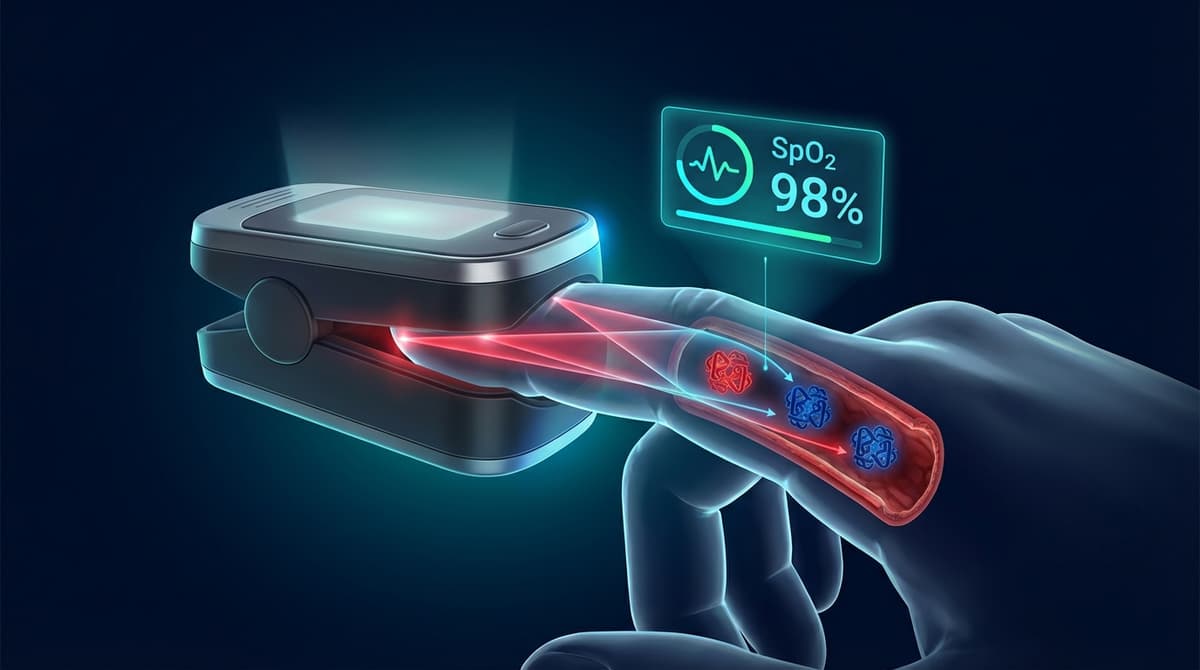
A pulse oximeter readings chart maps SpO2 (blood oxygen saturation) and heart rate values into normal, borderline, and dangerous ranges. For healthy adults at sea level, normal SpO2 is 95% to 100%, and normal resting heart rate is 60 to 100 beats per minute. Readings below 92% SpO2 typically require medical attention, and sustained readings below 88% are considered a clinical emergency.
Quick reference: SpO2 of 95 to 100% is normal. SpO2 of 91 to 94% is borderline and warrants monitoring. SpO2 at or below 90% is low and requires prompt evaluation.
This guide breaks down exactly what the numbers on a pulse oximeter mean, provides reference charts for both SpO2 and heart rate, and explains the factors that can make readings unreliable. If you want to understand how these readings are generated at the sensor level, see PPG signal basics.
What do the numbers on a pulse oximeter mean?
A standard pulse oximeter displays two values. The first is SpO2, which stands for peripheral oxygen saturation. It represents the percentage of hemoglobin molecules in your arterial blood that are carrying oxygen. The second number is your pulse rate, measured in beats per minute (bpm).
Both numbers are derived from photoplethysmography, or PPG. The device shines red and infrared light through your fingertip or wrist and measures how much light is absorbed by pulsating arterial blood. Oxygenated hemoglobin and deoxygenated hemoglobin absorb these two wavelengths differently, and the ratio between them is what produces the SpO2 estimate (Chan et al., 2013, DOI).
The pulse rate comes from detecting the rhythmic peaks in the PPG waveform, each peak corresponding to one heartbeat.
SpO2 readings chart: oxygen saturation ranges
Here is a reference chart for interpreting SpO2 readings at sea level in adults without known lung disease.
| SpO2 Range | Classification | What It Means |
|---|---|---|
| 97% to 100% | Normal | Fully adequate oxygenation. No action needed. |
| 95% to 96% | Normal (low end) | Still within normal range. Healthy for most adults. |
| 91% to 94% | Borderline / Mildly low | Below the typical healthy range. Monitor closely. May indicate early respiratory compromise. |
| 86% to 90% | Low (hypoxemia) | Clinically significant. Supplemental oxygen often indicated. Seek medical evaluation. |
| 80% to 85% | Severely low | Organ function may be impaired. Urgent medical attention required. |
| Below 80% | Critical | Risk of organ damage, confusion, loss of consciousness. Emergency care needed. |
A few important notes on this chart. First, these thresholds apply to adults at sea level. People with chronic lung conditions like COPD may have different baseline values that their clinician has established as acceptable. Second, a single low reading does not always mean a problem. Repeat the measurement with a warm, still finger before drawing conclusions.
For a deeper look at why consumer and clinical devices may report different SpO2 values, see SpO2 accuracy limitations in PPG.
Heart rate readings chart: resting pulse ranges
The pulse rate displayed on a pulse oximeter reflects your heart rate at the moment of measurement. Here are the standard adult resting ranges.
| Heart Rate (bpm) | Classification | Notes |
|---|---|---|
| Below 40 | Very low (severe bradycardia) | May indicate a conduction abnormality. Seek evaluation unless you are an elite athlete with known low resting HR. |
| 40 to 59 | Low (bradycardia) | Common in trained athletes. Otherwise, may warrant evaluation if symptomatic. |
| 60 to 100 | Normal | Standard adult resting range. |
| 101 to 120 | Elevated (mild tachycardia) | Can be normal after caffeine, exercise, stress, or fever. Persistent elevation worth investigating. |
| Above 120 | High (tachycardia) | At rest, this is abnormal and should be evaluated, especially with symptoms. |
Keep in mind that resting heart rate varies considerably between individuals. Well-conditioned endurance athletes frequently have resting rates in the low 40s or 50s. Anxiety, dehydration, fever, and medications can push heart rate above 100 bpm without any cardiac pathology.
How does a pulse oximeter produce these readings?
The measurement relies on a principle called photoplethysmography. Two LEDs, one red (around 660 nm) and one infrared (around 940 nm), emit light into tissue. A photodetector on the opposite side (in transmission-mode finger sensors) or the same side (in reflectance-mode wrist sensors) picks up the light that passes through or bounces back.
The key physics: oxygenated hemoglobin absorbs more infrared light, while deoxygenated hemoglobin absorbs more red light. The device isolates the pulsatile (AC) component of the signal at each wavelength, which corresponds to arterial blood volume changes during each heartbeat. It then calculates a ratio of ratios:
R = (AC_red / DC_red) / (AC_infrared / DC_infrared)
This R value is mapped to an SpO2 percentage through an empirical calibration curve built from controlled hypoxia studies in human volunteers (Jubran, 2015, DOI).
For more on the difference between clinical finger sensors and consumer wrist devices, see clinical-grade vs. consumer wearables.
What affects pulse oximeter accuracy?
Not every reading you see on a pulse oximeter is reliable. Several factors can push SpO2 estimates higher or lower than the true value.
Poor perfusion
Cold fingers, low blood pressure, or peripheral vascular disease reduce blood flow to the fingertip. With less pulsatile signal, the device has a harder time isolating the arterial component, and accuracy drops. If your hands are cold, warm them before measuring.
Motion artifact
Moving your hand during measurement introduces mechanical noise into the optical signal. Even small movements can distort the pulsatile waveform. Hold your hand still and rest it on a flat surface for the most reliable reading.
Skin pigmentation
Research has shown that pulse oximeters can overestimate SpO2 in patients with darker skin tones. A study by Sjoding et al. (2020) published in the New England Journal of Medicine found that Black patients had nearly three times the rate of occult hypoxemia, where pulse oximetry showed normal values while actual arterial oxygen was dangerously low (DOI). This is a known limitation of current calibration methods. For a full discussion, see PPG skin tone bias and accuracy.
Nail polish and artificial nails
Dark nail polish, especially blue, green, or black shades, absorbs light at wavelengths used by the sensor and can lower SpO2 readings artificially. Gel nails and acrylics can also interfere. Remove polish from the measurement finger or use a different finger.
Ambient light
Strong ambient light, particularly from surgical lamps or direct sunlight, can bleed into the sensor and contaminate the reading. Most modern devices have some ambient light rejection built in, but shielding the sensor helps.
Dyshemoglobinemias
Standard pulse oximeters assume that hemoglobin exists in only two forms: oxygenated and deoxygenated. Carbon monoxide poisoning produces carboxyhemoglobin, which the device reads as oxygenated hemoglobin, resulting in falsely high SpO2. Methemoglobinemia drives readings toward approximately 85% regardless of true saturation. Two-wavelength devices, including all consumer wearables, cannot detect these conditions.
How does altitude affect pulse oximeter readings?
At higher elevations, the partial pressure of oxygen in the atmosphere decreases. Your body receives less oxygen with each breath, and SpO2 drops as a result. This is a real physiological change, not a sensor error.
Here are approximate expected SpO2 ranges at various altitudes for healthy, acclimatized individuals.
| Altitude | Approximate Expected SpO2 |
|---|---|
| Sea level (0 ft) | 95% to 100% |
| 5,000 ft (1,500 m) | 93% to 97% |
| 8,000 ft (2,400 m) | 90% to 95% |
| 10,000 ft (3,000 m) | 87% to 93% |
| 14,000 ft (4,300 m) | 82% to 88% |
| 18,000 ft (5,500 m) | 75% to 85% |
These numbers reflect acclimatized individuals. During the first hours or days at a new altitude, SpO2 may be lower until the body adapts. If you are using a pulse oximeter at altitude and see readings that seem low compared to the sea-level chart, consider whether altitude is the explanation before assuming a medical problem.
For more on how PPG-based devices handle altitude, see continuous SpO2 monitoring in wearables.
When should you be concerned about your readings?
A pulse oximeter readings chart is a reference tool, not a diagnostic device on its own. Context matters as much as the number.
You should pay attention when:
- SpO2 is consistently below 94% at rest and at sea level
- SpO2 drops below 90% during normal activity, such as walking across a room
- heart rate is consistently above 100 bpm at rest without an obvious cause like caffeine, anxiety, or recent exercise
- readings are accompanied by symptoms: shortness of breath, chest tightness, confusion, or bluish discoloration of lips or fingertips
- there is a declining trend over days or weeks, even if individual readings are still borderline
A single reading of 93% that improves to 96% on repeat measurement with a warm, still finger is probably a measurement artifact. A pattern of repeated low readings is something different.
For patients with known conditions like COPD, heart failure, or interstitial lung disease, your clinician may have established a personal baseline and specific thresholds for when to seek care. Those individualized targets take priority over any general chart.
Tips for getting accurate pulse oximeter readings
Getting a reliable number from a pulse oximeter is straightforward, but a few habits make a real difference.
- Use the correct finger. The index or middle finger of your dominant hand typically gives the strongest signal. Avoid the thumb, which has its own pulsation that can confuse readings.
- Warm your hands. Cold fingers mean poor perfusion. Rub your hands together or hold them under warm water for 30 seconds before measuring.
- Stay still. Rest your hand on a table or your lap. Do not move your fingers during the reading.
- Wait for the reading to stabilize. Most pulse oximeters need 10 to 30 seconds to lock onto a stable signal. Do not read the number the instant it appears.
- Remove nail polish. If you see unexpectedly low readings, try a bare finger.
- Check placement. The sensor should be snug but not tight. The fingertip should be fully inserted so the light path crosses the nail bed.
- Take multiple readings. If one reading seems off, try a different finger. Try both hands. Consistent results across fingers are more trustworthy than a single measurement.
Pulse oximeter readings in specific populations
Children
Normal SpO2 in healthy children is the same as adults: 95% to 100%. Resting heart rates are higher in children, ranging from around 70 to 120 bpm in school-age children and even higher in infants. Pediatric pulse oximeters use smaller sensors designed for smaller fingers.
Elderly adults
Older adults may have slightly lower baseline SpO2, particularly those with chronic lung or heart disease. Reduced peripheral perfusion is more common with aging and can affect reading quality. The same accuracy limitations apply, and cold or poorly perfused fingers are a frequent practical issue.
Athletes
Well-trained endurance athletes commonly have resting heart rates of 40 to 55 bpm and sometimes lower. This is a normal training adaptation, not a sign of cardiac disease. SpO2 should remain in the normal range at rest, though exercise-induced arterial hypoxemia can temporarily lower SpO2 during intense exertion in some elite athletes.
Frequently asked questions
What is a normal pulse oximeter reading?
A normal SpO2 reading for a healthy adult at sea level is 95% to 100%. A normal resting heart rate is 60 to 100 bpm. Values outside these ranges do not automatically indicate disease but should be evaluated in context.
When should I worry about my pulse oximeter reading?
If SpO2 is consistently below 92% at sea level, or if low readings are accompanied by symptoms like breathlessness or confusion, contact a healthcare provider. A single borderline reading that improves on repeat measurement is less concerning.
Can a pulse oximeter be wrong?
Yes. Poor circulation, cold fingers, motion, nail polish, skin pigmentation, and sensor fit can all affect accuracy. Consumer wrist-based devices tend to be less precise than clinical finger sensors.
What do the two numbers on a pulse oximeter mean?
The SpO2 number is your blood oxygen saturation as a percentage. The second number is your pulse rate in beats per minute. Both are derived from the same PPG optical signal.
Does altitude affect pulse oximeter readings?
Yes. Higher altitude means lower atmospheric oxygen, and SpO2 will be lower as a result. A reading of 92% at 8,000 feet is physiologically expected, while the same reading at sea level would be abnormal.
Why does my pulse oximeter reading change from finger to finger?
Small differences between fingers are normal and reflect variations in blood flow and sensor contact. A difference of 1 to 2% is typical. Larger discrepancies may indicate poor placement or a circulation issue in one hand.
Is 93% oxygen level OK?
For most healthy adults at sea level, 93% is below the normal range and should be monitored. If repeated measurements confirm it, or if symptoms are present, medical evaluation is appropriate.
Frequently Asked Questions
- What is a normal pulse oximeter reading?
- A normal SpO2 reading is 95% to 100%, and a normal resting heart rate is 60 to 100 beats per minute for most adults.
- When should I worry about my pulse oximeter reading?
- You should seek medical attention if SpO2 drops below 92% at sea level, especially if symptoms like shortness of breath, confusion, or chest pain are present.
- Can a pulse oximeter be wrong?
- Yes. Poor circulation, cold fingers, dark nail polish, excessive motion, and skin pigmentation can all cause inaccurate readings.
- What do the two numbers on a pulse oximeter mean?
- The first number, usually labeled SpO2, is your blood oxygen saturation as a percentage. The second number is your pulse rate in beats per minute.
- Does altitude affect pulse oximeter readings?
- Yes. At higher altitudes, lower atmospheric oxygen means SpO2 readings naturally drop. A reading of 90% at 8,000 feet may be expected, while the same reading at sea level would be concerning.
- Why does my pulse oximeter reading fluctuate?
- Fluctuations can result from motion, poor finger placement, cold hands, low perfusion, or rapid breathing. Brief variations of 1 to 2% are normal.
- Is 93% oxygen level OK?
- For most people at sea level, 93% is below normal and worth monitoring. If it persists or drops further, medical evaluation is recommended.