PPG Sleep Apnea Detection
Sleep apnea affects an estimated 1 billion people worldwide, with the majority undiagnosed. PPG-based wearables can screen for it by tracking nocturna...
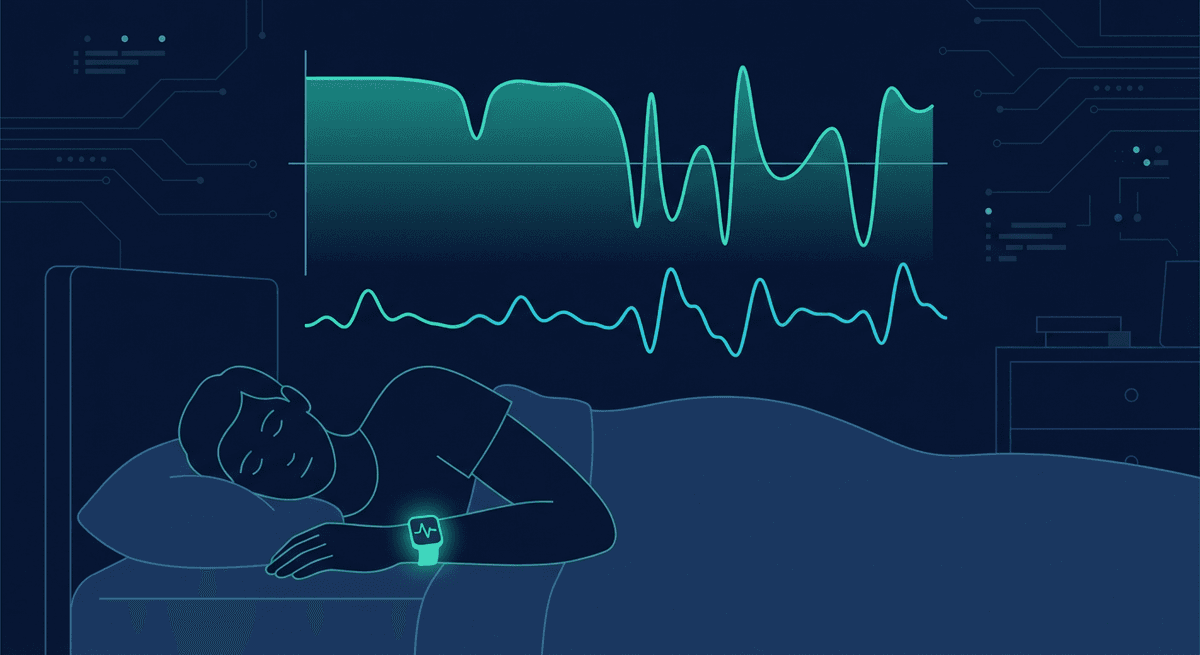
Sleep apnea affects an estimated 1 billion people worldwide, with the majority undiagnosed. PPG-based wearables can screen for it by tracking nocturnal oxygen desaturation and pulse rate variability, but the accuracy gap between a smartwatch and a clinical sleep study remains significant. This article explains what PPG can and cannot detect, and when a proper polysomnogram is still necessary.
How PPG Relates to Sleep Apnea
Obstructive sleep apnea (OSA) causes repeated pauses in breathing during sleep. Each apneic or hypopneic event has several consequences that are measurable with PPG:
Oxygen desaturation: When breathing stops, blood oxygen saturation (SpO2) drops. A typical moderate apneic event causes SpO2 to fall 4% or more before the person partially wakes and breathing resumes. Infrared PPG can estimate SpO2 via pulse oximetry.
Pulse rate changes: Each arousal from an apneic event triggers a sympathetic nervous system response that accelerates the heart rate transiently. This creates a characteristic oscillatory pulse rate variability pattern during sleep that correlates with apnea severity.
Pulse waveform morphology changes: Apneic events also produce characteristic changes in PPG waveform shape, including reduced amplitude (from vasoconstriction) and altered dicrotic notch appearance, due to increased sympathetic tone.
Respiratory effort signals: PPG amplitude modulation correlates with respiratory effort because intrathoracic pressure changes during breathing affect venous return and thus pulse amplitude. This creates a low-frequency oscillation in PPG amplitude that can be used to estimate respiratory rate and detect effort-independent breathing cessation.
PPG-Based Sleep Apnea Detection Methods
Oxygen Desaturation Index (ODI)
The simplest and most validated approach uses continuous SpO2 monitoring to compute the oxygen desaturation index: the number of times per hour SpO2 drops 3% or 4% from baseline. ODI correlates moderately with the apnea-hypopnea index (AHI) from polysomnography.
A systematic review by Borsini et al. (2022, doi:10.1183/13993003.01788-2021) found that ODI from pulse oximetry achieved sensitivity of 78–92% and specificity of 61–82% for identifying moderate-to-severe OSA (AHI ≥15), depending on the desaturation threshold used and the study population.
The limitation: ODI misses many hypopneas that cause arousals without significant desaturation. In REM-related OSA and in patients with high baseline SpO2 reserve (such as younger patients), desaturation may not occur even during genuine apneic events.
Pulse Rate Variability Analysis
Pulse rate variability during sleep shows characteristic patterns in OSA that differ from normal sleep. The autonomic nervous system cycles through arousal-recovery sequences that produce low-frequency PRV oscillations with a period matching the apnea cycle (typically 20–60 seconds).
Algorithms that analyze PRV frequency domain components (0.01–0.05 Hz band corresponds to respiratory rate oscillations) can detect these patterns. Combining PRV-based detection with SpO2 monitoring substantially improves sensitivity and specificity compared to either alone.
A study by Uçar et al. (2019, doi:10.1016/j.compbiomed.2019.103292) demonstrated that combining SpO2 and PPG-derived PRV features with a random forest classifier achieved AUC of 0.92 for OSA classification versus polysomnography, with sensitivity of 87% and specificity of 84%.
PPG Waveform Amplitude Variation
Respiratory-related amplitude modulation in the PPG waveform can be used to estimate respiratory rate during sleep. Sustained periods of absent respiratory signal, combined with concurrent pulse rate acceleration, are characteristic of obstructive events.
This approach is sensitive to signal quality and is difficult to implement reliably on consumer devices. Consumer sleep-apnea screening features do not share one sensor strategy: some use oximetry, while Apple's cleared feature uses accelerometer-derived breathing disturbances.
Consumer Wearable Performance
Apple Watch Sleep Apnea Detection
Apple received FDA clearance in September 2024 for sleep apnea notifications on supported Apple Watch models. The feature uses the accelerometer to detect small wrist movements associated with breathing disturbances. It analyzes breathing-disturbance data over 30-day evaluation periods and does not use the Blood Oxygen app.
The published validation data (available in the FDA 510(k) filing) showed 66.2% sensitivity and 97.6% specificity for moderate-to-severe OSA (AHI ≥15) compared to attended polysomnography. The high specificity means few false positives, but the sensitivity means about a third of people with moderate-to-severe OSA will not be flagged.
Withings ScanWatch
The Withings ScanWatch received CE mark in Europe as a medical device for sleep apnea screening. Clinical validation showed sensitivity of 87.0% and specificity of 89.2% for moderate-to-severe OSA detection using continuous SpO2 monitoring and breathing disturbance analysis over a single night.
Fitbit
Fitbit's Estimated Oxygen Variation (EOV) feature tracks SpO2 variation during sleep and provides a score indicating likely breathing disruption. The feature has not been validated as a medical device but shows qualitative correlation with AHI in observational data. Fitbit's formal validation work remains less published than Apple or Withings.
Ring-Form Devices
Finger-worn PPG devices (Oura Ring, Movano Ring) have better signal quality than wrist-worn devices because the finger has higher perfusion and the sensor sits closer to the arterial pulsation. Oura published internal validation data showing their third-generation ring achieved better SpO2 accuracy than wrist devices, though published peer-reviewed sleep apnea sensitivity/specificity data is limited.
Clinical Limitations
AHI is a crude measure: The apnea-hypopnea index counts events per hour but does not capture hypoxic burden (cumulative time below 90% SpO2), arousals without desaturation, or sleep architecture disruption. OSA treatment decisions based solely on AHI thresholds miss clinically significant disease.
Central sleep apnea: PPG-based methods are designed for obstructive events. Central sleep apnea, where breathing effort stops entirely, produces a different pattern that most consumer algorithms are not trained to distinguish. The treatment implications are completely different.
Patient-level variability: OSA severity varies night-to-night and position-to-position. A single night's home monitoring can miss significant disease if the patient happened to sleep supine less than usual, or had better-than-typical sleep continuity.
Insurance and clinical pathway: Even with a positive smartwatch screening result, the formal diagnostic pathway in most healthcare systems requires either an attended polysomnogram (PSG) or an FDA-cleared home sleep apnea test (HSAT). Consumer wearables are generally not accepted as HSAT devices by insurance providers for treatment authorization purposes.
When Is Clinical Testing Still Necessary?
Even with a normal or negative wearable screen, clinical evaluation is appropriate when:
- Symptoms are significant: loud snoring, witnessed apneas, excessive daytime sleepiness, morning headaches, nocturia
- Comorbidities increase risk: hypertension, atrial fibrillation, type 2 diabetes, metabolic syndrome, obesity
- High pre-test probability by STOP-BANG questionnaire (score ≥3)
- Occupational safety requirements (commercial drivers, pilots, other safety-critical jobs require formal HSATs or PSG)
- Concern for central sleep apnea or complex sleep-disordered breathing
For these situations, a laboratory PSG (attended) or FDA-cleared HSAT (WatchPAT, ApneaLink, etc.) remains the appropriate first-line test.
The Integration Opportunity
The most promising role for PPG wearables in sleep apnea management may not be initial diagnosis but longitudinal monitoring after treatment. CPAP compliance and residual AHI are tracked by the CPAP device, but PPG-based SpO2 and PRV monitoring provides independent verification of treatment effectiveness and can flag nights where mask leak or positional events caused breakthrough events.
This use case is less hampered by the sensitivity limitations of one-time screening because it is looking for large changes from a known baseline, rather than trying to establish a diagnosis from scratch.
Internal Links
For more on PPG-based sleep monitoring technology:
FAQ
Can a smartwatch diagnose sleep apnea? No. Smartwatches are screening tools. Apple Watch, Withings ScanWatch, and similar devices are cleared or marked as screening devices, not diagnostic devices. Formal sleep apnea diagnosis requires a physician evaluation and either a home sleep apnea test or polysomnogram.
How accurate is Apple Watch for sleep apnea detection? Apple's FDA-cleared sleep apnea detection feature showed 66.2% sensitivity and 97.6% specificity for moderate-to-severe OSA in its validation study. It misses about a third of cases but has very few false positives. Other devices like Withings ScanWatch showed higher sensitivity (87%) in their validation studies.
What does SpO2 have to do with sleep apnea? When a sleep apnea event occurs and breathing stops, blood oxygen saturation drops. Continuous SpO2 monitoring throughout the night can detect these drops (called oxygen desaturation events). The number of desaturations per hour is called the oxygen desaturation index (ODI), which correlates with apnea-hypopnea index severity.
What are the symptoms of sleep apnea I should watch for? Key symptoms include: loud snoring (often witnessed by a partner), choking or gasping during sleep, morning headaches, excessive daytime sleepiness, difficulty concentrating, and frequent nighttime urination. If you have these symptoms, see a physician regardless of what your wearable shows.
Is a home sleep test as accurate as a full sleep study? Home sleep apnea tests (HSATs) are FDA-cleared for diagnosing moderate-to-severe uncomplicated OSA and are 80–90% as accurate as attended polysomnography for that indication. Consumer wearables are not FDA-cleared HSATs and generally perform with lower sensitivity than clinical HSATs.
Can PPG detect central sleep apnea? Current consumer PPG algorithms are primarily trained and validated for obstructive sleep apnea. Central sleep apnea produces a different physiological pattern (no respiratory effort, different autonomic response) and most devices are not designed to reliably distinguish the two types.
Frequently Asked Questions
- Can a smartwatch diagnose sleep apnea?
- No. Smartwatches are screening tools. Formal sleep apnea diagnosis requires a physician evaluation and either a home sleep apnea test or polysomnogram.
- How accurate is Apple Watch for sleep apnea detection?
- Apple's FDA-cleared sleep apnea detection feature showed 66.2% sensitivity and 97.6% specificity for moderate-to-severe OSA. It misses about a third of cases but has very few false positives.
- What does SpO2 have to do with sleep apnea?
- When a sleep apnea event occurs and breathing stops, blood oxygen saturation drops. Continuous SpO2 monitoring detects these drops (oxygen desaturation events). The number per hour is the oxygen desaturation index (ODI), which correlates with apnea severity.