Learn PPG
What Is RMSSD?
RMSSD is the root mean square of successive differences between heartbeat intervals. Square each gap-to-gap change, average those squares, then take the square root. Watches usually print it in milliseconds. The conventional minimum recording in an open review is 5 minutes, and a nightly wearable average is a different object from that lab window.
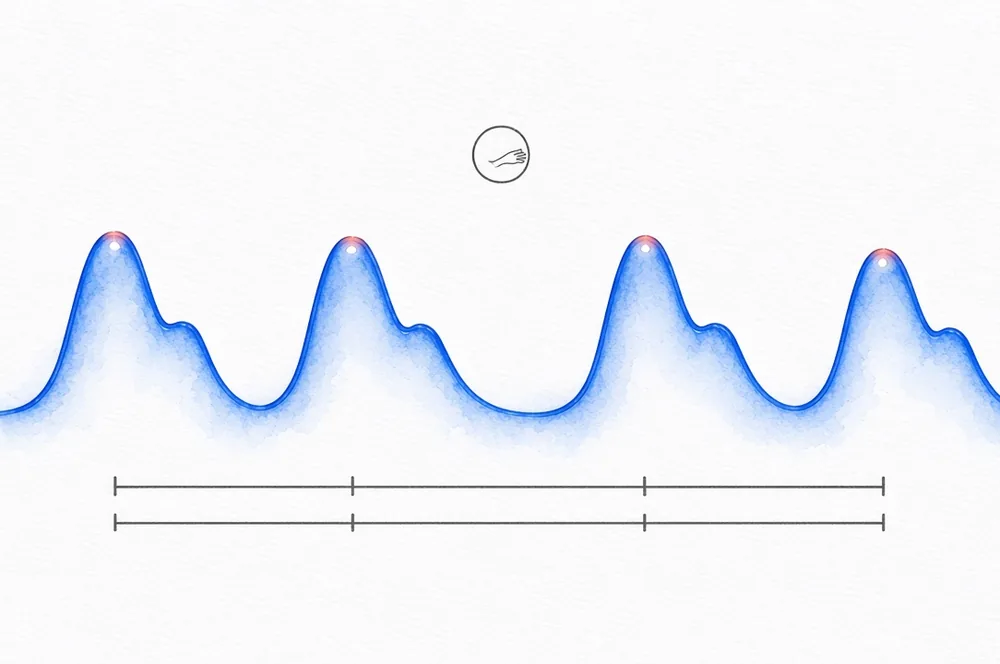
Measure the time between pulses.
Measure from one pulse peak to the next, using the same reference point on each beat.
RMSSD starts from a list of intervals. Subtract each interval from the next one, square those differences, average the squares, and take the square root. Shaffer and Ginsberg describe it that way in their open review of HRV metrics (Frontiers in Public Health, 2017, doi:10.3389/fpubh.2017.00258). They also call RMSSD the primary time-domain measure used to estimate vagally mediated beat-to-beat changes, and they note that it matches the Poincaré width SD1. The formula used on this site's algorithm card divides by the number of successive differences:
The 1996 Task Force standards (Circulation 93(5):1043–1065, doi:10.1161/01.CIR.93.5.1043) are the document later reviews point to for how to measure HRV. The full PDF was not opened for this page. The 5-minute figure quoted here is Shaffer and Ginsberg's: the conventional minimum recording is 5 minutes, and researchers have proposed ultra-short windows of 10 seconds, 30 seconds, and 60 seconds. Their abstract also says time-domain indices are used on recordings that may run from about 2 minutes to 24 hours. A value from one of those lengths does not substitute for a value from another.
Bourdillon, Schmitt, Yazdani, Vesin, and Millet tested window length on ECG during 159 orthostatic tests in athletes (Frontiers in Neuroscience, 2017, doi:10.3389/fnins.2017.00456). The reference windows were 4 minutes supine and 4 minutes standing. Cutting the analysis below 4 minutes hurt low-frequency power and total power. Cutting it to 2 minutes was acceptable when only RMSSD was kept. One-minute windows deteriorated every parameter they tested. They also required 1 minute of baseline before the analysis window, so an RMSSD-only supine recording in that protocol is 3 minutes (1 + 2). The recording was ECG in athletes. A wrist PPG window still needs its own check.
Two bad beats can move the result. Shaffer and Ginsberg write that, as with SDNN, contamination by only two artifacts inside a 5-minute segment can distort RMSSD. Missed peaks and extra peaks are covered on the interbeat-interval page (/learn/ibi). A successive-difference metric feels those errors immediately, because one false gap enters two differences.
On a watch the intervals usually come from the pulse, so the number is pulse rate variability even when the screen says HRV. A delay that is constant from beat to beat drops out of the successive differences. A delay that changes from beat to beat stays in. The pulse-rate variability article (/blog/pulse-rate-variability-vs-hrv) goes through the reviews, including why rest and movement should stay in separate piles. Pulse transit time (/learn/pulse-transit-time) is the travel piece of that delay.
A nightly average is another step removed. Dial et al. (2025) describe Garmin Fenix 6 HRV as 5-minute windows averaged across the sleep the watch detected. That single nightly figure is a different summary from one 5-minute seated recording. The printed Fenix 6 numbers, the one-night Garmin white paper, and Labfront's commentary are on /accuracy/garmin-hrv. Sleep timing across nights, a calendar question rather than a beat-to-beat question, is the sleep regularity index (/blog/sleep-regularity-index).
Go deeper
Frequently Asked Questions
What does RMSSD stand for?
Root mean square of successive differences. Each heartbeat interval is subtracted from the next, the differences are squared and averaged, and the square root is the result, in milliseconds. Shaffer and Ginsberg (2017, doi:10.3389/fpubh.2017.00258) give that sequence and treat RMSSD as a vagal, beat-to-beat metric.
How long a recording does RMSSD need?
Shaffer and Ginsberg call 5 minutes the conventional minimum, and they note proposed ultra-short windows of 10, 30, and 60 seconds. Bourdillon et al. (2017, doi:10.3389/fnins.2017.00456) found a 2-minute analysis window acceptable for RMSSD alone on ECG in athletes, after 1 minute of baseline, while 1-minute windows deteriorated every parameter they tested. A nightly wearable average of many windows is a different summary.
Is watch RMSSD the same as ECG RMSSD?
The formula can be the same. The input on a watch is usually a pulse interval, which makes the result pulse rate variability. Agreement with ECG is usable in resting comparisons and weaker during activity. See /blog/pulse-rate-variability-vs-hrv and /blog/ppg-vs-ecg-accuracy-comparison.
Why do artifacts matter so much for RMSSD?
RMSSD is built from neighboring intervals. One missed or extra beat changes two successive differences. Shaffer and Ginsberg note that two artifacts inside a 5-minute segment can distort RMSSD, as they can distort SDNN.