Paperdoi:10.1088/1361-6579/ae944f
Practical optimization of deep learning models for cuffless blood pressure estimation from photoplethysmography
Physiological Measurement
TL;DR
205,850 ten-second PPG–ABP segments from the MIMIC waveform database; multiresolution U-Net PPG→ABP. 62.5 Hz beats 125 Hz (SBP 5.24 vs 6.34; DBP 2.87 vs 3.27 mmHg MAE); 31.25 Hz fails (16.09 / 9.10). Averaging the top-4 peaks / bottom-4 troughs beats min–max extraction.
- Form factor: clinical_finger
Abstract
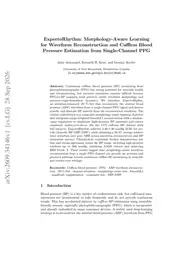
Objective. To improve deep learning–based cuffless blood pressure (BP) estimation from photoplethysmography (PPG) for continuous, non-invasive monitoring when cuff measurements are impractical, by assessing sampling frequency, systolic BP (SBP) and diastolic BP (DBP) derivation, respiratory rate (RR) effects, and errors at BP extremes. Approach. We analysed 205 850 ten-second paired PPG–arterial BP segments from the medical information mart for intensive care waveform database. A convolutional model with a multiresolution U-Net translated PPG to arterial BP waveforms. Inputs at 125, 62.5, and 31.25 Hz were compared. SBP and DBP were derived by minimum–maximum extraction or by averaging the top 4 systolic peaks and bottom 4 diastolic troughs per segment. Performance was summarized using mean absolute error (MAE). Main results. Inputs at 62.5 Hz reduced MAE versus 125 Hz (SBP 5.24 vs 6.34 mmHg; DBP 2.87 vs 3.27 mmHg), whereas 31.25 Hz increased error (SBP 16.09 mmHg; DBP 9.10 mmHg). Multi-peak averaging outperformed minimum–maximum extraction. MAE varied across RRs, with generally lower errors observed at moderate RRs, and higher errors observed at lower and higher SBP ranges. Significance. Sampling frequency, SBP/DBP derivation, and RR shape error patterns in PPG-only cuffless BP estimation, with higher errors at low and high SBP. These results inform device design for bedside and ambulatory monitoring. However, further validation using subject-level datasets is required to assess clinical applicability and compliance with established validation standards.
Verbatim from the publisher's DOI record (opens in a new tab) · Publisher licence: https://publishingsupport.iopscience.iop.org/iop-standard/v1
Results on ChatPPG leaderboards · 1
All leaderboards| Leaderboard | Method | Result | Rank |
|---|---|---|---|
| mimic-waveform-205k MAE (mmHg)Cuffless blood pressure estimation | Multiresolution U-Net @62.5 Hz | 5.24MAE (mmHg), lower is better | #1 of 1 |
1 row is credited to this paper. Ranks apply within each leaderboard only, as reported by the source.
Tasks & signals
Tasks
Signals
Keywords
How it works
Cite this paper
Khurana, V., Pamidi, A. M., Joshi, B. B., Belde, G., Goutha, R. R., Bajpai, R., Kumar, S., & Khan, A. (2026). Practical optimization of deep learning models for cuffless blood pressure estimation from photoplethysmography. Physiological Measurement. https://doi.org/10.1088/1361-6579/ae944f
Khurana, Vikas, Aejaz Mohammad Pamidi, Bharat Bhushan Joshi, Ganesh Belde, Rajesh Reddy Goutha, Ratan Bajpai, Subodha Kumar, and Akram Khan. 2026. "Practical optimization of deep learning models for cuffless blood pressure estimation from photoplethysmography." Physiological Measurement. https://doi.org/10.1088/1361-6579/ae944f.
Khurana, V., Pamidi, A. M., Joshi, B. B., Belde, G., Goutha, R. R., Bajpai, R., Kumar, S. and Khan, A. (2026) 'Practical optimization of deep learning models for cuffless blood pressure estimation from photoplethysmography', Physiological Measurement. doi: 10.1088/1361-6579/ae944f.
Khurana, Vikas, et al. "Practical optimization of deep learning models for cuffless blood pressure estimation from photoplethysmography." Physiological Measurement, 2026. https://doi.org/10.1088/1361-6579/ae944f.
V. Khurana et al., "Practical optimization of deep learning models for cuffless blood pressure estimation from photoplethysmography," Physiological Measurement, 2026, doi: 10.1088/1361-6579/ae944f.
@article{khurana2026practical,
  title         = {{Practical optimization of deep learning models for cuffless blood pressure estimation from photoplethysmography}},
  author        = {Khurana, Vikas and Pamidi, Aejaz Mohammad and Joshi, Bharat Bhushan and Belde, Ganesh and Goutha, Rajesh Reddy and Bajpai, Ratan and Kumar, Subodha and Khan, Akram},
  year          = {2026},
  journal       = {Physiological Measurement},
  doi           = {10.1088/1361-6579/ae944f}
}Added to the ChatPPG research hub