PaperarXiv:2602.23605
SleepLM: Natural-Language Intelligence for Human Sleep


arXiv preprint
TL;DR
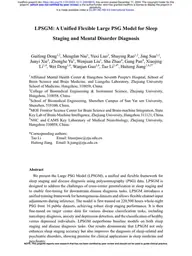
SleepLM is a family of sleep-language foundation models that link sleep signals with natural language. The authors built a sleep-text dataset of more than 100K hours from over 10,000 people and trained with contrastive alignment, caption generation and signal reconstruction. It beat earlier methods on zero-shot and few-shot tasks, retrieval and sleep captioning.
Abstract
We present SleepLM, a family of sleep-language foundation models that enable human sleep alignment, interpretation, and interaction with natural language. Despite the critical role of sleep, learning-based sleep analysis systems operate in closed label spaces (e.g., predefined stages or events) and fail to describe, query, or generalize to novel sleep phenomena. SleepLM bridges natural language and multimodal polysomnography, enabling language-grounded representations of sleep physiology. To support this alignment, we introduce a multilevel sleep caption generation pipeline that enables the curation of the first large-scale sleep-text dataset, comprising over 100K hours of data from more than 10,000 individuals. Furthermore, we present a unified pretraining objective that combines contrastive alignment, caption generation, and signal reconstruction to better capture physiological fidelity and cross-modal interactions. Extensive experiments on real-world sleep understanding tasks verify that SleepLM outperforms state-of-the-art in zero-shot and few-shot learning, cross-modal retrieval, and sleep captioning. Importantly, SleepLM also exhibits intriguing capabilities including language-guided event localization, targeted insight generation, and zero-shot generalization to unseen tasks. All code and data will be open-sourced.
Verbatim from arXiv (opens in a new tab) · arXiv metadata (abstracts are released under CC0)
Results on ChatPPG leaderboards
All leaderboardsNo results from this paper on ChatPPG leaderboards yet. Browse the leaderboards.
Tasks & signals
Tasks
Signals
Keywords
Datasets used
Models
How it works
- Cohort
- 10,000 individuals
Cite this paper
Xu, Z., Shuai, Z., Mozaffari, E., Aysola, R. S., Kumar, R., & Yang, Y. (2026). SleepLM: Natural-Language Intelligence for Human Sleep. arXiv preprint. https://arxiv.org/abs/2602.23605
Xu, Zongzhe, Zitao Shuai, Eideen Mozaffari, Ravi S. Aysola, Rajesh Kumar, and Yuzhe Yang. 2026. "SleepLM: Natural-Language Intelligence for Human Sleep." arXiv preprint. https://arxiv.org/abs/2602.23605.
Xu, Z., Shuai, Z., Mozaffari, E., Aysola, R. S., Kumar, R. and Yang, Y. (2026) 'SleepLM: Natural-Language Intelligence for Human Sleep', arXiv preprint. Available at: https://arxiv.org/abs/2602.23605
Xu, Zongzhe, et al. "SleepLM: Natural-Language Intelligence for Human Sleep." arXiv preprint, 2026. https://arxiv.org/abs/2602.23605.
Z. Xu, Z. Shuai, E. Mozaffari, R. S. Aysola, R. Kumar, and Y. Yang, "SleepLM: Natural-Language Intelligence for Human Sleep," arXiv preprint, 2026, [Online]. Available: https://arxiv.org/abs/2602.23605.
@misc{xu2026sleeplm,
  title         = {{SleepLM: Natural-Language Intelligence for Human Sleep}},
  author        = {Xu, Zongzhe and Shuai, Zitao and Mozaffari, Eideen and Aysola, Ravi S. and Kumar, Rajesh and Yang, Yuzhe},
  year          = {2026},
  howpublished  = {arXiv preprint},
  eprint        = {2602.23605},
  archivePrefix = {arXiv}
}Record updated