Activity counts measure attention, not model quality. Missing counts are unknown. Publication status follows the linked source; a listed venue alone does not confirm peer review.
Inertia-1 is a fully open study of foundation models for wearable motion data. Using more than 18.2M hours of accelerometer data from sources around the world, the authors built a controlled framework to test how sensor type, device placement, sampling rate, window length, architecture, model size, pretraining objective and data scale affect the resulting models.
Published
arXiv preprint, 2026
Signals
IMU
Pretraining
18.2M+ hours of accelerometer data
Year
2026
Scope
data, model and training choices for motion FMs, fully open
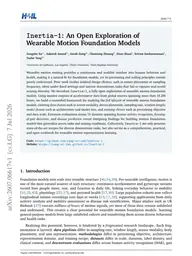
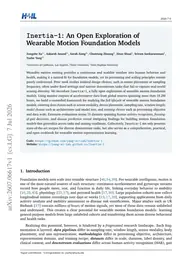
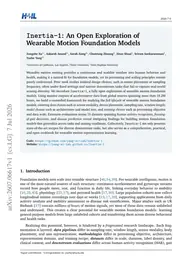
Wearable motion sensing provides a continuous and scalable window into human behavior and health, making it a natural fit for foundation models, yet its pretraining and scaling principles remain poorly understood. Prior work studies isolated design choices, such as sensor placement or sampling frequency, often under fixed settings and narrow downstream tasks that fail to capture real-world sensing diversity. We introduce Inertia-1, a fully open exploration of wearable motion foundation models. Using massive corpora of accelerometer data from global sources spanning more than 18.2M hours, we build a controlled framework for studying the full lifecycle of wearable motion foundation models, covering data choices such as sensor modality, device placement, sampling rate, window length; model choices such as architectures and model size; and training choices such as pretraining objective and data scale. Extensive evaluations across 15 datasets spanning human activity recognition, freezing-of-gait detection, and disease prediction reveal intriguing findings for building motion foundation models that generalize across tasks and sensing conditions. Collectively, Inertia-1 not only presents state-of-the-art recipes for diverse downstream tasks, but also serves as a comprehensive, practical, and open cookbook for wearable motion representation learning.
Verbatim fromarXiv· arXiv metadata (abstracts are released under CC0)
Cite the publication recorded for this model. Check it against the publisher before submitting.
Xu, Z., Anand, A., Jiang, S., Zhuang, C., Shuai, Z., Sankararaman, S., & Yang, Y. (2026). Inertia-1: An Open Exploration of Wearable Motion Foundation Models. arXiv preprint. https://doi.org/10.48550/arXiv.2607.06617
Xu, Zongzhe, Aakarsh Anand, Sarah Jiang, Chuntung Zhuang, Zitao Shuai, Sriram Sankararaman, and Yuzhe Yang. 2026. "Inertia-1: An Open Exploration of Wearable Motion Foundation Models." arXiv preprint. https://doi.org/10.48550/arXiv.2607.06617.
Xu, Z., Anand, A., Jiang, S., Zhuang, C., Shuai, Z., Sankararaman, S. and Yang, Y. (2026) 'Inertia-1: An Open Exploration of Wearable Motion Foundation Models', arXiv preprint. doi: 10.48550/arXiv.2607.06617.
Xu, Zongzhe, et al. "Inertia-1: An Open Exploration of Wearable Motion Foundation Models." arXiv preprint, 2026. https://doi.org/10.48550/arXiv.2607.06617.
Z. Xu et al., "Inertia-1: An Open Exploration of Wearable Motion Foundation Models," arXiv preprint, 2026, doi: 10.48550/arXiv.2607.06617.
@misc{xu2026inertia1,
  title         = {{Inertia-1: An Open Exploration of Wearable Motion Foundation Models}},
  author        = {Xu, Zongzhe and Anand, Aakarsh and Jiang, Sarah and Zhuang, Chuntung and Shuai, Zitao and Sankararaman, Sriram and Yang, Yuzhe},
  year          = {2026},
  howpublished  = {arXiv preprint},
  doi           = {10.48550/arXiv.2607.06617},
  eprint        = {2607.06617},
  archivePrefix = {arXiv}
}
History
Record updated
Added to the ChatPPG research hub
Newsletter
Get new PPG datasets, papers and models
Get alerts when Inertia-1 is benchmarked on new datasets, plus the weekly digest.
New datasets, papers and models
Practical guides from the hub
Unsubscribe anytime
The waveform is an illustration of a PPG pulse, not a recording.