Paperdoi:10.1109/JBHI.2025.3619070
Utilizing Multi-PPG-Sensor Site Information in a Localized Wrist Area for Improving Cuffless Blood Pressure Estimation
IEEE J. Biomed. Health Inform. 30(4):3579–3592 (issue 2026-04; early access 2025)
Key results
All results4.84
MAE (mmHg) ↓
Cuffless blood pressure · Own wrist 9-channel PPG array (121 subjects)
SBP · multi-site PPG model
Results as reported by the authors; not independently reproduced. A SOTA star marks the best value among results reported under the same evaluation protocol; ties go to the earlier publication.
TL;DR
The PPG Atlas says 13 features per channel, 27,214 beats and a 511-subset search. None of that appears in the abstract, and the abstract says 9 features were analysed. The train/test split (subject-disjoint or not) and calibration amount are unknown.
- Result: As a starting point, the authors analyzed the variability of 9 PPG features across channels, revealing notable site-specific variations, with amplitude-based features showing greater sensitivity.
- Result: Tested on 121 subjects, the 3M-BPNet achieved mean absolute errors (MAEs) of 4.84 mmHg for systolic BP (SBP) and 3.28 mmHg for diastolic BP (DBP), outperforming a standard RFR model.
Abstract
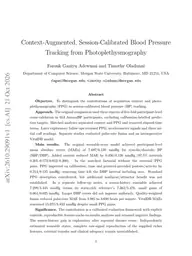
Blood pressure (BP) measurement accuracy is highly sensitive to sensor placement. To address this, we investigated the effect of multi-sensor sites on BP estimation using a 9-channel single-wavelength photoplethysmography (PPG) sensor array placed within a localized wrist area. As a starting point, we analyzed the variability of 9 PPG features across channels, revealing notable site-specific variations, with amplitude-based features showing greater sensitivity. Leveragingthese these findings, we developed 3M-BPNet, which processes PPG signals through varying channel/site counts. The network incorporates signal trimming and Bayesian optimization for channel-weight allocation, followed by a Random Forest Regression (RFR) model with personalized calibration. Tested on 121 subjects, the 3M-BPNet achieved mean absolute errors (MAEs) of 4.84 mmHg for systolic BP (SBP) and 3.28 mmHg for diastolic BP (DBP), outperforming a standard RFR model. Notably, BP estimation accuracy improved as the channel counts increased from 1 to 5, then declined beyond 5. The optimal 5-channel combination (C5-C6-C7-C8-C9), located near the radial artery, yielded MAEs of 1.33 mmHg for SBP and 1.16 mmHg for DBP, corresponding to accuracy gains of 72.6% for SBP and 73.2% for DBP over the single-channel setup (P < 0.001 for both MAE_SBP and MAE_DBP). Compared with the best prior PPG-based BP estimation results, our method reduced SBP MAE by 71.9% and DBP MAE by 51.3%. These findings highlight the critical role of sensor location in PPG-based BP estimation, suggesting that optimized sensor placement can enhance the accuracy and guide the design of wearable cuffless BP devices, thereby advancing hypertension management.
Verbatim from Europe PMC (opens in a new tab) · Abstract via Europe PMC; © the authors/publisher
Results on ChatPPG leaderboards · 1
All leaderboards| Leaderboard | Method | Result | Rank |
|---|---|---|---|
| liu-wrist-9ch-array-121 MAE (mmHg)Cuffless blood pressure estimation | 3M-BPNet | 4.84MAE (mmHg), lower is better | #1 of 1 |
1 row is credited to this paper. Ranks apply within each leaderboard only, as reported by the source.
Tasks & signals
Tasks
Signals
Keywords
How it works
- Cohort
- 121 subjects
Cite this paper
Liu, Z., Zhou, R., Xiang, T., Ji, N., & Zhang, Y. (2026). Utilizing Multi-PPG-Sensor Site Information in a Localized Wrist Area for Improving Cuffless Blood Pressure Estimation. IEEE J. Biomed. Health Inform, 30(4), 3579–3592. https://doi.org/10.1109/JBHI.2025.3619070
Liu, Zijun, Rushuang Zhou, Ting Xiang, Nan Ji, and Yuanting Zhang. 2026. "Utilizing Multi-PPG-Sensor Site Information in a Localized Wrist Area for Improving Cuffless Blood Pressure Estimation." IEEE J. Biomed. Health Inform 30 (4): 3579–3592. https://doi.org/10.1109/JBHI.2025.3619070.
Liu, Z., Zhou, R., Xiang, T., Ji, N. and Zhang, Y. (2026) 'Utilizing Multi-PPG-Sensor Site Information in a Localized Wrist Area for Improving Cuffless Blood Pressure Estimation', IEEE J. Biomed. Health Inform, 30(4), pp. 3579–3592. doi: 10.1109/JBHI.2025.3619070.
Liu, Zijun, et al. "Utilizing Multi-PPG-Sensor Site Information in a Localized Wrist Area for Improving Cuffless Blood Pressure Estimation." IEEE J. Biomed. Health Inform, vol. 30, no. 4, 2026, pp. 3579–3592. https://doi.org/10.1109/JBHI.2025.3619070.
Z. Liu, R. Zhou, T. Xiang, N. Ji, and Y. Zhang, "Utilizing Multi-PPG-Sensor Site Information in a Localized Wrist Area for Improving Cuffless Blood Pressure Estimation," IEEE J. Biomed. Health Inform, vol. 30, no. 4, pp. 3579–3592, 2026, doi: 10.1109/JBHI.2025.3619070.
@article{liu2026utilizing,
  title         = {{Utilizing Multi-PPG-Sensor Site Information in a Localized Wrist Area for Improving Cuffless Blood Pressure Estimation}},
  author        = {Liu, Zijun and Zhou, Rushuang and Xiang, Ting and Ji, Nan and Zhang, Yuanting},
  year          = {2026},
  journal       = {IEEE J. Biomed. Health Inform},
  volume        = {30},
  number        = {4},
  pages         = {3579--3592},
  doi           = {10.1109/JBHI.2025.3619070}
}Added to the ChatPPG research hub