PaperarXiv:2605.17859
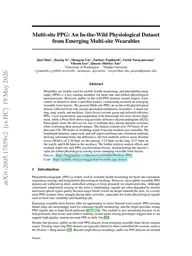
Multi-site PPG: An In-the-Wild Physiological Dataset from Emerging Multi-site Wearables
arXiv preprint (cs.HC, cs.LG) · 20 pages, 6 figures, 11 tables. Dataset and code available at the URLs in the paper
 (opens in a new tab)
Shao, Jiayi et al., "Multi-site PPG: An In-the-Wild Physiological Dataset from Emerging Multi-site Wearables", arXiv:2605.17859, CC BY 4.0
TL;DR
Wearables are widely used for mobile health monitoring, and photoplethysmography (PPG) is a key sensing modality for heart rate and related physiological measurements. However, public in-the-wild PPG datasets remain largely wrist-centric or limited to short, controlled studies, constraining research on emerging wearable form factors. Each device records green and infrared reflective PPG, 3-axis acceleration, and temperature with timestamps for cross-device alignment, while a Polar H10 chest strap provides reference electrocardiogram (ECG).
- Form factor: wrist
Abstract
Wearables are widely used for mobile health monitoring, and photoplethysmography (PPG) is a key sensing modality for heart rate and related physiological measurements. However, public in-the-wild PPG datasets remain largely wrist-centric or limited to short, controlled studies, constraining research on emerging wearable form factors. We present Multi-site PPG, an in-the-wild physiological dataset collected from four custom-developed unobtrusive wearables: a smart earring, ring, watch, and necklace. Each device records green and infrared reflective PPG, 3-axis acceleration, and temperature with timestamps for cross-device alignment, while a Polar H10 chest strap provides reference electrocardiogram (ECG). Participants wore the devices for multiple days during daytime activities while continuing their normal routines. The dataset contains over 350 hours of raw data and 230-290 hours of modeling-ready 8-second windows per wearable. We benchmark heuristic, supervised, and self-supervised heart-rate estimation methods, showing substantial body-site differences: the best methods achieve mean absolute errors (MAEs) of 2.30 bpm on the earring, 5.13 bpm on the ring, 8.37 bpm on the watch, and 8.68 bpm on the necklace. We further analyze motion effects and evaluate multi-site and PPG-accelerometer fusion, demonstrating the dataset's value for robust physiological sensing across emerging wearable form factors.
Verbatim from arXiv (opens in a new tab) · arXiv metadata (abstracts are released under CC0)
Results on ChatPPG leaderboards
All leaderboardsNo results from this paper on ChatPPG leaderboards yet. Browse the leaderboards.
Tasks & signals
Signals
Keywords
How it works
Cite this paper
APA
Shao, J., Ye, J., Liu, S., Englhardt, Z., Narayanswamy, G., Iyer, V., et al. (2026). Multi-site PPG: An In-the-Wild Physiological Dataset from Emerging Multi-site Wearables. arXiv preprint · 20 pages, 6 figures, 11 tables. Dataset and code available at the URLs in the paper. https://doi.org/10.48550/arXiv.2605.17859
BibTeX
@misc{shao2026multisite,
  title         = {{Multi-site PPG: An In-the-Wild Physiological Dataset from Emerging Multi-site Wearables}},
  author        = {Shao, Jiayi and Ye, Jiaying and Liu, Shengyao and Englhardt, Zachary and Narayanswamy, Girish and Iyer, Vikram and others},
  year          = {2026},
  howpublished  = {arXiv preprint · 20 pages, 6 figures, 11 tables. Dataset and code available at the URLs in the paper},
  doi           = {10.48550/arXiv.2605.17859},
  eprint        = {2605.17859},
  archivePrefix = {arXiv}
}
Built from the hub record. Check it against the publisher before submitting.
Record updated
Added to the ChatPPG research hub