PaperarXiv:2610.02292
Diffusion-Based Synthetic Data Pretraining for Enhancing Activity Recognition
arXiv preprint
Key results
All results- CABiGRU + diffusion synthetic pretrainingResults (source, opens in a new tab)
90.6
Balanced accuracy (%) ↑
Activity recognition · DEO (drinking / eating / other)
pretrained on diffusion-generated smartwatch IMU, fine-tuned on real data
Results as reported by the authors; not independently reproduced. A SOTA star marks the best value among results reported under the same evaluation protocol; ties go to the earlier publication.
TL;DR
This paper improves detection of eating and drinking from wearable motion data by pretraining a CaBiGRU model on synthetic sensor windows made with a diffusion model, then fine-tuning on real data. On the DEO dataset it reached a balanced accuracy of 90.6%, beating a strong supervised baseline and helping with the rare class.
- Result: On the DEO (drinking/eating/other) dataset, the proposed pipeline achieves a balanced accuracy of 90.6%, improving over a strong supervised baseline and showing the benefits of diffusion-based synthetic pre-training for recognizing alimentary activities…
Abstract
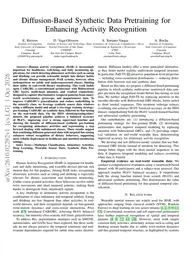
Human activity recognition (HAR) is increasingly important for healthcare, well-being, and daily monitoring ap- plications, for which detecting alimentary activities such as eating and drinking can provide actionable insight into dietary habits and chronic disease management. HAR systems, however, often underperform on subtle and underrepresented classes, limiting their utility in real-world dietary monitoring. This work builds upon CABiGRU, a convolutional architecture with Bidirectional GRU layers, multi-head attention, and residual connections, designed to capture discriminative temporal patterns from smart- watch accelerometer, gyroscope, and magnetometer data. To improve CaBiGRU's generalization and reduce underfitting in the minority class, we leverage synthetic sensor data windows using a diffusion model and adopt a two-stage training strategy: pre-training CABiGRU on synthetic data, followed by fine-tuning on the real-world data. On the DEO (drinking/eating/other) dataset, the proposed pipeline achieves a balanced accuracy of 90.6%, improving over a strong supervised baseline and showing the benefits of diffusion-based synthetic pre-training for recognizing alimentary activities and representing a step forward dealing with unbalanced classes. These results suggest that combining diffusion-generated data with targeted fine-tuning enhances robust recognition of dietary behaviors, supporting more reliable deployment in healthcare and nutrition-monitoring settings.
Verbatim from arXiv (opens in a new tab) · arXiv metadata (abstracts are released under CC0)
Results on ChatPPG leaderboards · 1
All leaderboards| Leaderboard | Method | Result | Rank |
|---|---|---|---|
| DEO balanced accuracyHuman activity recognition | Diffusion-Based Synthetic Data Pretraining for… | 90.6balanced accuracy, higher is better | #1 of 1 |
1 row is credited to this paper. Ranks apply within each leaderboard only, as reported by the source.
Tasks & signals
Tasks
Signals
Devices
Keywords
Datasets used
How it works
Cite this paper
Riveros, E., Vega-Oliveros, D., Soriano-Vargas, A., & Rocha, A. (2026). Diffusion-Based Synthetic Data Pretraining for Enhancing Activity Recognition. arXiv preprint. https://arxiv.org/abs/2610.02292
Riveros, E., D. Vega-Oliveros, A. Soriano-Vargas, and A. Rocha. 2026. "Diffusion-Based Synthetic Data Pretraining for Enhancing Activity Recognition." arXiv preprint. https://arxiv.org/abs/2610.02292.
Riveros, E., Vega-Oliveros, D., Soriano-Vargas, A. and Rocha, A. (2026) 'Diffusion-Based Synthetic Data Pretraining for Enhancing Activity Recognition', arXiv preprint. Available at: https://arxiv.org/abs/2610.02292
Riveros, E., et al. "Diffusion-Based Synthetic Data Pretraining for Enhancing Activity Recognition." arXiv preprint, 2026. https://arxiv.org/abs/2610.02292.
E. Riveros, D. Vega-Oliveros, A. Soriano-Vargas, and A. Rocha, "Diffusion-Based Synthetic Data Pretraining for Enhancing Activity Recognition," arXiv preprint, 2026, [Online]. Available: https://arxiv.org/abs/2610.02292.
@misc{riveros2026diffusionbased,
  title         = {{Diffusion-Based Synthetic Data Pretraining for Enhancing Activity Recognition}},
  author        = {Riveros, E. and Vega-Oliveros, D. and Soriano-Vargas, A. and Rocha, A.},
  year          = {2026},
  howpublished  = {arXiv preprint},
  eprint        = {2610.02292},
  archivePrefix = {arXiv}
}Added to the ChatPPG research hub