Paperdoi:10.3389/fdgth.2026.1783507
An open-source deep learning model for classifying real-world activity intensities in persons with chronic pain using a wrist-worn accelerometer
Frontiers in Digital Health 8:1783507 (published 2026-10-14)
 (opens in a new tab)
Annet Doomen et al., "An open-source deep learning model for classifying real-world activity intensities in persons with chronic pain using a wrist-worn accelerometer", doi:10.3389/fdgth.2026.1783507, CC BY 4.0
TL;DR
In chronic pain (CP) care, patterns of activity and rest are relevant across diagnostic, intervention, and evaluation phases. Public availability of a detailed dataset together with a validated deep learning (DL) model for classifying activity intensities from raw accelerometer data can promote clinical use and standardize activity intensity measurement in CP research. This study aimed to (1) develop, test, and share a DL model that classifies activity intensity from raw accelerometer data, (2) explore whether CP-specific training improves performance in CP, and (3) explore construct validity in real-world settings among individuals with and without CP, using real-world observations as comparator instrument. Seven strategies were applied to train a Convolutional Neural Network, using three datasets comprising 211,864 ten-second windows.
- Result: Classification accuracy was 76.5% in individuals with CP and 80.5% in individuals without CP.
- Result: Real-world agreement was 73.6% in CP and 78.6% in individuals without CP.
Abstract
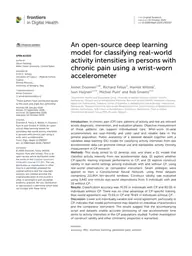
Introduction: In chronic pain (CP) care, patterns of activity and rest are relevant across diagnostic, intervention, and evaluation phases. Objective measurement of these patterns can support individualized care. Wrist-worn tri-axial accelerometers are user-friendly and yield valid and reliable data in the general population. Public availability of a detailed dataset together with a validated deep learning (DL) model for classifying activity intensities from raw accelerometer data can promote clinical use and standardize activity intensity measurement in CP research.
Methods: This study aimed to (1) develop, test, and share a DL model that classifies activity intensity from raw accelerometer data, (2) explore whether CP-specific training improves performance in CP, and (3) explore construct validity in real-world settings among individuals with and without CP, using real-world observations as comparator instrument. Seven strategies were applied to train a Convolutional Neural Network, using three datasets comprising 211,864 ten-second windows. Construct validity was evaluated using 3,443 one-minute real-world observations from 5 individuals with and 10 without CP.
Results: Classification accuracy was 76.5% in individuals with CP and 80.5% in individuals without CP. There was no clear advantage of CP-specific training. Real-world agreement was 73.6% in CP and 78.6% in individuals without CP.
Discussion: Lower and individually variable real-world agreement, particularly in CP, indicates that model performance may depend on individual characteristics and the comparator instrument. The results suggest that the accompanying script and datasets enable accurate processing of raw accelerometer time series to activity intensities in the CP populations studied. Further investigation of construct validity and other clinimetric properties is warranted.
Verbatim from the publisher's DOI record (opens in a new tab) · Publisher licence: https://creativecommons.org/licenses/by/4.0/
Results on ChatPPG leaderboards · 1
All leaderboards| Leaderboard | Method | Result | Rank |
|---|---|---|---|
| CAPTURE-24 macro-F1 (3-class activity intensity)Human activity recognition | An open-source deep learning model for… | 0.661macro-F1, higher is better | #1 of 1 |
1 row is credited to this paper. Ranks apply within each leaderboard only, as reported by the source.
Tasks & signals
Tasks
Signals
Devices
Keywords
Datasets used

Models
How it works
- Cohort
- 5 individuals
Cite this paper
Doomen, A., Felius, R., Wittink, H., Huijnen, I., Punt, M., & Smeets, R. (2026). An open-source deep learning model for classifying real-world activity intensities in persons with chronic pain using a wrist-worn accelerometer. Frontiers in Digital Health, 8, 1783507. https://doi.org/10.3389/fdgth.2026.1783507
Doomen, Annet, Richard Felius, Harriët Wittink, Ivan Huijnen, Michiel Punt, and Rob Smeets. 2026. "An open-source deep learning model for classifying real-world activity intensities in persons with chronic pain using a wrist-worn accelerometer." Frontiers in Digital Health 8: 1783507. https://doi.org/10.3389/fdgth.2026.1783507.
Doomen, A., Felius, R., Wittink, H., Huijnen, I., Punt, M. and Smeets, R. (2026) 'An open-source deep learning model for classifying real-world activity intensities in persons with chronic pain using a wrist-worn accelerometer', Frontiers in Digital Health, 8, p. 1783507. doi: 10.3389/fdgth.2026.1783507.
Doomen, Annet, et al. "An open-source deep learning model for classifying real-world activity intensities in persons with chronic pain using a wrist-worn accelerometer." Frontiers in Digital Health, vol. 8, 2026, p. 1783507. https://doi.org/10.3389/fdgth.2026.1783507.
A. Doomen, R. Felius, H. Wittink, I. Huijnen, M. Punt, and R. Smeets, "An open-source deep learning model for classifying real-world activity intensities in persons with chronic pain using a wrist-worn accelerometer," Frontiers in Digital Health, vol. 8, p. 1783507, 2026, doi: 10.3389/fdgth.2026.1783507.
@article{doomen2026opensource,
  title         = {{An open-source deep learning model for classifying real-world activity intensities in persons with chronic pain using a wrist-worn accelerometer}},
  author        = {Doomen, Annet and Felius, Richard and Wittink, Harriët and Huijnen, Ivan and Punt, Michiel and Smeets, Rob},
  year          = {2026},
  journal       = {Frontiers in Digital Health},
  volume        = {8},
  pages         = {1783507},
  doi           = {10.3389/fdgth.2026.1783507}
}Record updated
Added to the ChatPPG research hub