Model

StreamPPG

low-latency frame-wise rPPG via consistent privileged learning

Cite
PreprintCatalog paper date: 2026Source

Activity counts measure attention, not model quality. Missing counts are unknown. Publication status follows the linked source; a listed venue alone does not confirm peer review.

StreamPPG predicts an rPPG sample for each incoming frame (causal streaming) instead of buffering a multi-second clip. Training uses consistent privileged learning (CPL): ground-truth BVP is available as privileged input during training and dropped at inference, with a consistency term so train and test behavior stay aligned. Paper: arXiv:2606.23186 (v2 2026-09-28).

Signals
RGB
Form factor
camera_rppg
Year
2026
Architecture

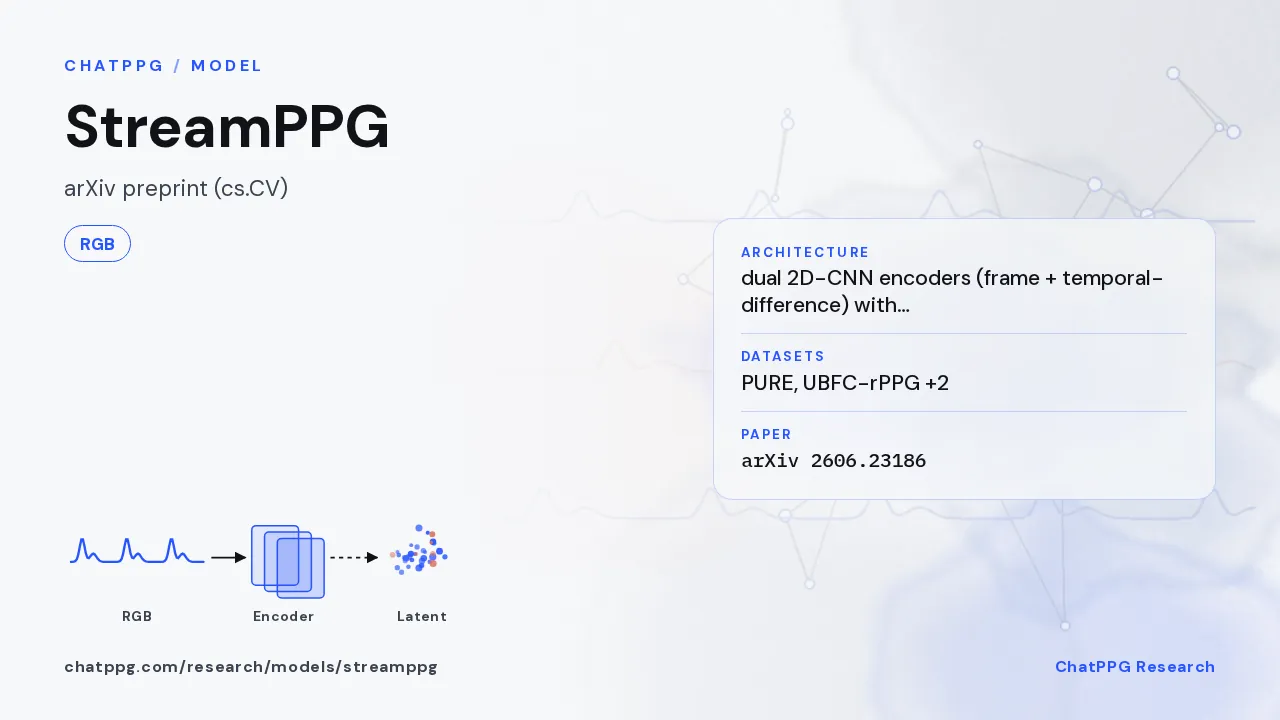
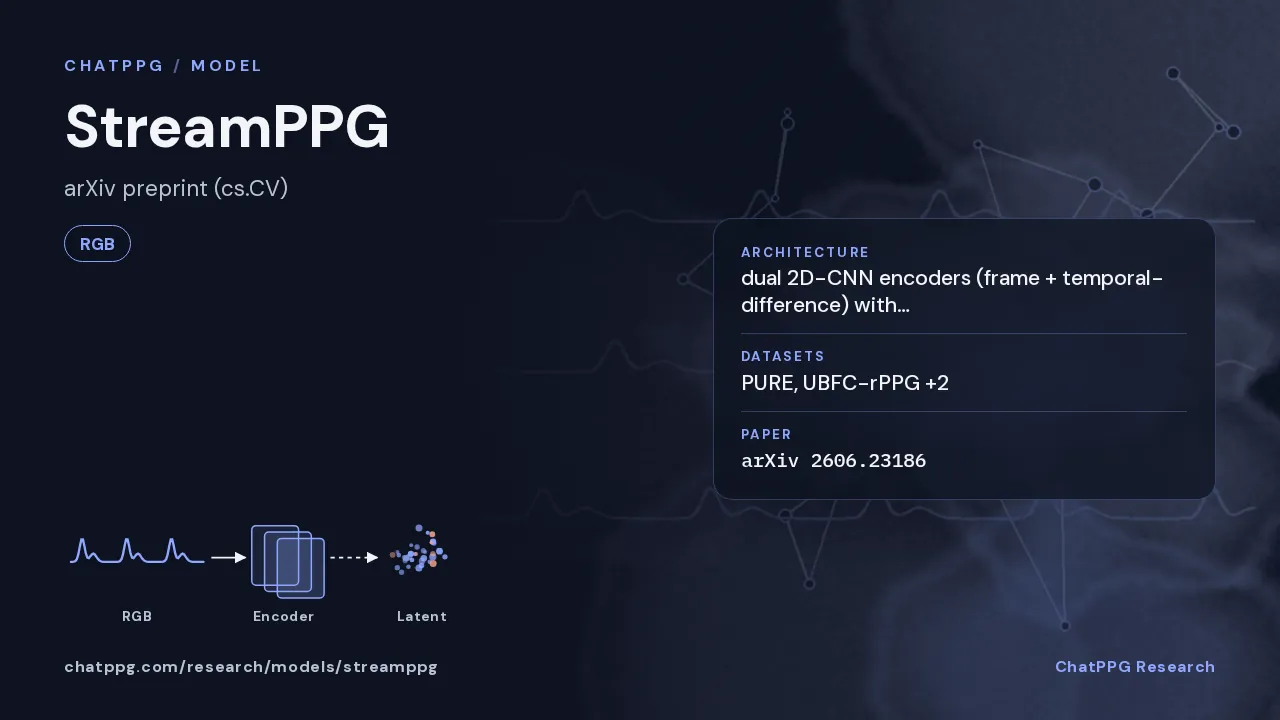
dual 2D-CNN encoders (frame + temporal-difference) with channel attention, adaptive temporal modeling module (ATMM) / temporal state-space block, lightweight MLP decoder; trained under consistent privileged learning (CPL) that uses GT rPPG as privileged info at train time only

At a glance
Type
Task model
Modalities
RGB
Form factor
Camera rPPG
Parameters
Not reported
Architecture
dual 2D-CNN encoders (frame + temporal-difference) with channel attention, adaptive temporal modeling module (ATMM) / temporal state-space block, lightweight MLP decoder; trained under consistent privileged learning (CPL) that uses GT rPPG as privileged info at train time only
Venue
arXiv preprint (cs.CV)
Year
2026
DOI
Not reported
Code
Not reported
Weights
Not reported
Licence
Not reported
Caveats
Not reported
Added
Not reported
Updated
Nov 9, 2026

Abstract

Remote photoplethysmography (rPPG) estimates the blood volume pulse (BVP) signal from facial videos, enabling contact-free health monitoring. Conventional clip-wise approaches, which use video clips as input, require capturing over one hundred frames before inference, thus introducing several seconds of delay and hindering real-time use. Meanwhile, frame-wise approaches struggle to capture long-range temporal and periodic features of physiological rhythms, and therefore lead to reduced estimation accuracy. To overcome these issues, we propose StreamPPG, a unified architecture that enables low-latency frame-wise physiological signal estimation while achieving competitive accuracy compared with clip-wise approaches. StreamPPG is trained under a consistent privileged learning (CPL) strategy, which leverages ground-truth rPPG signals as privileged information to enhance the model's representation capability. Extensive experiments demonstrate that StreamPPG achieves state-of-the-art accuracy across multiple datasets while maintaining real-time throughput on edge devices.
Verbatim fromarXiv· arXiv metadata (abstracts are released under CC0)

StreamPPG: ChatPPG research summary card

Key results

How it works

How StreamPPG works: Input signals → Model → Downstream tasksInput signals: RGB. Datasets: PURE, UBFC-rPPG, COHFACE, MMPD. Model: StreamPPG (State-space model · Transformer). Downstream tasks: Heart rate.Input signalsRGBRGBDatasets: PURE, UBFC-rPPG, COHFACE, MMPDDatasetsPURE, UBFC-rPPG +2 moreModelStreamPPGState-space model · TransformerDownstream tasksHeart rateHeart rate

Datasets linked in the hub; pretraining vs evaluation roles follow the paper.

Architecture
dual 2D-CNN encoders (frame + temporal-difference) with channel attention, adaptive temporal modeling module (ATMM) / temporal state-space block, lightweight MLP decoder; trained under consistent privileged learning (CPL) that uses GT rPPG as privileged info at train time only
Inputs
RGB
Approach
rppg · model · streaming · frame wise · privileged learning · low latency

Leaderboard rows· 8

All leaderboards
TaskDatasetMetricValueRank
Rppg hrCOHFACE intraHR MAE ↓0.71#2 / 2
Rppg hrPURE intraHR MAE ↓0.2#5 / 5
Rppg hrUBFC-rPPG intraHR MAE ↓0.14#2 / 5
Rppg hrmmpd intraHR MAE ↓3.39#2 / 6
Rppg hrpure → mmpdHR MAE ↓10.42#3 / 3
Rppg hrpure → ubfc-rppgHR MAE ↓0.33#1 / 3
Rppg hrubfc-rppg → mmpdHR MAE ↓9.29#2 / 2
Rppg hrubfc-rppg → pureHR MAE ↓2.0#2 / 2

Datasets used· 3

Cite this model

Cite the publication recorded for this model. Check it against the publisher before submitting.

StreamPPG. (2026). arXiv preprint. https://arxiv.org/abs/2606.23186
@misc{streamppg2026streamppg,
  title         = {{StreamPPG}},
  year          = {2026},
  howpublished  = {arXiv preprint},
  eprint        = {2606.23186},
  archivePrefix = {arXiv}
}

Source metadata: 2026

Record updated Nov 9, 2026

History

  1. Record updated