Model

FacePhys

streaming state-space rPPG with a transferable heart state

PreprintCatalog paper date: 2025Source

Activity counts measure attention, not model quality. Missing counts are unknown. Publication status follows the linked source; a listed venue alone does not confirm peer review.

Follow-up to me-rppg by the same group (Kegang Wang, Yuntao Wang, Yuanchun Shi at Tsinghua; Daniel McDuff co-author). Same temporal-spatial state space duality idea, now with a "transferable heart state" so the network can train on long sequences and still run one frame at a time with constant memory.

Form factor
camera_rppg
Year
2025
Architecture

temporal-spatial state space duality (TSD) SSM; transferable heart state for single-frame streaming; ~3.6 MB memory, 9.46 ms/frame (per abstract)

License

MIT + 'Privacy Protection Addendum' (on-device inference only; no cloud offload of video; derived metrics leave the device only with explicit consent)

At a glance
Type
Task model
Modalities
Not reported
Form factor
Camera rPPG
Parameters
Not reported
Architecture
temporal-spatial state space duality (TSD) SSM; transferable heart state for single-frame streaming; ~3.6 MB memory, 9.46 ms/frame (per abstract)
Venue
arXiv preprint (no venue stated in v1)
Year
2025
DOI
Not reported
Code
Not reported
Weights
Not reported
Licence
MIT + 'Privacy Protection Addendum' (on-device inference only; no cloud offload of video; derived metrics leave the device only with explicit consent)
Caveats
Not reported
Datasets
Added
Not reported
Updated
Oct 29, 2026

Abstract

Vital sign measurement using cameras presents opportunities for comfortable, ubiquitous health monitoring. Remote photoplethysmography (rPPG), a foundational technology, enables cardiac measurement through minute changes in light reflected from the skin. However, practical deployment is limited by the computational constraints of performing analysis on front-end devices and the accuracy degradation of transmitting data through compressive channels that reduce signal quality. We propose a memory efficient rPPG algorithm - FacePhys - built on temporal-spatial state space duality, which resolves the trilemma of model scalability, cross-dataset generalization, and real-time operation. Leveraging a transferable heart state, FacePhys captures subtle periodic variations across video frames while maintaining a minimal computational overhead, enabling training on extended video sequences and supporting low-latency inference. FacePhys establishes a new state-of-the-art, with a substantial 49% reduction in error. Our solution enables real-time inference with a memory footprint of 3.6 MB and per-frame latency of 9.46 ms – surpassing existing methods by 83% to 99%. These results translate into reliable real-time performance in practical deployments, and a live demo is available at https://www.facephys.com/.
Verbatim fromarXiv· arXiv metadata (abstracts are released under CC0)

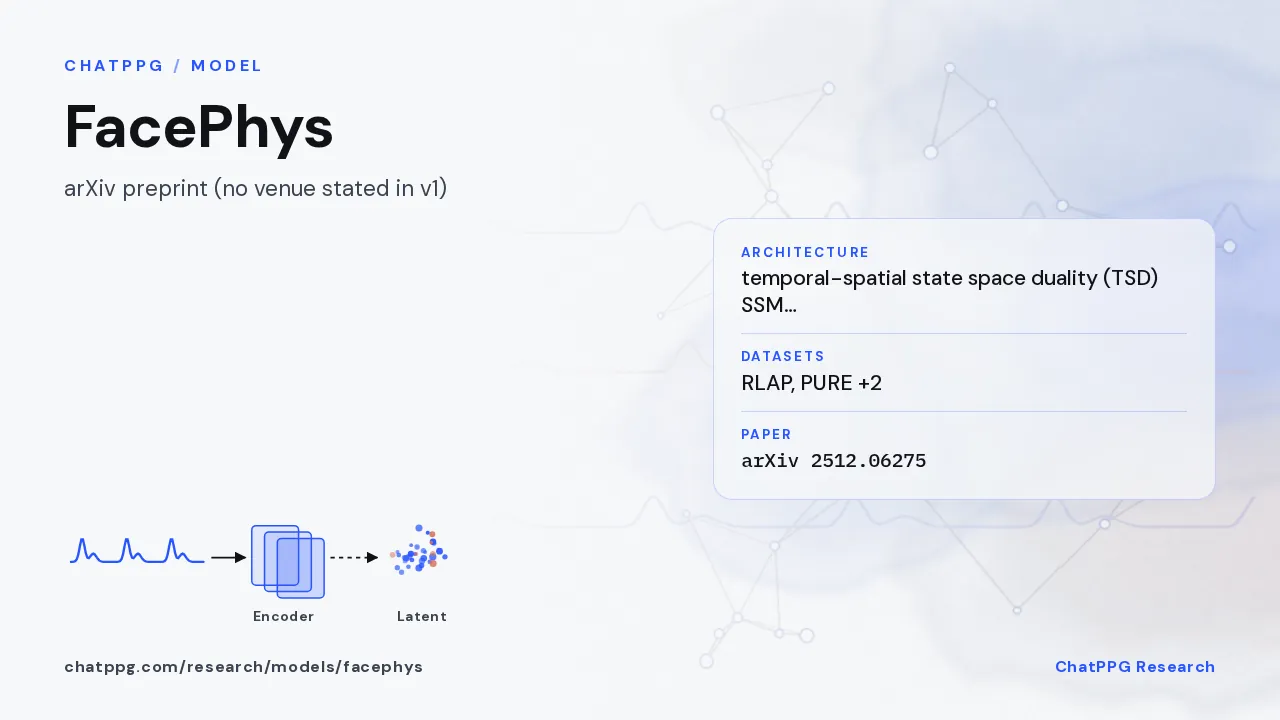
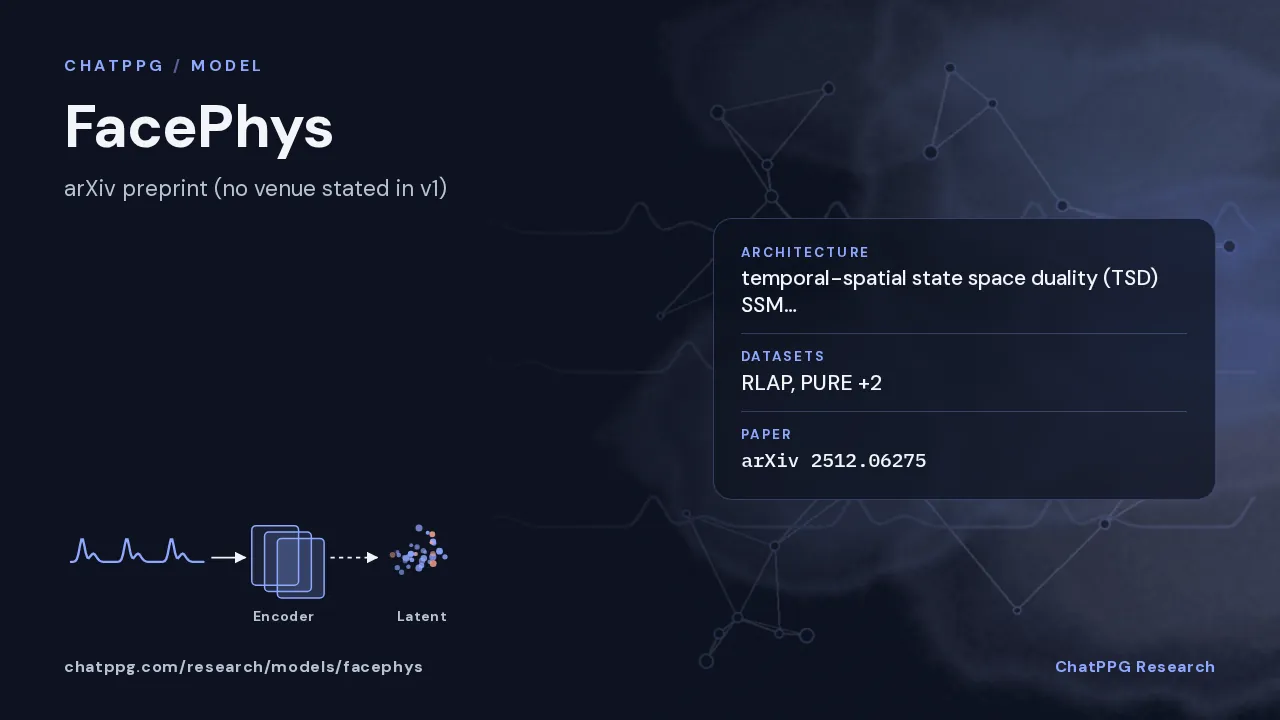
FacePhys: ChatPPG research summary card

How it works

How FacePhys works: Input signals → Model → Downstream tasksDatasets: RLAP, PURE, UBFC-rPPG, MMPD. Model: FacePhys (State-space model).Input signalsDatasets: RLAP, PURE, UBFC-rPPG, MMPDDatasetsRLAP, PURE +2 moreModelFacePhysState-space model

Datasets linked in the hub; pretraining vs evaluation roles follow the paper.

Architecture
temporal-spatial state space duality (TSD) SSM; transferable heart state for single-frame streaming; ~3.6 MB memory, 9.46 ms/frame (per abstract)
Approach
rppg · model · facephys · state space · realtime · on device

Datasets used· 3

Cite this model

Cite the publication recorded for this model. Check it against the publisher before submitting.

FacePhys. (2025). arXiv preprint. https://arxiv.org/abs/2512.06275
@misc{facephys2025facephys,
  title         = {{FacePhys}},
  year          = {2025},
  howpublished  = {arXiv preprint},
  eprint        = {2512.06275},
  archivePrefix = {arXiv}
}

Source metadata: 2025

Record updated Oct 29, 2026

History

  1. Record updated