Model

FreqPhys

physiological frequency prior + frequency-aware diffusion for rPPG (ECCV 2026)

Venue listedCatalog paper date: 2026Source

Activity counts measure attention, not model quality. Missing counts are unknown. Publication status follows the linked source; a listed venue alone does not confirm peer review.

Frequency-first rPPG. The input passes through a physiological bandpass (out-of-band rejection), then a spectrum-modulation block with adaptive spectral selection that boosts pulse-band components and suppresses in-band noise. Spectral and time-domain features are fused, and a frequency-aware conditional diffusion process reconstructs the waveform.

Signals
RGB
Form factor
camera_rppg
License
NONE (no LICENSE file)
Year
2026
Architecture

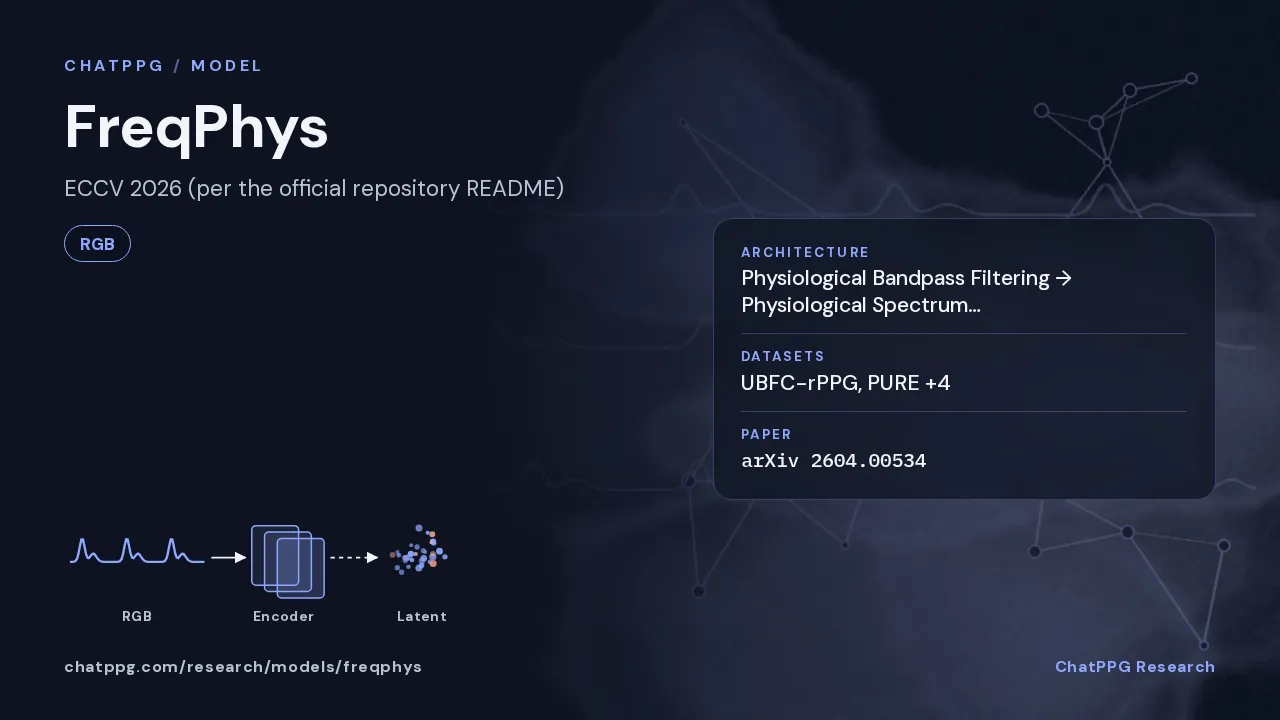
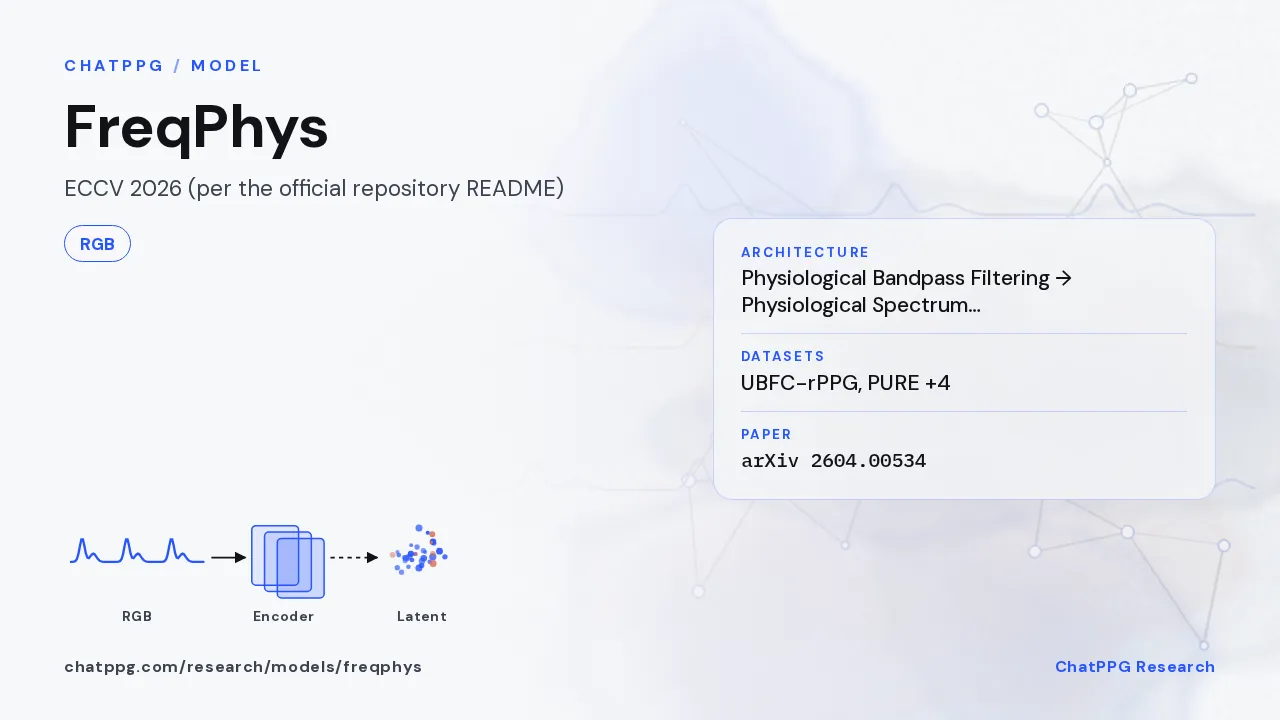
Physiological Bandpass Filtering → Physiological Spectrum Modulation (real/imag encoding) + adaptive spectral selection → Cross-domain Representation Learning (spectral priors fused with deep time-domain features) → frequency-aware conditional diffusion that reconstructs the rPPG signal

At a glance
Type
Task model
Modalities
RGB
Form factor
Camera rPPG
Parameters
Not reported
Architecture
Physiological Bandpass Filtering → Physiological Spectrum Modulation (real/imag encoding) + adaptive spectral selection → Cross-domain Representation Learning (spectral priors fused with deep time-domain features) → frequency-aware conditional diffusion that reconstructs the rPPG signal
Venue
ECCV 2026 (per the official repository README)
Year
2026
DOI
Not reported
Code
Not reported
Weights
Not reported
Licence
NONE (no LICENSE file)
Caveats
Not reported
Added
Not reported
Updated
Nov 10, 2026

Abstract

Remote photoplethysmography (rPPG) enables contactless physiological monitoring by capturing subtle skin-color variations from facial videos. However, most existing methods predominantly rely on time-domain modeling, making them vulnerable to motion artifacts and illumination fluctuations, where weak physiological clues are easily overwhelmed by noise. To address these challenges, we propose FreqPhys, a frequency-guided rPPG framework that explicitly leverages physiological frequency priors for robust signal recovery. Specifically, FreqPhys first applies a Physiological Bandpass Filtering module to suppress out-of-band interference, and then performs Physiological Spectrum Modulation together with adaptive spectral selection to emphasize pulse-related frequency components while suppress residual in-band noise. A Cross-domain Representation Learning module further fuses these spectral priors with deep time-domain features to capture informative spatial–temporal dependencies. Finally, a frequency-aware conditional diffusion process progressively reconstructs high-fidelity rPPG signals. Extensive experiments on six benchmarks demonstrate that FreqPhys yields significant improvements over state-of-the-art approaches, particularly under challenging motion conditions. It highlights the importance of explicitly modeling physiological frequency priors. The source code will be released.

Verbatim fromarXiv· arXiv metadata (abstracts are released under CC0)

FreqPhys: ChatPPG research summary card

Key results

How it works

How FreqPhys works: Input signals → Model → Downstream tasksInput signals: RGB. Datasets: UBFC-rPPG, PURE, BUAA-MIHR, MMPD, VIPL-HR, MR-NIRP. Model: FreqPhys (Masked reconstruction). Downstream tasks: Heart rate; Respiration.Input signalsRGBRGBDatasets: UBFC-rPPG, PURE, BUAA-MIHR, MMPD, VIPL-HR, MR-NIRPDatasetsUBFC-rPPG, PURE +4 moreModelMASK → RECONSTRUCTFreqPhysMasked reconstructionDownstream tasksHeart rateHeart rateRespirationRespiration

Datasets linked in the hub; pretraining vs evaluation roles follow the paper.

Architecture
Physiological Bandpass Filtering → Physiological Spectrum Modulation (real/imag encoding) + adaptive spectral selection → Cross-domain Representation Learning (spectral priors fused with deep time-domain features) → frequency-aware conditional diffusion that reconstructs the rPPG signal
Inputs
RGB
Approach
rppg · model · frequency domain · diffusion · hrv · respiration

Leaderboard rows· 8

All leaderboards
TaskDatasetMetricValueRank
Rppg hrBUAA-MIHR intraHR MAE ↓1.13#2 / 4
Rppg hrPURE intraHR MAE ↓0.17#2 / 5
Rppg hrUBFC-rPPG intraHR MAE ↓0.17#4 / 5
Rppg hrmmpd intraHR MAE ↓4.2#4 / 6
Rppg hrmr-nirp MR-NIRP-Car intraHR MAE ↓5.75#1 / 1
Rppg hrpure → mmpdHR MAE ↓10.11#2 / 3
Rppg hrpure → ubfc-rppgHR MAE ↓0.43#2 / 3
Rppg hrubfc-rppg → mmpdHR MAE ↓8.91#1 / 2

Datasets used· 4

Cite this model

Cite the publication recorded for this model. Check it against the publisher before submitting.

FreqPhys. (2026). ECCV 2026. https://arxiv.org/abs/2604.00534
@inproceedings{freqphys2026freqphys,
  title         = {{FreqPhys}},
  year          = {2026},
  booktitle     = {ECCV 2026},
  eprint        = {2604.00534},
  archivePrefix = {arXiv}
}

Source metadata: 2026

Record updated Nov 10, 2026

History

  1. Record updated