Model

PhysLLM

LLM-assisted cross-modal rPPG (ICLR 2026)

Venue listedCatalog paper date: 2025Source

Activity counts measure attention, not model quality. Missing counts are unknown. Publication status follows the linked source; a listed venue alone does not confirm peer review.

A hybrid of a conventional rPPG CNN and a language model. A fixed PhysNet backbone produces a raw rPPG waveform, which is smoothed (Dual-Domain Stationary module). Text Prototype Guidance projects the signal and the multi-scale visual features into the LLM's token space.

Signals
RGB
Form factor
camera_rppg
License
Responsible AI Source Code License v1.1
Year
2025
Architecture

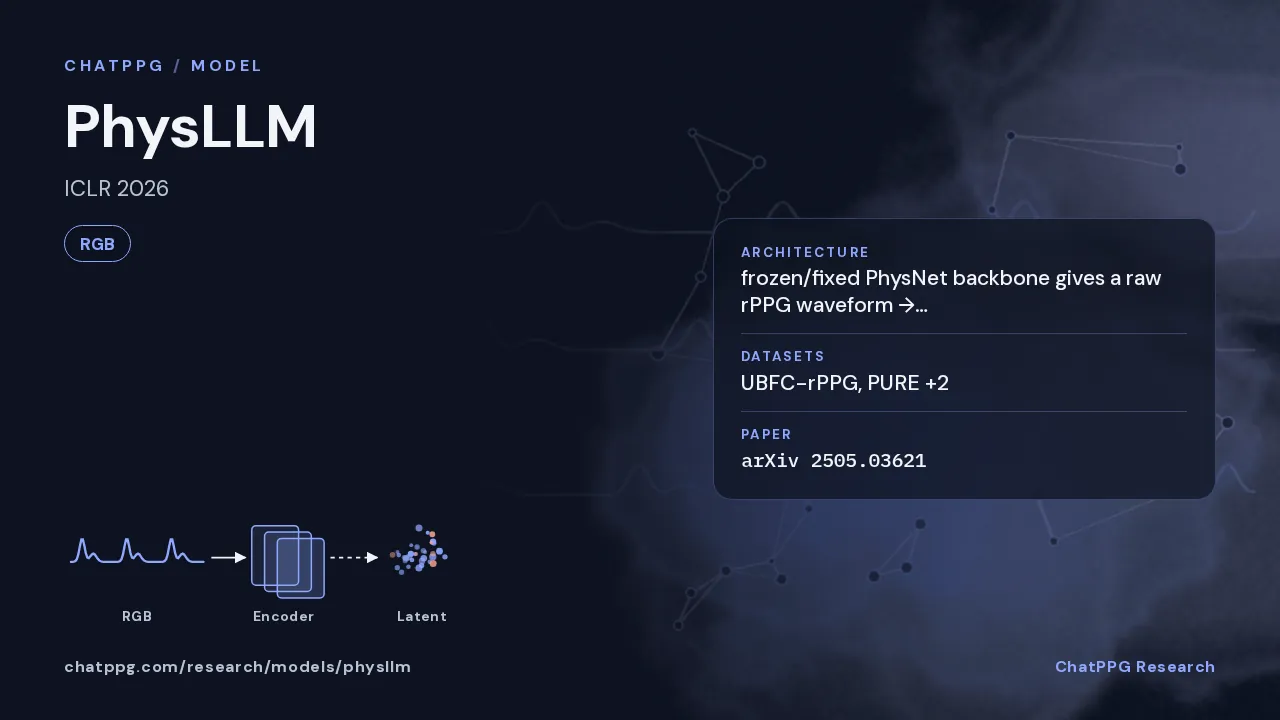
frozen/fixed PhysNet backbone gives a raw rPPG waveform → Dual-Domain Stationary (DDS) smoothing; multi-scale visual features; Text Prototype Guidance (TPG) maps signal and visual features to LLM token space; Adaptive Prompt Learning fuses task, vision (LLaVA caption) and signal-statistics cues; LLM (DeepSeek best in ablation; GPT-2, LLaMA, BERT also supported) predicts the waveform; MSE loss

At a glance
Type
Task model
Modalities
RGB
Form factor
Camera rPPG
Parameters
Not reported
Architecture
frozen/fixed PhysNet backbone gives a raw rPPG waveform → Dual-Domain Stationary (DDS) smoothing; multi-scale visual features; Text Prototype Guidance (TPG) maps signal and visual features to LLM token space; Adaptive Prompt Learning fuses task, vision (LLaVA caption) and signal-statistics cues; LLM (DeepSeek best in ablation; GPT-2, LLaMA, BERT also supported) predicts the waveform; MSE loss
Venue
ICLR 2026
Year
2025
DOI
Not reported
Code
Not reported
Weights
Not reported
Licence
Responsible AI Source Code License v1.1
Caveats
Not reported
Added
Not reported
Updated
Nov 10, 2026

Abstract

Remote photoplethysmography (rPPG) enables non-contact physiological measurement but remains highly susceptible to illumination changes, motion artifacts, and limited temporal modeling. Large Language Models (LLMs) excel at capturing long-range dependencies, offering a potential solution but struggle with the continuous, noise-sensitive nature of rPPG signals due to their text-centric design. To bridge this gap, we introduce the PhysLLM, a collaborative optimization framework that synergizes LLMs with domain-specific rPPG components. Specifically, the Text Prototype Guidance (TPG) strategy is proposed to establish cross-modal alignment by projecting hemodynamic features into LLM-interpretable semantic space, effectively bridging the representational gap between physiological signals and linguistic tokens. Besides, a novel Dual-Domain Stationary (DDS) Algorithm is proposed for resolving signal instability through adaptive time-frequency domain feature re-weighting. Finally, rPPG task-specific cues systematically inject physiological priors through physiological statistics, environmental contextual answering, and task description, leveraging cross-modal learning to integrate both visual and textual information, enabling dynamic adaptation to challenging scenarios like variable illumination and subject movements. Evaluation on four benchmark datasets, PhysLLM achieves state-of-the-art accuracy and robustness, demonstrating superior generalization across lighting variations and motion scenarios. The source code is available at https://github.com/Alex036225/PhysLLM.

Verbatim fromarXiv· arXiv metadata (abstracts are released under CC0)

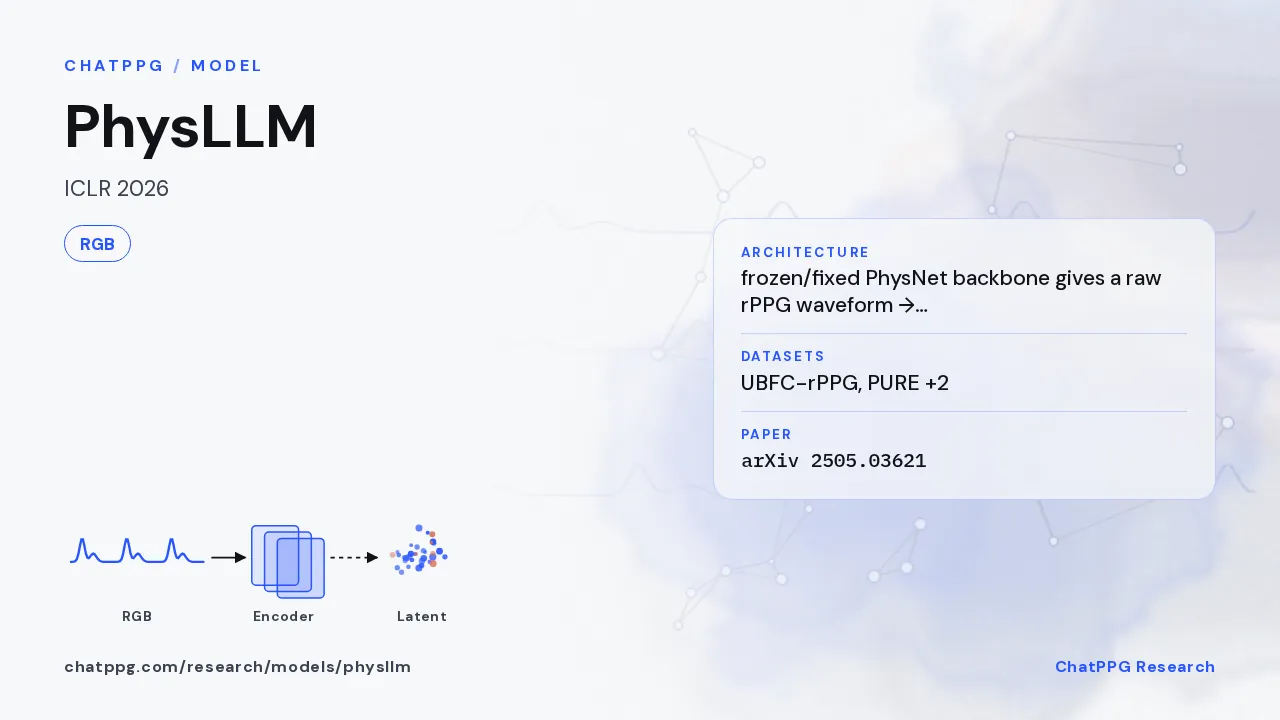
PhysLLM: ChatPPG research summary card

Key results

How it works

How PhysLLM works: Input signals → Model → Downstream tasksInput signals: RGB. Datasets: UBFC-rPPG, PURE, BUAA-MIHR, MMPD. Model: PhysLLM (Transformer · Convolutional network). Downstream tasks: Heart rate.Input signalsRGBRGBDatasets: UBFC-rPPG, PURE, BUAA-MIHR, MMPDDatasetsUBFC-rPPG, PURE +2 moreModel×NPhysLLMTransformer · Convolutional networkDownstream tasksHeart rateHeart rate

Datasets linked in the hub; pretraining vs evaluation roles follow the paper.

Architecture
frozen/fixed PhysNet backbone gives a raw rPPG waveform → Dual-Domain Stationary (DDS) smoothing; multi-scale visual features; Text Prototype Guidance (TPG) maps signal and visual features to LLM token space; Adaptive Prompt Learning fuses task, vision (LLaVA caption) and signal-statistics cues; LLM (DeepSeek best in ablation; GPT-2, LLaMA, BERT also supported) predicts the waveform; MSE loss
Inputs
RGB
Approach
rppg · model · llm · multimodal · prompt learning · physnet

Leaderboard rows· 7

All leaderboards
TaskDatasetMetricValueRank
Rppg hrBUAA-MIHR intraHR MAE ↓6.48#4 / 4
Rppg hrPURE intraHR MAE ↓0.17#3 / 5
Rppg hrUBFC-rPPG intraHR MAE ↓0.21#5 / 5
Rppg hrmmpd intraHR MAE ↓4.36#5 / 6
Rppg hrothers → buaa-mihrHR MAE ↓6.01#1 / 1
Rppg hrpure+ubfc-rppg → mmpdHR MAE ↓9.95#2 / 2
Rppg hrubfc-rppg+pure+buaa-mihr → mmpdHR MAE ↓12.2#1 / 1

Datasets used· 3

Cite this model

Cite the publication recorded for this model. Check it against the publisher before submitting.

PhysLLM. (2025). ICLR 2026. https://arxiv.org/abs/2505.03621
@inproceedings{physllm2025physllm,
  title         = {{PhysLLM}},
  year          = {2025},
  booktitle     = {ICLR 2026},
  eprint        = {2505.03621},
  archivePrefix = {arXiv}
}

Source metadata: 2025

Record updated Nov 10, 2026

History

  1. Record updated