Model

PhysVR

VLM-guided interference-aware temporal feature refinement for rPPG (arXiv 2026)

Cite
PreprintCatalog paper date: 2026Source

Activity counts measure attention, not model quality. Missing counts are unknown. Publication status follows the linked source; a listed venue alone does not confirm peer review.

A refinement stage that sits after feature learning. An rPPG backbone outputs temporal features and a coarse signal. Local temporal statistics of that signal provide physiological reliability evidence.

Signals
NIR, RGB
Form factor
camera_rppg
Year
2026
Architecture

physiological backbone (spatial encoder + temporal features + coarse rPPG) → signal-derived reliability evidence; frozen VLM on sampled frames with an interference prompt → visual evidence head; temporal cross-attention context; shared correction unit + 4 interference-specific experts with adaptive routing

At a glance
Type
Task model
Modalities
NIRRGB
Form factor
Camera rPPG
Parameters
Not reported
Architecture
physiological backbone (spatial encoder + temporal features + coarse rPPG) → signal-derived reliability evidence; frozen VLM on sampled frames with an interference prompt → visual evidence head; temporal cross-attention context; shared correction unit + 4 interference-specific experts with adaptive routing
Venue
arXiv preprint (cs.CV)
Year
2026
DOI
Not reported
Code
Not reported
Weights
Not reported
Licence
Not reported
Caveats
Not reported
Added
Not reported
Updated
Nov 10, 2026

Abstract

Remote photoplethysmography (rPPG) enables contactless physiological measurement from facial videos, yet its subtle pulse-related variations are easily affected by illumination variation, head motion, facial blur, and region-of-interest instability. Existing methods mainly suppress interference during feature learning, while whether the learned temporal features remain affected by interference and how to further suppress such interference before rPPG estimation are rarely examined. To address this limitation, we propose PhysVR, a vision-language model guided interference-aware temporal feature refinement framework for rPPG estimation. Specifically, a physiological backbone produces global temporal features and a coarse rPPG prediction, from which signal-derived physiological reliability evidence is constructed from local temporal characteristics. In parallel, a frozen vision-language model processes sampled facial frames under an interference-oriented prompt, and an evidence head extracts visual interference evidence from the VLM output. Temporal cross-attention integrates the physiological and visual evidence with the global temporal features to construct interference-aware temporal context. Guided by this context, a shared temporal correction unit performs general refinement, while four interference-specific experts selectively suppress different interference through adaptive routing. The refined temporal features are then used for final rPPG estimation. Extensive experiments on five public benchmarks demonstrate that PhysVR consistently outperforms representative methods under both intra-dataset and cross-dataset evaluation protocols.
Verbatim fromarXiv· arXiv metadata (abstracts are released under CC0)

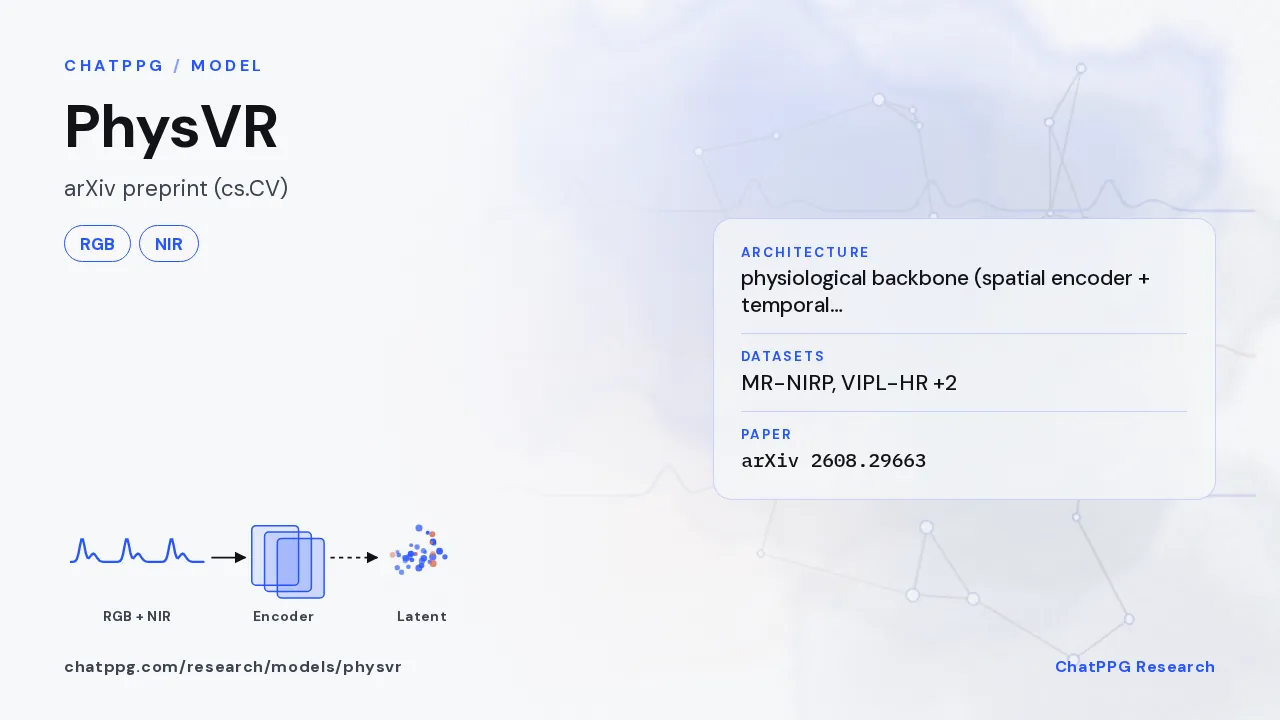
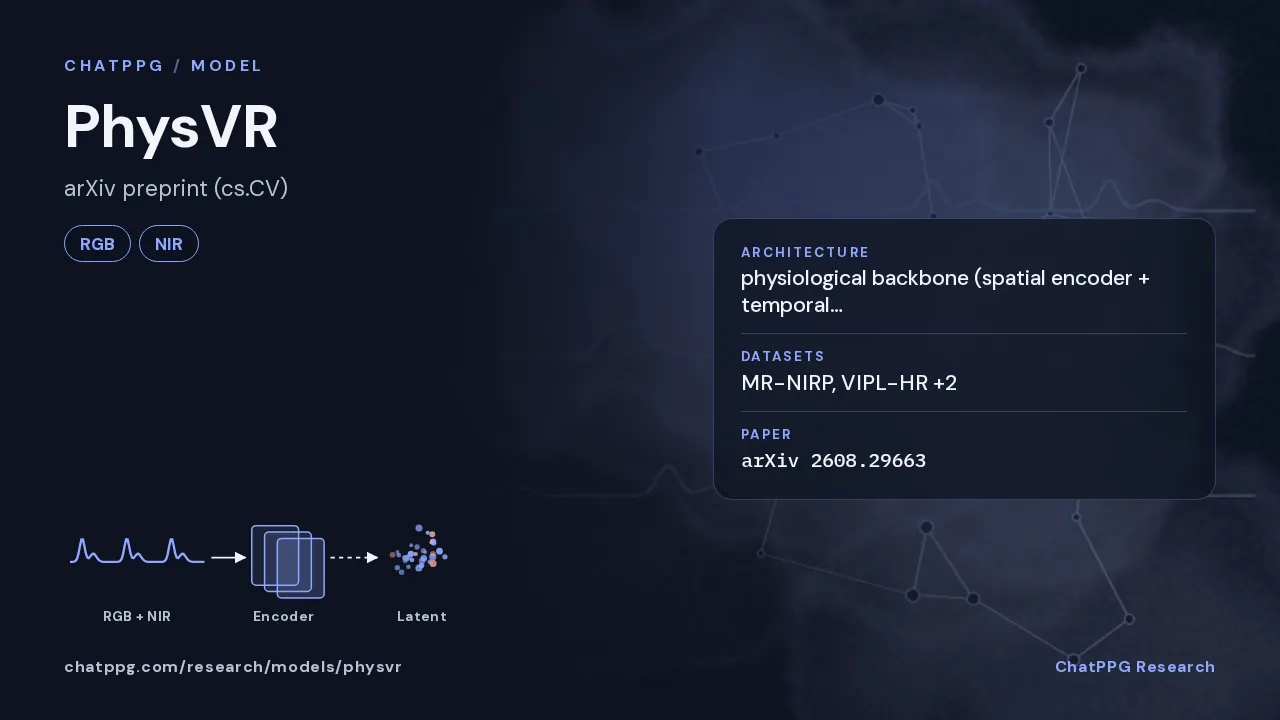
PhysVR: ChatPPG research summary card

Key results

How it works

How PhysVR works: Input signals → Model → Downstream tasksInput signals: NIR; RGB. Datasets: MR-NIRP, VIPL-HR, MMPD, BUAA-MIHR. Model: PhysVR (Transformer · Language-aligned). Downstream tasks: Heart rate.Input signalsNIRNIRRGBRGBDatasets: MR-NIRP, VIPL-HR, MMPD, BUAA-MIHRDatasetsMR-NIRP, VIPL-HR +2 moreModel×NPhysVRTransformer · Language-alignedDownstream tasksHeart rateHeart rate

Datasets linked in the hub; pretraining vs evaluation roles follow the paper.

Architecture
physiological backbone (spatial encoder + temporal features + coarse rPPG) → signal-derived reliability evidence; frozen VLM on sampled frames with an interference prompt → visual evidence head; temporal cross-attention context; shared correction unit + 4 interference-specific experts with adaptive routing
Inputs
NIR, RGB
Approach
rppg · model · vlm · interference · mixture of experts · nir

Leaderboard rows· 8

All leaderboards
TaskDatasetMetricValueRank
Rppg hrBUAA-MIHR intraHR MAE ↓0.42#1 / 4
Rppg hrmmpd intraHR MAE ↓3.92#3 / 6
Rppg hrmr-nirp NIRP-DRV intraHR MAE ↓2.56#1 / 1
Rppg hrmr-nirp NIRP-IND intraHR MAE ↓0.38#1 / 1
Rppg hrmr-nirp → vipl-hrHR MAE ↓3.92#1 / 1
Rppg hrvipl-hr intraHR MAE ↓3.59#1 / 2
Rppg hrvipl-hr → mr-nirp NIRP-DRVHR MAE ↓5.14#1 / 1
Rppg hrvipl-hr → mr-nirp NIRP-INDHR MAE ↓1.34#1 / 1

Datasets used· 3

Cite this model

Cite the publication recorded for this model. Check it against the publisher before submitting.

PhysVR. (2026). arXiv preprint. https://arxiv.org/abs/2608.29663
@misc{physvr2026physvr,
  title         = {{PhysVR}},
  year          = {2026},
  howpublished  = {arXiv preprint},
  eprint        = {2608.29663},
  archivePrefix = {arXiv}
}

Source metadata: 2026

Record updated Nov 10, 2026

History

  1. Record updated