Model

LQ-rPPG

label-quantized coarse-to-fine learning for remote physiological measurement

Venue listedCatalog paper date: 2026Source

Activity counts measure attention, not model quality. Missing counts are unknown. Publication status follows the linked source; a listed venue alone does not confirm peer review.

LQ-rPPG is a remote-PPG model that treats the target as quantized labels and refines from coarse to fine. It comes from Jun Seong Lee, Samyeul Noh, Changki Sung and Hyun Myung and is published in Expert Systems with Applications (DOI). The official repo (GitHub, MIT) ships configs and pretrained checkpoints for intra-dataset runs on MMPD, V4V, UBFC-rPPG, COHFACE and PURE, and cross-dataset runs PURE→UBFC, UBFC→PURE, PURE→MMPD and UBFC→MMPD.

Signals
RGB
Form factor
camera_rppg
License
code MIT (GitHub licence file); paper Elsevier copyright
Year
2026
Architecture

label-quantized coarse-to-fine learning framework (per-stage "LQ" checkpoints 1–5 plus an rPPG head, per repo file names)

At a glance
Type
Task model
Modalities
RGB
Form factor
Camera rPPG
Parameters
Not reported
Architecture
label-quantized coarse-to-fine learning framework (per-stage "LQ" checkpoints 1–5 plus an rPPG head, per repo file names)
Venue
Expert Systems with Applications (Elsevier), issue dated 2026-11-01
Year
2026
arXiv
Not reported
Code
Not reported
Weights
Not reported
Licence
code MIT (GitHub licence file); paper Elsevier copyright
Caveats
Not reported
Added
Not reported
Updated
Nov 2, 2026

Abstract

Remote photoplethysmography (rPPG) enables non-contact measurement of physiological signals from facial videos, offering strong potential for remote healthcare and daily health monitoring. Driven by this potential, various deep learning-based rPPG methods have been proposed to improve rPPG estimation. However, previous deep learning-based rPPG methods have paid little attention to the quality of training labels and their impact on model learning. Contact-based PPG signals used as training labels often contain noise and variability caused by motion artifacts, inconsistent sensor contact, and morphological distortions. Such label inconsistency can lead models to overfit to the label noise and variability and consequently degrade generalization performance. To address this issue, we propose LQ-rPPG, a label-quantized coarse-to-fine learning framework for robust rPPG estimation. LQ-rPPG consists of a label quantization module and a coarse-to-fine rPPG estimation model. The label quantization module transforms continuous PPG signals into multi-bit quantized pseudo labels with reduced noise and variability. The coarse-to-fine estimation model progressively refines rPPG signals under hierarchical supervision guided by the multi-bit pseudo labels. This design alleviates overfitting to label-specific variations and enables the model to learn structured and consistent representations. As a result, LQ-rPPG achieves robust and generalizable rPPG estimation even under challenging conditions. Experiments on multiple benchmark datasets demonstrate that LQ-rPPG achieves strong performance in both intra- and cross-dataset evaluations, while reducing parameters and multiply-accumulate operations by 88% and 29%, respectively, and increasing throughput by 191%. The code is available at https://github.com/Anonymous-repo-code/LQ-rPPG.
Verbatim fromSemantic Scholar· Abstract via Semantic Scholar; © the authors/publisher

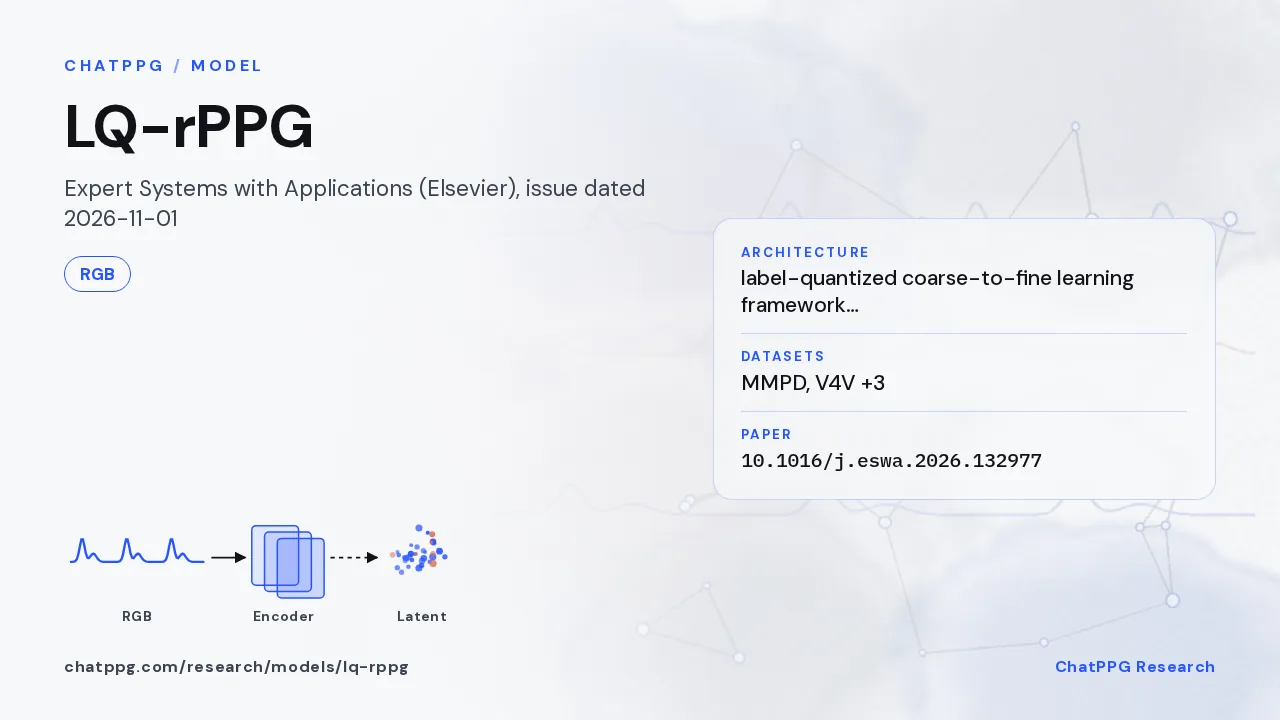
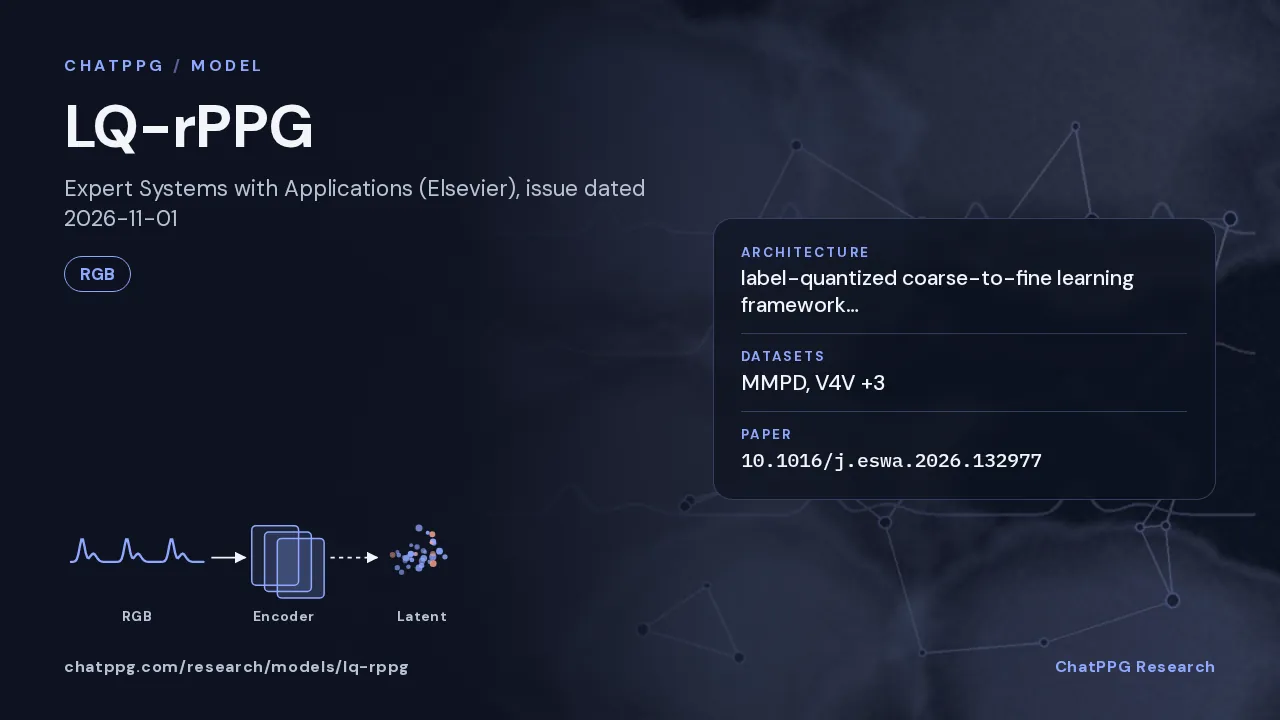
LQ-rPPG: ChatPPG research summary card

How it works

How LQ-rPPG works: Input signals → Model → Downstream tasksInput signals: RGB. Datasets: MMPD, V4V, UBFC-rPPG, COHFACE, PURE. Model: LQ-rPPG (Transformer).Input signalsRGBRGBDatasets: MMPD, V4V, UBFC-rPPG, COHFACE, PUREDatasetsMMPD, V4V +3 moreModel×NLQ-rPPGTransformer

Datasets linked in the hub; pretraining vs evaluation roles follow the paper.

Architecture
label-quantized coarse-to-fine learning framework (per-stage "LQ" checkpoints 1–5 plus an rPPG head, per repo file names)
Inputs
RGB
Approach
rppg · model · label quantization · coarse to fine · open weights · rppg toolbox

Datasets used· 3

Cite this model

Cite the publication recorded for this model. Check it against the publisher before submitting.

LQ-rPPG. (2026). Expert Systems with Applications , issue dated. https://doi.org/10.1016/j.eswa.2026.132977
@article{lqrppg2026lqrppg,
  title         = {{LQ-rPPG}},
  year          = {2026},
  journal       = {Expert Systems with Applications , issue dated},
  publisher     = {Elsevier},
  doi           = {10.1016/j.eswa.2026.132977}
}

History

  1. Record updated