Model

PHASE-Net

physics-grounded lightweight rPPG (gated causal TCN, CVPR 2026)

Venue listedCatalog paper date: 2025Source

Activity counts measure attention, not model quality. Missing counts are unknown. Publication status follows the linked source; a listed venue alone does not confirm peer review.

Lightweight, physics-motivated rPPG. The authors model the pulse as a second-order dynamical system (from Navier–Stokes hemodynamics) and argue its discrete solution is a causal convolution, which justifies a temporal convolutional network. The network adds two cheap spatial pieces: a parameter-free Zero-FLOPs Axial Swapper that permutes a few channels to mix distant face regions, and a learned per-frame soft spatial mask.

Parameters
0.29M
Signals
RGB
Form factor
camera_rppg
License
NONE (no LICENSE file)
Year
2025
Architecture

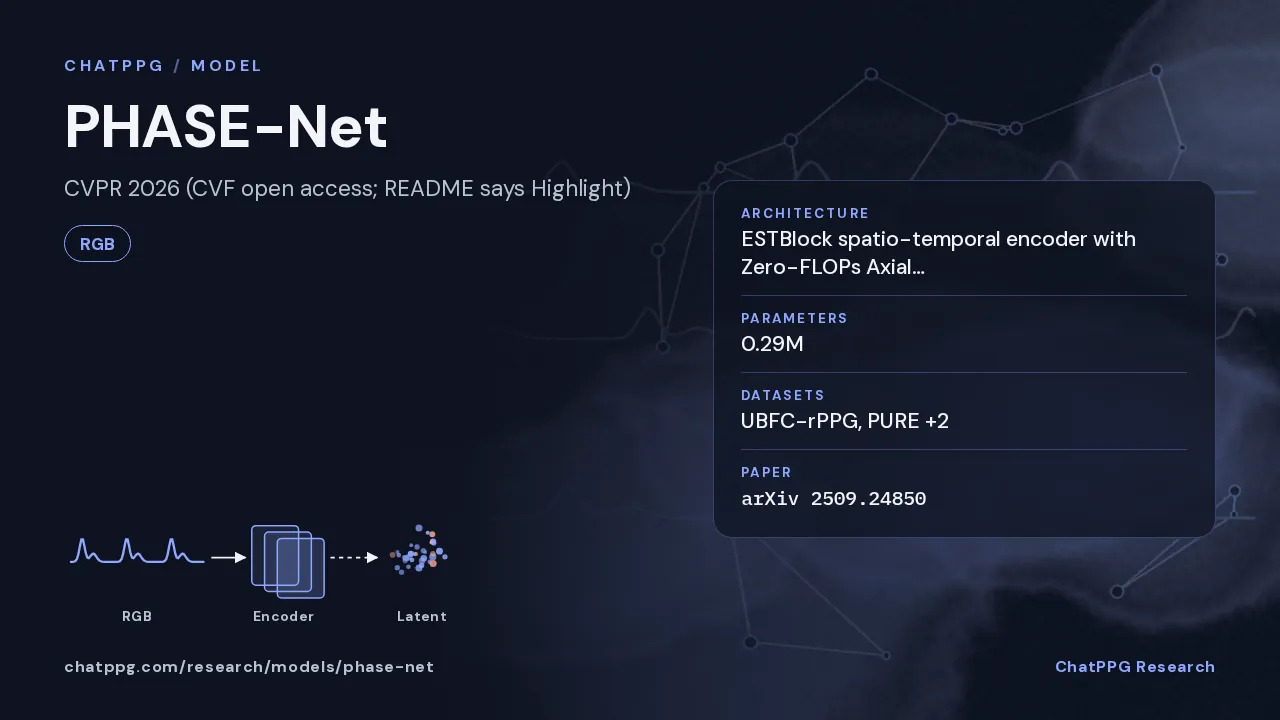
ESTBlock spatio-temporal encoder with Zero-FLOPs Axial Swapper (parameter-free channel/axis permutation mixing distant face regions) → Adaptive Spatial Filter (per-frame soft spatial mask) → Gated TCN (causal dilated TCN with gating, 3 layers default); loss weight λ = 0.1

At a glance
Type
Task model
Modalities
RGB
Form factor
Camera rPPG
Parameters
0.29M
Architecture
ESTBlock spatio-temporal encoder with Zero-FLOPs Axial Swapper (parameter-free channel/axis permutation mixing distant face regions) → Adaptive Spatial Filter (per-frame soft spatial mask) → Gated TCN (causal dilated TCN with gating, 3 layers default); loss weight λ = 0.1
Venue
CVPR 2026 (CVF open access; README says Highlight)
Year
2025
DOI
Not reported
Code
Not reported
Weights
Not reported
Licence
NONE (no LICENSE file)
Caveats
Not reported
Added
Not reported
Updated
Nov 11, 2026

Abstract

Remote photoplethysmography (rPPG) measurement enables non-contact physiological monitoring but suffers from accuracy degradation under head motion and illumination changes. Existing deep learning methods are mostly heuristic and lack theoretical grounding, limiting robustness and interpretability. In this work, we propose a physics-informed rPPG paradigm derived from the Navier-Stokes equations of hemodynamics, showing that the pulse signal follows a second-order dynamical system whose discrete solution naturally leads to a causal convolution, justifying the use of a Temporal Convolutional Network (TCN). Based on this principle, we design the PHASE-Net, a lightweight model with three key components: 1) Zero-FLOPs Axial Swapper module to swap or transpose a few spatial channels to mix distant facial regions, boosting cross-region feature interaction without changing temporal order; 2) Adaptive Spatial Filter to learn a soft spatial mask per frame to highlight signal-rich areas and suppress noise for cleaner feature maps; and 3) Gated TCN, a causal dilated TCN with gating that models long-range temporal dynamics for accurate pulse recovery. Extensive experiments demonstrate that PHASE-Net achieves state-of-the-art performance and strong efficiency, offering a theoretically grounded and deployment-ready rPPG solution. The source code is available at https://github.com/Alex036225/PhaseNet.

Verbatim fromarXiv· arXiv metadata (abstracts are released under CC0)

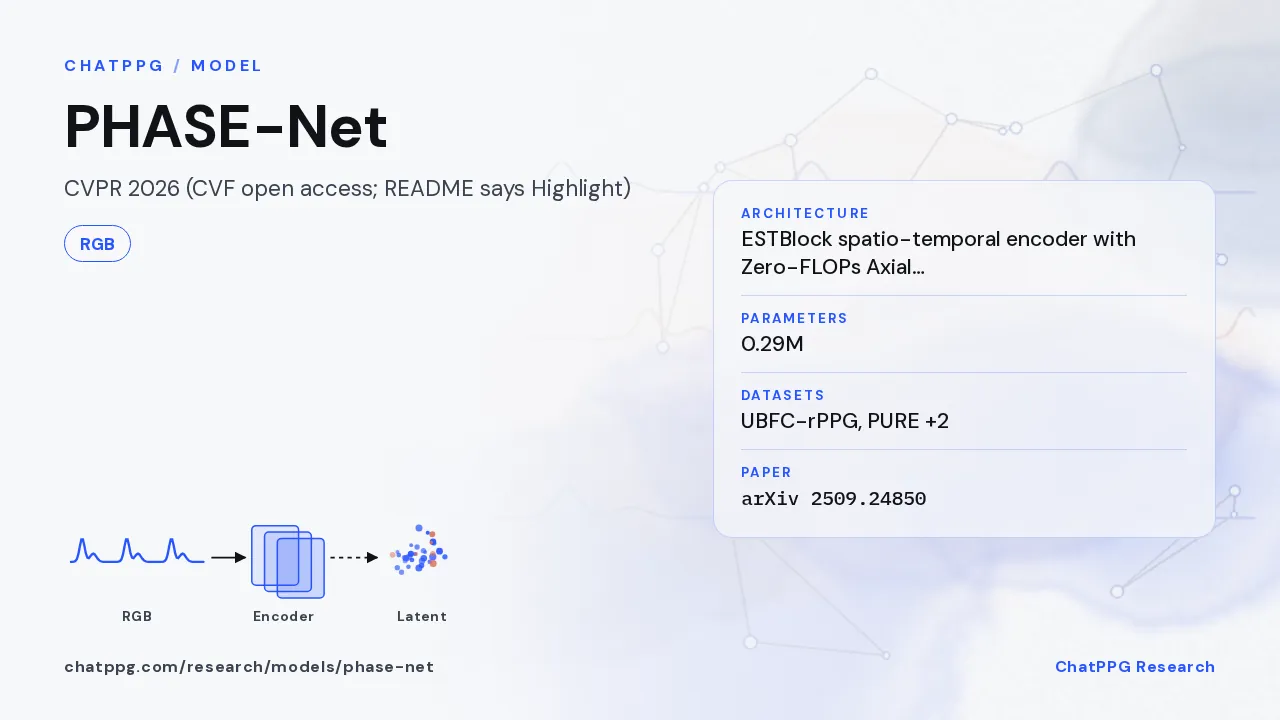
PHASE-Net: ChatPPG research summary card

Key results

How it works

How PHASE-Net works: Input signals → Model → Downstream tasksInput signals: RGB. Datasets: UBFC-rPPG, PURE, BUAA-MIHR, MMPD. Model: PHASE-Net, 0.29M parameters (Convolutional network · Masked reconstruction). Downstream tasks: Heart rate.Input signalsRGBRGBDatasets: UBFC-rPPG, PURE, BUAA-MIHR, MMPDDatasetsUBFC-rPPG, PURE +2 moreModelPHASE-Net0.29M parametersConvolutional network · Masked…Downstream tasksHeart rateHeart rate

Datasets linked in the hub; pretraining vs evaluation roles follow the paper.

Architecture
ESTBlock spatio-temporal encoder with Zero-FLOPs Axial Swapper (parameter-free channel/axis permutation mixing distant face regions) → Adaptive Spatial Filter (per-frame soft spatial mask) → Gated TCN (causal dilated TCN with gating, 3 layers default); loss weight λ = 0.1
Inputs
RGB
Approach
rppg · model · lightweight · tcn · physics informed · cvpr 2026

Leaderboard rows· 8

All leaderboards
TaskDatasetMetricValueRank
Rppg hrBUAA-MIHR intraHR MAE ↓5.89#3 / 4
Rppg hrPURE intraHR MAE ↓0.14#1 / 5
Rppg hrUBFC-rPPG intraHR MAE ↓0.15#3 / 5
Rppg hrmmpd intraHR MAE ↓4.78#6 / 6
Rppg hrothers → buaa-mihr (leave-one-out)HR MAE ↓2.56#1 / 1
Rppg hrothers → mmpd (leave-one-out)HR MAE ↓10.33#1 / 1
Rppg hrothers → pure (leave-one-out)HR MAE ↓2.86#1 / 1
Rppg hrothers → ubfc-rppg (leave-one-out)HR MAE ↓10.04#1 / 1

Datasets used· 3

Cite this model

Cite the publication recorded for this model. Check it against the publisher before submitting.

PHASE-Net. (2025). CVPR 2026. https://arxiv.org/abs/2509.24850
@inproceedings{phasenet2025phasenet,
  title         = {{PHASE-Net}},
  year          = {2025},
  booktitle     = {CVPR 2026},
  eprint        = {2509.24850},
  archivePrefix = {arXiv}
}

Source metadata: 2025

Record updated Nov 11, 2026

History

  1. Record updated