PaperarXiv:2210.03115
SimPer: Simple Self-Supervised Learning of Periodic Targets





arXiv preprint
TL;DR
SimPer is a contrastive self-supervised method for learning periodic signals. It uses custom augmentations, similarity measures and a generalized contrastive loss, and beat other self-supervised methods on real-world tasks in behaviour analysis, environmental sensing and healthcare, with better data efficiency and robustness.
- Domains: human behaviour, environmental sensing, healthcare
- Strengths: data efficiency, robustness to distribution shift
Abstract
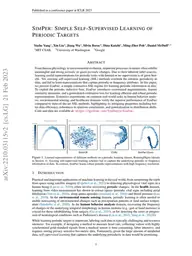
From human physiology to environmental evolution, important processes in nature often exhibit meaningful and strong periodic or quasi-periodic changes. Due to their inherent label scarcity, learning useful representations for periodic tasks with limited or no supervision is of great benefit. Yet, existing self-supervised learning (SSL) methods overlook the intrinsic periodicity in data, and fail to learn representations that capture periodic or frequency attributes. In this paper, we present SimPer, a simple contrastive SSL regime for learning periodic information in data. To exploit the periodic inductive bias, SimPer introduces customized augmentations, feature similarity measures, and a generalized contrastive loss for learning efficient and robust periodic representations. Extensive experiments on common real-world tasks in human behavior analysis, environmental sensing, and healthcare domains verify the superior performance of SimPer compared to state-of-the-art SSL methods, highlighting its intriguing properties including better data efficiency, robustness to spurious correlations, and generalization to distribution shifts. Code and data are available at: https://github.com/YyzHarry/SimPer.
Verbatim from arXiv (opens in a new tab) · arXiv metadata (abstracts are released under CC0)
Results on ChatPPG leaderboards
All leaderboardsNo results from this paper on ChatPPG leaderboards yet. Browse the leaderboards.
Tasks & signals
Tasks
Signals
Keywords
Datasets used
How it works
- Method
- contrastive SSL with periodicity-aware augmentations and loss
Cite this paper
Yang, Y., Liu, X., Wu, J., Borac, S., Katabi, D., Poh, M.-Z., & McDuff, D. (2022). SimPer: Simple Self-Supervised Learning of Periodic Targets. arXiv preprint. https://arxiv.org/abs/2210.03115
Yang, Yuzhe, Xin Liu, Jiang Wu, Silviu Borac, Dina Katabi, Ming-Zher Poh, and Daniel McDuff. 2022. "SimPer: Simple Self-Supervised Learning of Periodic Targets." arXiv preprint. https://arxiv.org/abs/2210.03115.
Yang, Y., Liu, X., Wu, J., Borac, S., Katabi, D., Poh, M.-Z. and McDuff, D. (2022) 'SimPer: Simple Self-Supervised Learning of Periodic Targets', arXiv preprint. Available at: https://arxiv.org/abs/2210.03115
Yang, Yuzhe, et al. "SimPer: Simple Self-Supervised Learning of Periodic Targets." arXiv preprint, 2022. https://arxiv.org/abs/2210.03115.
Y. Yang et al., "SimPer: Simple Self-Supervised Learning of Periodic Targets," arXiv preprint, 2022, [Online]. Available: https://arxiv.org/abs/2210.03115.
@misc{yang2022simper,
  title         = {{SimPer: Simple Self-Supervised Learning of Periodic Targets}},
  author        = {Yang, Yuzhe and Liu, Xin and Wu, Jiang and Borac, Silviu and Katabi, Dina and Poh, Ming-Zher and McDuff, Daniel},
  year          = {2022},
  howpublished  = {arXiv preprint},
  eprint        = {2210.03115},
  archivePrefix = {arXiv}
}