Cite this dataset
ADABase [Data set]. (n.d.). zenodo. https://doi.org/10.5281/zenodo.24051552
@misc{adabasecognitiveadabase,
  title         = {{ADABase}},
  howpublished  = {zenodo},
  doi           = {10.5281/zenodo.24051552}
}Zenodo Public Set 10.5281/zenodo.24051552, Private Set 10.5281/zenodo.24059812. Paper: Oppelt et al., "ADABase: A Multimodal Dataset for Cognitive Load Estimation", Sensors 23(1):340, 2023, 10.3390/s23010340. HDF5 per session with SIGNALS (1 kHz grid with STUDY/PHASE/LEVEL labels plus ECGIPEAKS / PPGPEAKS / RSPPEAKS markers), SUBJECTIVE, PERFORMANCE and META tables.
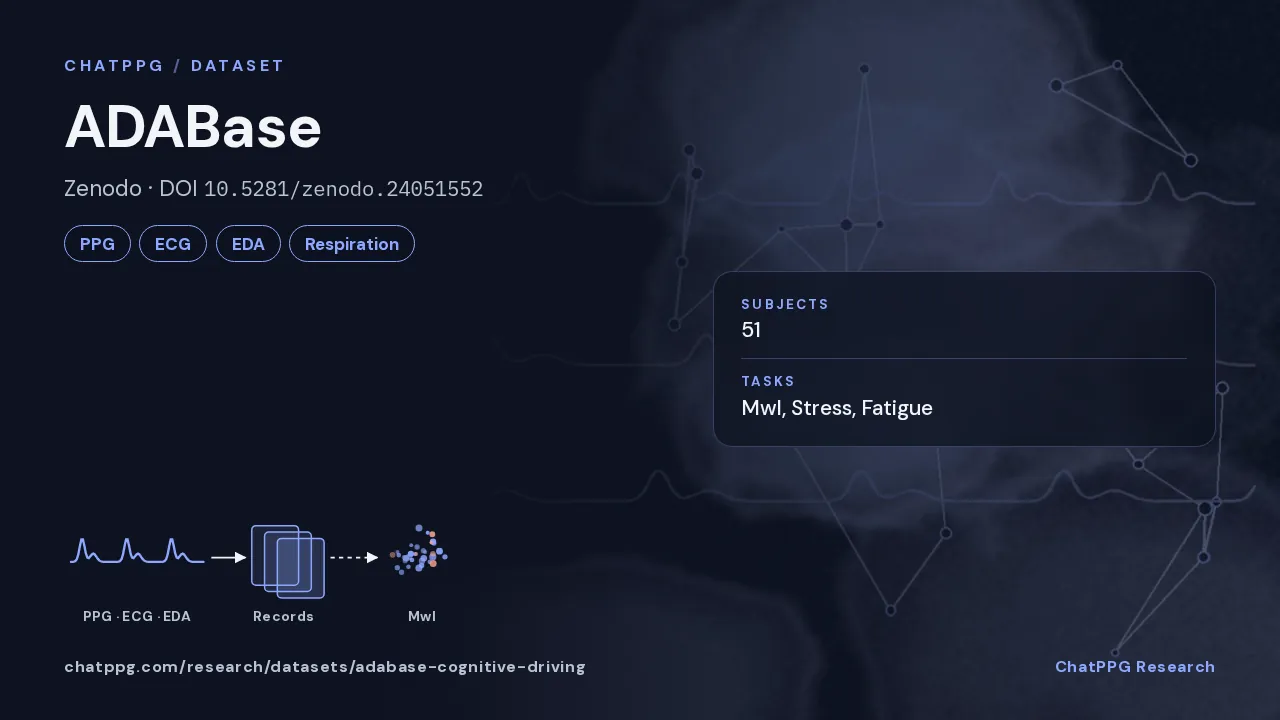
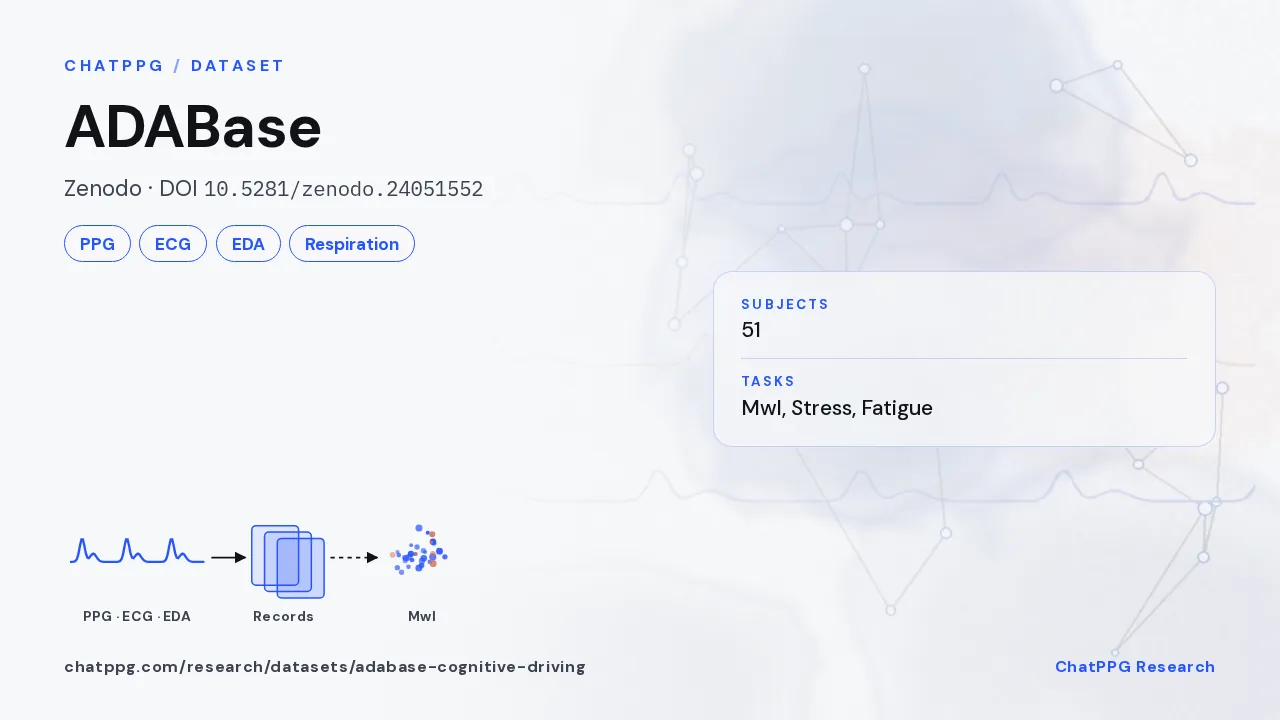
Multimodal physiological and behavioral recordings for cognitive load estimation during an n-back test and a driving-simulator study. This record holds the Public Set: 30 of the 51 ADABase recordings.
How to cite Please cite this dataset record and both papers: ADABase introduced the acquisition setup, and REVELIO extends it with the gaming cohort.
@articleoppelt2023adabase, author = Oppelt, Maximilian P. and Foltyn, Andreas and Deuschel, Jessica and Lang, Nadine R. and Holzer, Nina and Eskofier, Bjoern M. and Yang, Seung Hee, title = ADABase: A Multimodal Dataset for Cognitive Load Estimation, journal = Sensors, year = 2023, volume = 23, number = 1, pages = 340, doi = 10.3390/s23010340
@articleoppelt2026revelio, author = Oppelt, Maximilian P. and Foltyn, Andreas and Lang-Richter, Nadine R. and Eskofier, Bjoern M., title = REVELIO: Multimodal Task Load Estimation for Cross-Domain Generalization, journal = International Journal of Human–Computer Interaction, publisher = Taylor & Francis, year = 2026, doi = 10.48550/arXiv.2509.01642, note = In press. DOI refers to the arXiv preprint arXiv:2509.01642
Dataset overview Participants. ADABase and REVELIO together comprise 96 sessions from 88 subjects (51 in the driving study, 37 in the gaming study). Five people took part in both studies, so the subjects are 83 different individuals. The sessions are split into four Zenodo records:
Subset Sessions DOI
ADABase: Cognitive Driving Public Set (this record) 30 10.5281/zenodo.24051552
ADABase: Cognitive Driving Private Set 21 10.5281/zenodo.24059812
REVELIO: Cognitive Gaming Public Set 30 10.5281/zenodo.24060698
REVELIO: Cognitive Gaming Private Set 15 10.5281/zenodo.24076078
The full ADABase cohort comprises 51 participants.
Tasks. Each recording contains an n-back test and a driving-simulator study with single- and dual-task workloads of increasing intensity. Each recording lasts more than two hours. See the ADABase paper for the protocol.
Modalities.
Physiological signals (BIOPAC MP160, recorded at 2000 Hz, stored at 1 kHz): ECG, PPG, EDA, EMG (trapezius), respiration, skin temperature Eye tracking (Tobii Pro Fusion, 250 Hz): gaze and pupil diameter Behavioral features extracted from video (camera at 25 Hz): facial action units and body landmarks. No raw video or images are released. Performance measures (e.g. reaction times) and subjective ratings (NASA-TLX questionnaires)
Public/private split. The 51 recordings are split into two Zenodo records:
Public Set: 30 recordings (IDs 0000–0029), access on request. Private Set: 21 recordings (IDs 0030–0050), retained as a hidden test set.
Data collection was approved by the ethics committee of Friedrich-Alexander-Universität Erlangen-Nürnberg (no. 129_21 B, 21 April 2021). All participants gave written informed consent, and only participants who consented to data sharing are included.
Files This record contains 30 HDF5 files (27.32 GB in total, IDs 0000–0029), plus checksums.md5.
File naming scheme: -.h5
NNNN: four-digit participant ID. IDs are unique across ADABase and REVELIO, so the same NNNN always denotes the same person. ADABase uses IDs 0000–0050. CODE: pseudonym of the session.
Example: 0009-ILAB.h5 is the driving recording of participant 0009. The same participant also appears in REVELIO (0009-WMS15.h5, 0009-VRE30.h5).
All 30 files 0000-ACAA.h5, 0001-AGDJ.h5, 0002-AHEG.h5, 0003-AZFR.h5, 0004-BDCD.h5, 0005-BQAB.h5, 0006-BRJG.h5, 0007-FKDN.h5, 0008-GCAF.h5, 0009-ILAB.h5, 0010-ISJP.h5, 0011-KISN.h5, 0012-KSLI.h5, 0013-KYXT.h5, 0014-LEDG.h5, 0015-LINI.h5, 0016-LTRQ.h5, 0017-MDMS.h5, 0018-NMIL.h5, 0019-PFAC.h5, 0020-RLCE.h5, 0021-RNDM.h5, 0022-RSBC.h5, 0023-SFKF.h5, 0024-SZLE.h5, 0025-TBMO.h5, 0026-XAPL.h5, 0027-YMAD.h5, 0028-ZFML.h5, 0029-ZZOV.h5
HDF5 structure Each file is written with pandas (PyTables) and holds four tables, which pandas.read_hdf reads directly. Driving (ADABase) and gaming (REVELIO) files share this layout.
Key Rows Content
SIGNALS one per millisecond All time series on a common 1 kHz grid. The index is the time in ms since the start of the recording. Annotation columns STUDY, PHASE, LEVEL, then one column per channel (see below).
SUBJECTIVE one per rated level NASA-TLX ratings with STUDY, PHASE, LEVEL. Six dimensions MENTAL, PHYSICAL, TEMPORAL, PERFORMANCE, EFFORT, FRUSTRATION on a 21-point scale (0 to 20), and their pairwise-comparison weights WEIGHT (sum 15).
PERFORMANCE one per scored level Task performance with STUDY, PHASE, LEVEL. The columns differ between tasks and are empty where they do not apply, e.g. F1, VISUAL F1, AUDITIVE F1, REACTION TIME, VISUAL MEAN REACTION TIME, AUDITIVE MEAN REACTION TIME, SONGS RECALL, RACE TIME (text, mm:ss,cc), MISSED RINGS, SCORE. Some levels have no score.
META one per session Demographics and questionnaires, with a two-level column index grouped by topic, e.g. ("Subject", "Age"), ("Subject", "Sex").
Channels in SIGNALS.
Columns Content
RAW_ECG_I, RAW_ECG_II ECG, two leads
RAW_PPG Photoplethysmogram
RAW_EDA Electrodermal activity
RAW_RSP Respiration (chest belt)
RAW_EMG EMG (trapezius)
RAW_SKT Skin temperature
ECG_I_PEAKS, PPG_PEAKS, RSP_PEAKS Event markers: R peaks in ECG I, pulse peaks in PPG, inspiration peaks in respiration
EYE_LEFT_*, EYE_RIGHT_* Eye tracker, e.g. EYE_LEFT_PUPIL_DIAMETER (mm), EYE_LEFT_PUPIL_VALIDITY, EYE_LEFT_GAZE_POINT_ON_DISPLAY_AREA_X
FACE_AU* Facial action units extracted from video, e.g. FACE_AU12
MOVE_* Body landmarks extracted from video, e.g. MOVE_X_NOSE
The full channel list is printed by the example in "Loading the data in Python".
Sampling rates. The biosignals are stored at 1 kHz. Streams with a lower native rate (eye tracker 250 Hz, video features 25 Hz) are NaN between their samples. Calling .dropna() on a column recovers the native samples. The row number equals the time in ms, so the start and stop arguments of pandas.read_hdf select a time range without reading the whole file. A file has about 9 million rows, so read only the columns and time range you need.
Annotation. Every sample in SIGNALS carries three labels:
STUDY: the task. Time outside all tasks is n/a. PHASE: baseline, train (practice), test, or n/a between phases. LEVEL: numbers the conditions within a study and phase.
Verbatim fromZenodo· Licence: see record
No model in the hub reports results on this dataset yet.
ADABase [Data set]. (n.d.). zenodo. https://doi.org/10.5281/zenodo.24051552
@misc{adabasecognitiveadabase,
title = {{ADABase}},
howpublished = {zenodo},
doi = {10.5281/zenodo.24051552}
}Cite the dated snapshot 2026-10 for a fixed, reproducible version. Please also cite the original publications listed above.
ChatPPG. (2026). ADABase: dataset record (Version 2026-10) [Data set]. ChatPPG Research Hub. https://chatppg.com/research/datasets/adabase-cognitive-driving
@misc{chatppg_dataset_adabase_cognitive_driving,
  author       = {{ChatPPG}},
  title        = {{ADABase: dataset record}},
  year         = {2026},
  month        = nov,
  version      = {2026-10},
  howpublished = {\url{https://chatppg.com/research/datasets/adabase-cognitive-driving}},
  note         = {ChatPPG Research Hub, Snapshot 2026-10, https://chatppg.com/research/snapshots/2026-10}
}cff-version: 1.2.0 message: "If you use this resource, please cite it as below." type: dataset title: "ADABase: dataset record" authors: - name: "ChatPPG" url: "https://chatppg.com/research/datasets/adabase-cognitive-driving" repository-artifact: "https://chatppg.com/research/snapshots/2026-10" version: "2026-10" date-released: "2026-11-10"
Record updated
 Cross-Modal Correlation Fusion for End-to-End ECG–PPG Stress ClassificationSame task: Mental workloadFrontiers in Artificial Intelligence and A · 2026
 AdVitamSame task: Respirationphysiological state and behaviour of drivers in conditionally automated driving (raw ECG + EDA + respiration at 1000 Hz, 346 drivers, 6 simulator experiments; Zenodo CC BY 4.0)346 subjects · ECG · EDA · Resp
 LOADXSame task: Mental workloadphysical/mental workload in single- and dual-task execution (raw ECG + respiration + GSR + accel + MediaPipe pose + NASA-TLX, 20 participants; Zenodo open CC BY 4.0 since 2026-11-09)20 subjects · ECG · IMU · EDA
 REVELIOSame task: Respirationmultimodal task load during n-back and commercial video games (ECG, PPG, EDA, EMG, resp, skin temp, eye tracking, facial AUs; 45 sessions, Fraunhofer EULA, non-commercial)37 subjects · PPG · ECG · EDA