Dataset

ICBHI 2017 Respiratory Sound Database

The ICBHI 2017 database is a public set of respiratory sound recordings created for a scientific challenge. It contains 920 recordings from 126 participants with two sets of annotations, one for respiratory cycles and one for adventitious events. The best challenge entry scored 52.5% on the cycle annotations and 91.2% on the event annotations.

Published
Physiological Measurement, 2019
Size
920 recordings from 126 participants
Result

best challenge system scored 52.5% (respiratory cycles) and 91.2% (events)

At a glance
Type
Dataset
Licence
Not reported
Access
Open
Subjects
126
Signals
Audio
PPG sites
None
Setting
Clinical
Wrist
No
Raw waveforms
Yes
Tasks
Auscultation
Updated
Nov 13, 2026

Original description

Objective: Over the last few decades, there has been significant interest in the automatic analysis of respiratory sounds. However, currently there are no publicly available large databases with which new algorithms can be evaluated and compared. Further developments in the field are dependent on the creation of such databases. Approach: This paper describes a public respiratory sound database, which was compiled for an international competition, the first scientific challenge of the IFMBE’s International Conference on Biomedical and Health Informatics. The database includes 920 recordings acquired from 126 participants and two sets of annotations. One set contains 6898 annotated respiratory cycles, some including crackles, wheezes, or a combination of both, and some with no adventitious respiratory sounds. In the other set, precise locations of 10 775 events of crackles and wheezes were annotated. Main results: The best system that participated in the challenge achieved an average score of 52.5% with the respiratory cycle annotations and an average score of 91.2% with the event annotations. Significance: The creation and public release of this database will be useful to the research community and could bring attention to the respiratory sound classification problem.
Verbatim fromSemantic Scholar· Abstract via Semantic Scholar; © the authors/publisher

ICBHI 2017 Respiratory Sound Database: overview

The ICBHI 2017 Respiratory Sound Database was compiled for the challenge at the International Conference on Biomedical Health Informatics 2017 and now includes both its public and private sets. It holds 5.5 hours of recordings: 920 annotated audio samples from 126 subjects containing 6,898 respiratory cycles, of which 1,864 contain crackles, 886 contain wheezes and 506 contain both. Recordings come from teams in Aveiro, Portugal and Thessaloniki/Naousa, Greece.

What's inside

Subjects
126
Recordings
920 audio samples, 10–90 s each, 5.5 h total
Cycles
6,898: 1,864 crackles, 886 wheezes, 506 both
Annotations
Per cycle: start, end, crackles (0/1), wheezes (0/1)
Chest locations
Trachea, anterior/posterior/lateral left and right
Equipment
AKG C417L microphone, Littmann Classic II SE, Littmann 3200, WelchAllyn Meditron
Metadata
Diagnosis per subject (e.g. COPD, LRTI, URTI), demographics, official train/test split

How to access it

Host: ICBHI Challenge website (Aristotle University of Thessaloniki)

  1. Download the database zip from the challenge page; no registration.
  2. Also download the diagnosis file, the train/test split file and the demographic file linked on the same page.
  3. If you used an early copy, apply the published file-name correction (92 files had the wrong equipment name).

Licence: No formal licence stated; the page says the database is freely available for research

What it allows: Research use. Commercial use is not addressed; ask the organisers before using it commercially.

Load ICBHI 2017 Respiratory Sound Database in Python

Untestedpip install soundfile pandas
import glob
import pandas as pd
import soundfile as sf

wav = sorted(glob.glob("ICBHI_final_database/*.wav"))[0]
pid, idx, loc, mode, device = wav.rsplit("/", 1)[1][:-4].split("_")
audio, fs = sf.read(wav)
cycles = pd.read_csv(wav[:-4] + ".txt", sep="\t", names=["start", "end", "crackles", "wheezes"])
print(pid, loc, device, fs, len(cycles))

Not run here. File naming and the four annotation columns follow the challenge page; the folder name depends on the zip you download.

Caveats

  • Recordings use four different devices with different sampling rates; resample before mixing them.
  • Noise is high in some cycles by design, to simulate real conditions.
  • Use the official patient-wise train/test split; random cycle splits leak patients.
  • Early copies had 92 files with the wrong equipment name; check filename_differences.txt.
  • This is audio, not PPG: it is in the hub for respiratory sensing comparisons.

Similar datasets

DatasetSubjectsSignalsLicence
BIDMC PPG and Respiration (Pimentel 2016 / PhysioNet)53ppg, ecg, resp, spo2ODC-By 1.0
CapnoBase IEEE TBME RR benchmark (Karlen 2013)n/appg, ecg, respCustom terms specific to this dataset

Sources: ICBHI 2017 Challenge page · Rocha et al. 2019 · Updated 2026-10-19

ICBHI 2017 Respiratory Sound Database: ChatPPG research summary card

Key numbers

126
Subjects

How it works

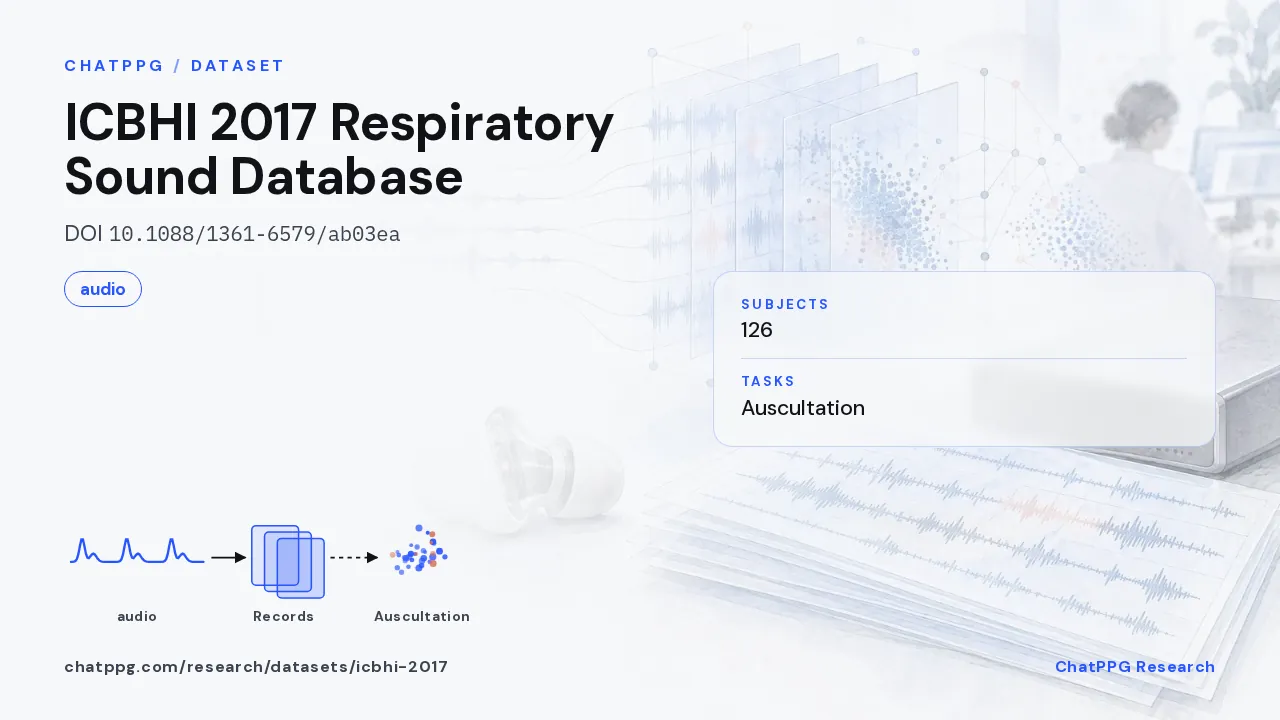
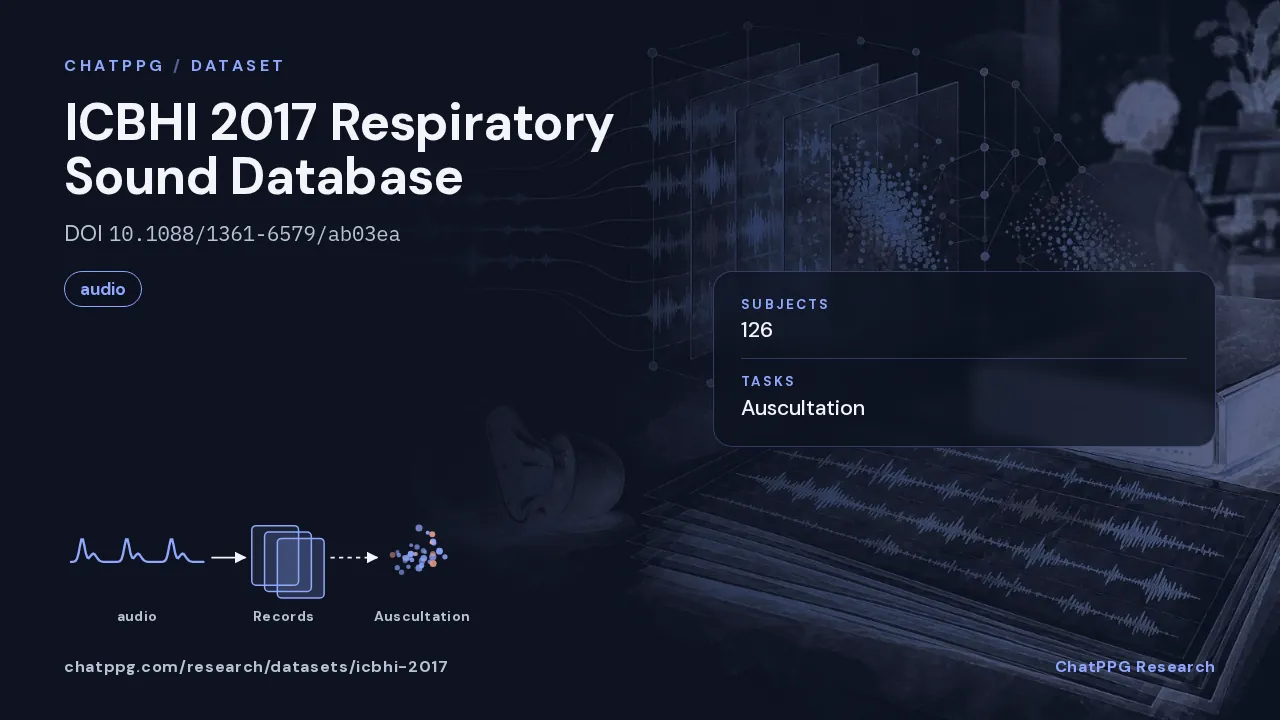
How ICBHI 2017 Respiratory Sound Database works: Devices & body sites → Signals recorded → TasksDevices & body sites: None (PPG site). Signals recorded: ICBHI 2017 Respiratory Sound Database, 126 subjects, signals Audio. Tasks: Auscultation.Devices & body sitesNone: PPG siteNonePPG siteSignals recordedICBHI 2017 Respiratory Sound…126 subjectsAudioTasksAuscultationAuscultation

No model in the hub reports results on this dataset yet.

Papers using this dataset· 1

#131 of 186 most-used datasets by published papers and models

FAQ

How many recordings are in the ICBHI 2017 dataset?

920 annotated audio samples from 126 subjects, 5.5 hours in total, containing 6,898 respiratory cycles.

What labels does ICBHI 2017 have?

Each respiratory cycle is labelled for presence or absence of crackles and wheezes. Subject-level diagnoses are in a separate file.

Is the ICBHI dataset free?

Yes, the challenge page says it is freely available for research and can be downloaded as a zip. No formal licence is stated.

What do ICBHI file names mean?

Patient number, recording index, chest location, acquisition mode (single or multichannel) and recording equipment, separated by underscores.

How do I download the ICBHI 2017 dataset?

From the ICBHI Challenge page (https://bhichallenge.med.auth.gr/ICBHI_2017_Challenge). Download the database zip plus the diagnosis, train/test split and demographic files. No registration is required.

Cite this dataset

Cite this dataset with the fields recorded here. Check it against the publisher before submitting.

ICBHI 2017 Respiratory Sound Database [Data set]. (n.d.). auth-gr. https://doi.org/10.1088/1361-6579/ab03ea
@misc{icbhi2017icbhi,
  title         = {{ICBHI 2017 Respiratory Sound Database}},
  howpublished  = {auth-gr},
  doi           = {10.1088/1361-6579/ab03ea}
}

Cite the ChatPPG record

Cite the dated snapshot 2026-10 for a fixed, reproducible version. Please also cite the original publications listed above.

APA

ChatPPG. (2026). ICBHI 2017 Respiratory Sound Database: dataset record (Version 2026-10) [Data set]. ChatPPG Research Hub. https://chatppg.com/research/datasets/icbhi-2017

BibTeX
@misc{chatppg_dataset_icbhi_2017,
  author       = {{ChatPPG}},
  title        = {{ICBHI 2017 Respiratory Sound Database: dataset record}},
  year         = {2026},
  month        = nov,
  version      = {2026-10},
  howpublished = {\url{https://chatppg.com/research/datasets/icbhi-2017}},
  note         = {ChatPPG Research Hub, Snapshot 2026-10, https://chatppg.com/research/snapshots/2026-10}
}
CITATION.cff
cff-version: 1.2.0
message: "If you use this resource, please cite it as below."
type: dataset
title: "ICBHI 2017 Respiratory Sound Database: dataset record"
authors:
  - name: "ChatPPG"
url: "https://chatppg.com/research/datasets/icbhi-2017"
repository-artifact: "https://chatppg.com/research/snapshots/2026-10"
version: "2026-10"
date-released: "2026-11-13"

History

  1. Record updated