
Cite this dataset
ZCHSound [Data set]. (n.d.). zju. https://doi.org/10.1109/TBME.2023.3348800
@misc{zchsoundzchsound,
  title         = {{ZCHSound}},
  howpublished  = {zju},
  doi           = {10.1109/TBME.2023.3348800}
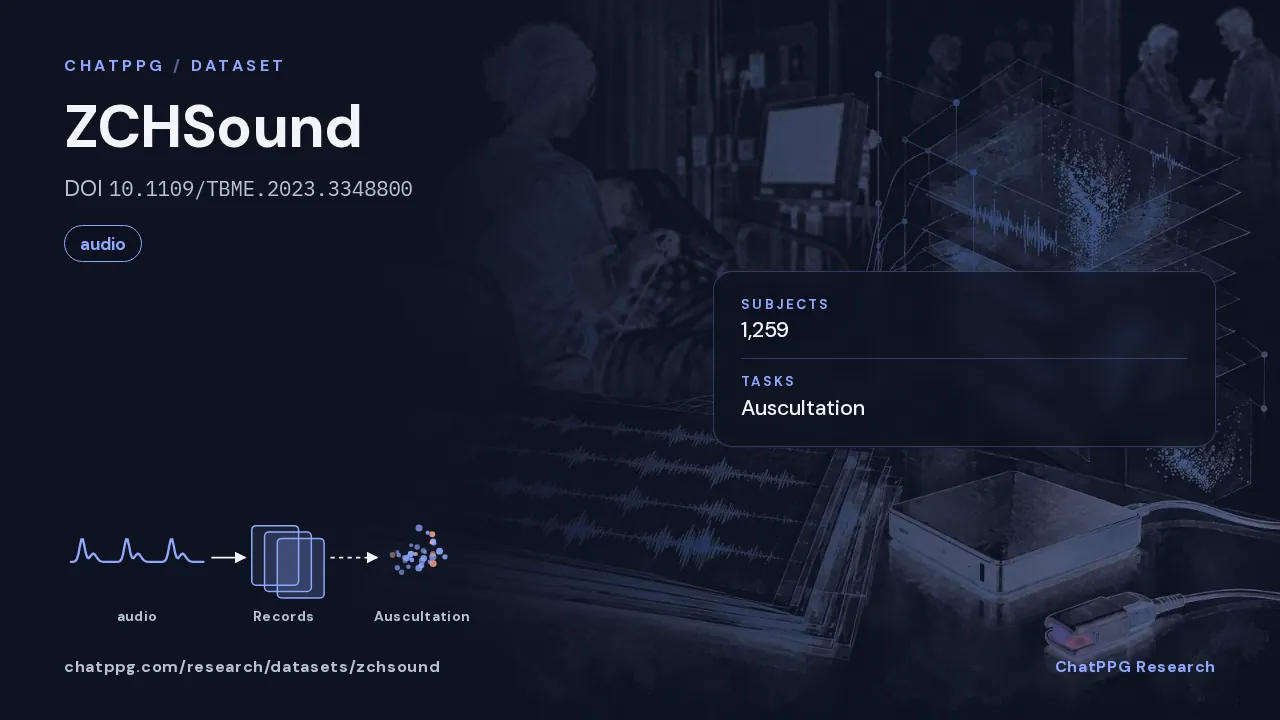
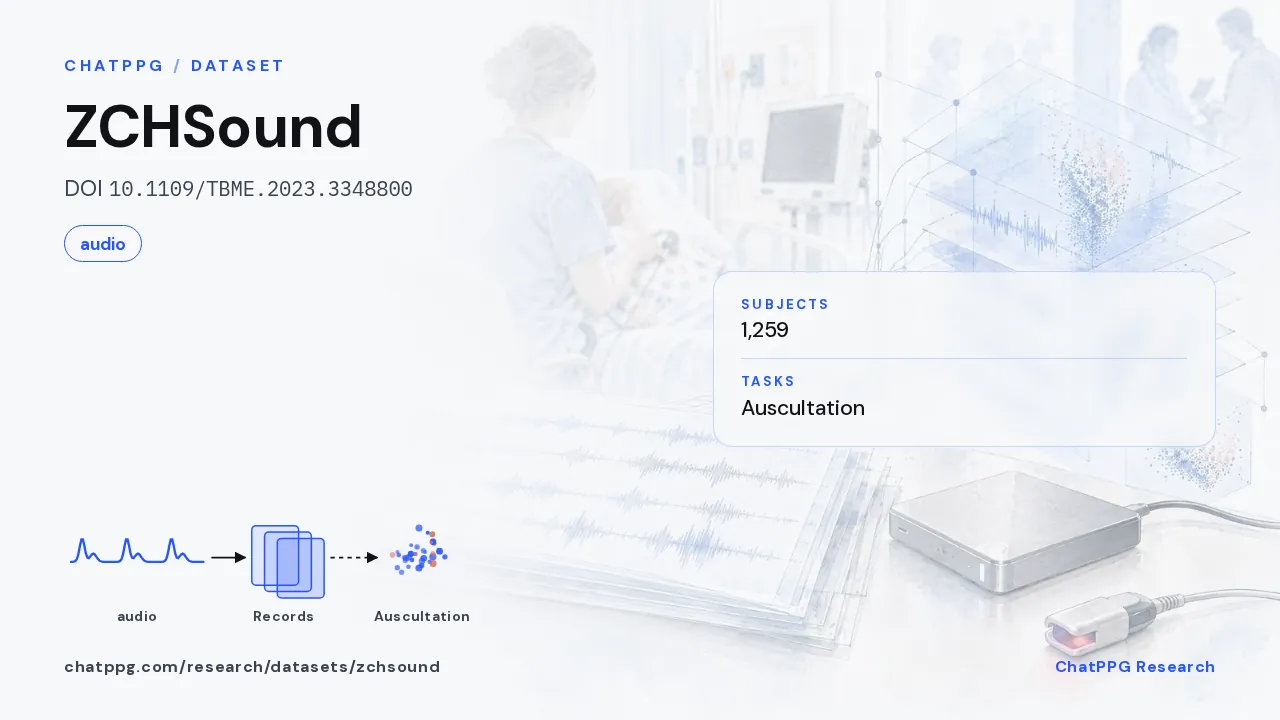
}ZCHSound is a pediatric heart sound database for detecting congenital heart disease. Between 2020 and 2022 the authors worked with cardiac surgeons at three children's hospitals to record 1,259 participants with electronic stethoscopes, and two cardiac experts confirmed every label. A random forest ensemble reached an F1 score of 90.3% for normal versus pathological heart sounds.
Congenital heart disease (CHD) is a common birth defect in children. Intelligent auscultation algorithms have been proven to reduce the subjectivity of diagnoses and alleviate the workload of doctors. However, the development of this algorithm has been limited by the lack of reliable, standardized, and publicly available pediatric heart sound databases. Therefore, the objective of this research is to develop a large-scale, high-standard, high-quality, and accurately labeled pediatric CHD heart sound database. Method: From 2020 to 2022, we collaborated with experienced cardiac surgeons from three general children's hospitals to collect heart sound signals from 1259 participants using electronic stethoscopes. To ensure the accuracy of the labels, the labels for all data were confirmed by two cardiac experts. To establish the baseline of ZCHsound, we extracted 84 features and used machine learning models to evaluate the performance of the classification task. Results: The ZCHSound database was divided into two datasets: one is a high-quality, filtered clean heart sound dataset, and the other is a low-quality, noisy heart sound dataset. In the evaluation of the high-quality dataset, our random forest ensemble model achieved an F1 score of 90.3% in the classification task of normal and pathological heart sounds. Conclusion: This study has successfully established a large-scale, high-quality, rigorously standardized pediatric CHD sound database with precise disease diagnosis. This database not only provides important learning resources for clinical doctors in auscultation knowledge but also offers valuable data support for algorithm engineers in developing intelligent auscultation algorithms.
Verbatim fromSemantic Scholar· Abstract via Semantic Scholar; © the authors/publisher
No model in the hub reports results on this dataset yet.
#131 of 186 most-used datasets by published papers and models
ZCHSound [Data set]. (n.d.). zju. https://doi.org/10.1109/TBME.2023.3348800
@misc{zchsoundzchsound,
title = {{ZCHSound}},
howpublished = {zju},
doi = {10.1109/TBME.2023.3348800}
}Cite the dated snapshot 2026-10 for a fixed, reproducible version. Please also cite the original publications listed above.
ChatPPG. (2026). ZCHSound: dataset record (Version 2026-10) [Data set]. ChatPPG Research Hub. https://chatppg.com/research/datasets/zchsound
@misc{chatppg_dataset_zchsound,
  author       = {{ChatPPG}},
  title        = {{ZCHSound: dataset record}},
  year         = {2026},
  month        = nov,
  version      = {2026-10},
  howpublished = {\url{https://chatppg.com/research/datasets/zchsound}},
  note         = {ChatPPG Research Hub, Snapshot 2026-10, https://chatppg.com/research/snapshots/2026-10}
}cff-version: 1.2.0 message: "If you use this resource, please cite it as below." type: dataset title: "ZCHSound: dataset record" authors: - name: "ChatPPG" url: "https://chatppg.com/research/datasets/zchsound" repository-artifact: "https://chatppg.com/research/snapshots/2026-10" version: "2026-10" date-released: "2026-11-13"
Record updated
 AI-READIShared topic: size/500 5kFlagship type 2 diabetes dataset (FAIRhub): Garmin Vivosmart 5 wrist HR/SpO2/stress + Dexcom G6 CGM + clinical, ECG and retinal imaging2,280 subjects · ECG · IMU · SpO₂