PPG for HRV: How Wearables Measure Heart Rate Variability
Heart rate variability from PPG wearables: accuracy, best practices, and what the research shows about HRV measured with optical sensors vs. ECG gold standard.
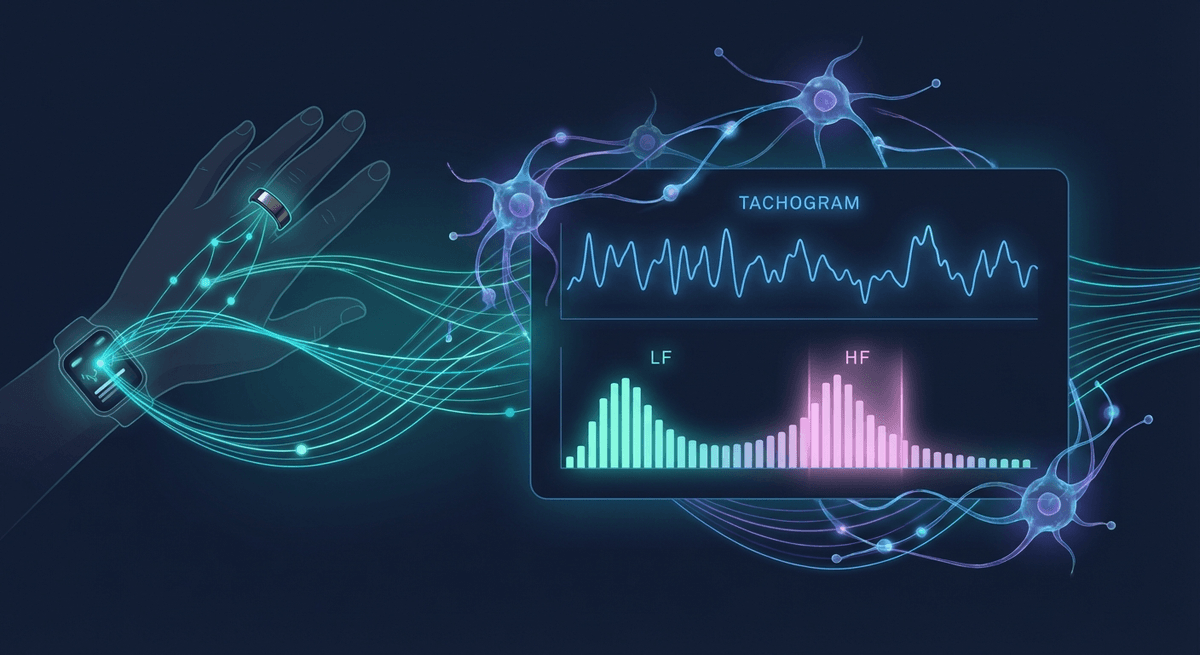
Heart rate variability (HRV) from wearable PPG sensors is now available on dozens of consumer devices, from Oura Ring and Apple Watch to Whoop and Garmin Fenix. But PPG-derived HRV is not the same as ECG-derived HRV — and the differences matter depending on what you are trying to measure.
HRV from PPG captures the timing between consecutive heartbeats using pulse arrival rather than the electrical R-wave. For most practical health monitoring purposes, this distinction is minor. For research-grade autonomic analysis, it requires careful consideration.
What Heart Rate Variability Measures
HRV is the variation in the time between consecutive heartbeats — specifically, the standard deviation or frequency-domain decomposition of inter-beat intervals (IBIs). It is a proxy for the balance of sympathetic (stress/arousal) and parasympathetic (recovery/rest) activity of the autonomic nervous system.
High HRV generally indicates good cardiovascular health, effective recovery, and parasympathetic dominance. Low HRV is associated with stress, poor recovery, fatigue, and various cardiovascular conditions. HRV measurement has applications in athletic training, stress monitoring, sleep staging, cardiovascular risk assessment, and mental health tracking.
The clinical gold standard is R-R interval measurement from ECG. The R-peak — the sharp peak of the QRS complex — can be detected with millisecond precision, giving very accurate beat-to-beat timing.
How PPG-Based HRV Works
PPG sensors detect the pulse waveform arrival at the measurement site (wrist, finger, ear). Beat timing is extracted from the PPG signal using one of several algorithms:
Peak detection: Finds the systolic peak (highest point) of each PPG pulse. Simple but less precise than foot detection, because the systolic peak is rounder and harder to localize exactly.
Foot (onset) detection: Finds the onset of each pulse at the beginning of the upstroke. More precise than peak detection for timing purposes, because the foot has a sharper inflection point.
Derivative-based detection: Uses the maximum of the first derivative (maximum slope of the upstroke) as the timing reference. More resistant to waveform shape variations than peak detection.
The resulting sequence of inter-beat intervals from PPG is called the PPI (pulse-to-pulse interval) or IBI derived from PPG, as distinct from RRI (R-R interval from ECG). In practice, many wearable manufacturers and health apps report these as "HRV" without distinguishing PPG from ECG source.
PPG HRV vs. ECG HRV: Key Differences
Pulse Arrival Time Delay
The PPG pulse arrives at the wrist approximately 150–350 ms after the ECG R-wave (the electromechanical delay plus pulse transit time). This constant offset does not affect HRV calculations — the variation in this delay (not the absolute delay) is what matters for autonomic analysis, and that variation is typically small at rest.
Waveform Distortion
PPG pulse shape varies with vascular compliance, sympathetic tone, and motion. The foot of the waveform may be harder to detect precisely in low-perfusion states or when the waveform morphology changes. This introduces some beat-timing error that does not exist with ECG R-peaks.
Sampling Rate Effects
Timing precision is limited by the sampling rate of the PPG sensor. At 25 Hz, timing resolution is ±40 ms — too coarse for reliable high-frequency HRV components (0.15–0.4 Hz). At 128 Hz, resolution is ±8 ms — adequate for most HRV applications. Most medical-grade and research PPG devices sample at 64–256 Hz. Many consumer wrist devices process PPG internally and only expose the IBI output, often at coarser resolution.
Agreement with ECG HRV
Meta-analyses show good agreement for time-domain HRV metrics (SDNN, RMSSD) between PPG and ECG at rest when sampling rate is adequate (≥64 Hz) and signal quality is good. The Bland-Altman limits of agreement for RMSSD in controlled resting studies are typically ±10–20 ms.
For frequency-domain HRV (LF/HF ratio, HF power in ms²), agreement is acceptable but shows more device-to-device variation. High-frequency HRV is particularly sensitive to sampling rate and beat detection precision.
During exercise and in the presence of motion artifact, PPG HRV diverges more substantially from ECG reference. Most wearable platforms perform HRV analysis only during sleep or dedicated resting periods for this reason.
Device-Specific Performance
Oura Ring: Generation 2 and 3 use infrared LEDs at 940 nm with 250 Hz sampling rate. Night-time RMSSD from Oura shows good agreement with ECG Holter in several published studies (Kinnunen et al., 2020, Sensors). The ring form factor benefits from stable sensor-skin contact and low motion during sleep.
Apple Watch (Series 6+): Uses nightly "Breathing Sessions" and background HRV measurements. The Watch captures 30-second respiratory-gated HRV samples (SDNN-30s). Agreement with ECG for SDNN at rest is good; the methodology was validated internally and published as a supplement to the Apple Heart Study. The Watch does not expose raw IBI data to third-party apps at full temporal resolution.
Whoop Band: Reports HRV as a daily morning score derived from 5 minutes of sleep data. Uses proprietary algorithms. No independent peer-reviewed validation of their specific HRV methodology has been published at the time of writing.
Garmin devices: Export raw IBI data to compatible health apps. In studies using Garmin data with dedicated HRV apps like Elite HRV, resting RMSSD agreement with ECG chest straps is generally within ±10 ms.
Polar OH1/H10: The OH1 is an optical arm sensor; the H10 is an ECG chest strap. Both are widely used as research reference devices. The OH1 is often used as an "above average consumer PPG" benchmark against the H10 gold standard. Agreement for RMSSD at rest: typically ±5–15 ms.
Factors That Affect PPG HRV Accuracy
Measurement conditions: Sleep-time HRV (still, supine, stable) is most accurate. Standing or post-exercise HRV measurements have more noise and artifact. Most wearable manufacturers recommend morning resting or overnight sleep HRV for tracking.
Sensor-skin contact: Consistent, stable contact matters more for HRV than for simple heart rate because timing precision is the metric. Oura Ring performs well partly due to its circumferential contact with the finger.
Ectopic beats: Premature atrial or ventricular contractions create spuriously short or long inter-beat intervals that inflate HRV metrics. Ectopic removal is an important preprocessing step. Research-grade HRV analysis includes ectopic filtering; many consumer devices do not expose whether this is applied.
Respiration: Respiratory sinus arrhythmia (RSA) — the normal increase in heart rate on inspiration and decrease on expiration — is the primary driver of high-frequency HRV. PPG captures this accurately at rest. During controlled breathing protocols (5–6 breaths/min for HF HRV resonance frequency measurements), PPG agrees well with ECG.
Best Practices for PPG HRV Monitoring
For meaningful HRV tracking with a PPG wearable:
- Measure at the same time each day: HRV has strong circadian rhythmicity. Morning resting HRV post-sleep is the most reproducible window.
- Ensure consistent sensor fit: Especially for ring or wristband devices — too loose means motion noise; too tight can affect peripheral blood flow.
- Allow acclimatization: 3–5 minutes of quiet rest before a deliberate HRV measurement improves stability.
- Track trends, not absolute values: Individual baseline HRV varies enormously (RMSSD ranges from <10 ms in sedentary individuals to >100 ms in elite athletes). The meaningful metric is deviation from your personal baseline, not comparison to population norms.
- Validate with an ECG-based device: If you are using PPG HRV for clinical decisions or serious training optimization, periodic cross-checks with an ECG strap (Polar H10, Garmin HRM-Pro) are worthwhile.
For a deeper dive into HRV analysis methodology, see our PPG inter-beat interval accuracy guide and PPG autonomic function testing guide.
Frequently Asked Questions
Is PPG HRV accurate enough for health monitoring? For tracking trends in your personal HRV baseline, resting-condition PPG HRV from a quality wearable (Oura Ring, Apple Watch, Garmin) is accurate enough for practical health monitoring. For research-grade autonomic analysis or clinical applications, ECG-derived HRV remains the standard.
Why does my HRV look different between devices? Different devices measure HRV at different times (continuous vs. 5-min morning window), using different beat detection algorithms, different sampling rates, and different ectopic filtering strategies. They also use different metrics (RMSSD vs. SDNN vs. LF/HF). These methodological differences produce legitimately different numbers even when the underlying biology is the same.
What HRV sampling rate is needed for accurate results? At minimum, 64 Hz for time-domain HRV (SDNN, RMSSD). For frequency-domain HRV including HF power, 128 Hz or higher is preferred. At 25 Hz (which some early consumer devices used), HRV measurements are unreliable.
Does wearing position affect PPG HRV? Yes. Finger-based sensors (ring) generally outperform wrist-based sensors for HRV because the finger has better perfusion, less motion artifact, and more stable contact geometry. Ear canal sensors are also good. Wrist sensors are acceptable for sleep monitoring but more variable for awake measurements.
Can PPG detect low HRV as a sign of overtraining? Yes, with caveats. Suppressed HRV (below your personal baseline by 1–2 standard deviations) is a validated indicator of autonomic stress from overtraining, illness, or poor sleep. The key is consistent measurement methodology and a sufficient baseline window (3–4 weeks minimum). Single-day low HRV readings are not reliable signals without this context.
What is RMSSD and why is it the preferred HRV metric for wearables? RMSSD (root mean square of successive differences) measures beat-to-beat variability — it is the square root of the mean of squared differences between consecutive IBIs. It reflects primarily parasympathetic activity and is less affected by breathing pattern and respiratory rate than frequency-domain LF/HF metrics. It is also more statistically stable for short (1–5 minute) recordings, making it well-suited for consumer wearable windows.
References
-
Kinnunen, H., Rantanen, A., Kenttä, T., & Koskimäki, H. (2020). Feasible assessment of recovery and cardiovascular health: accuracy of nocturnal HR and HRV assessed via ring PPG in comparison to medical-grade ECG. Physiological Measurement, 41(4), 04NT01. https://doi.org/10.1088/1361-6579/ab840a
-
Georgiou, K., Larentzakis, A. V., Khamis, N. N., Alsuhaibani, G. I., Alaska, Y. A., & Giallafos, E. J. (2018). Can wearable devices accurately measure heart rate variability? A systematic review. Folia Medica, 60(1), 7–20. https://doi.org/10.2478/folmed-2018-0001
-
Plews, D. J., Scott, B., Altini, M., Wood, M., Kilding, A. E., & Laursen, P. B. (2017). Comparison of heart-rate-variability recording with smartphone photoplethysmography, Polar H7 chest strap, and electrocardiography. International Journal of Sports Physiology and Performance, 12(10), 1324–1328. https://doi.org/10.1123/ijspp.2016-0668
-
Hernando, D., Garatachea, N., Almeida, R., Casajús, J. A., & Bailón, R. (2018). Validation of heart rate monitor Polar RS800 for heart rate variability analysis during exercise. Journal of Strength and Conditioning Research, 32(5), 1386–1398. https://doi.org/10.1519/JSC.0000000000001662