PPG Nocturnal Atrial Fibrillation Detection: Why Overnight Rhythm Irregularity Matters
PPG nocturnal atrial fibrillation detection helps flag overnight irregular rhythm burden, screening value, algorithm limits, and when ECG confirmation is still needed.
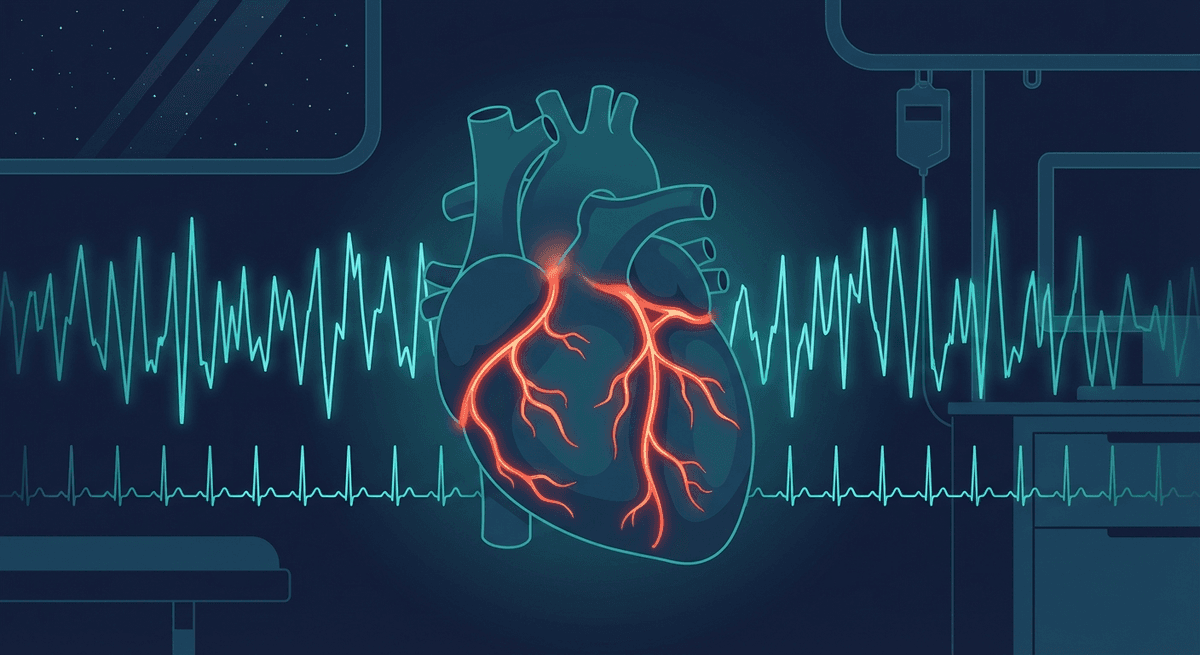
PPG nocturnal atrial fibrillation detection uses overnight optical pulse data to flag irregularly irregular rhythm when a person is asleep. It is one of the most promising use cases for wearable rhythm screening because sleep offers long, low-motion windows that improve signal quality, but any suspected AF still needs ECG confirmation before diagnosis or treatment decisions.
Definition box: Nocturnal atrial fibrillation means episodes of AF that occur during sleep or are first recognized overnight, often without symptoms.
A lot of atrial fibrillation is quiet. Patients may not feel palpitations. They may wake up tired, or not notice anything at all. That is why nighttime screening matters. If AF episodes cluster during sleep, spot checks during the day can miss a meaningful slice of total burden.
Can PPG detect atrial fibrillation during sleep?
Yes, and in some ways sleep is the ideal environment for it. PPG does not read the heart's electrical activity directly. Instead, it reads the peripheral pulse wave generated by each beat. In AF, the time between beats becomes highly irregular, without a stable repeating pattern. That irregularity shows up in the inter-beat interval sequence derived from the PPG waveform.
At night, several things help:
- less motion artifact than waking hours
- longer continuous recordings
- fewer exercise-related heart rate shifts
- more stable sensor contact in many users
This does not make PPG equal to ECG. It means PPG gets cleaner raw material for rhythm screening during sleep.
If you want the broader AF background first, see PPG atrial fibrillation screening and PPG arrhythmia classification ML.
Why does nocturnal AF matter?
AF burden is not just about whether AF exists. Duration, timing, and recurrence also matter.
Silent burden is common
Some patients have asymptomatic episodes that occur mainly at night. If those episodes are frequent, the patient may still carry stroke risk and may still need formal rhythm workup.
Sleep apnea and AF often travel together
Obstructive sleep apnea increases atrial stretch, autonomic swings, and intermittent hypoxemia. That creates a physiological environment that supports AF initiation and maintenance. If a wearable shows irregular rhythm plus nocturnal oxygen instability, that combination should raise suspicion rather than be dismissed as noise.
Therapy planning depends on burden
Rate control, antiarrhythmic choices, ablation decisions, and anticoagulation discussions are not driven by smartwatch data alone, but rhythm burden still matters in the real world. Nighttime episodes contribute to the whole picture.
How do algorithms screen for nighttime AF?
Most PPG AF screening pipelines follow a similar structure.
Beat detection
The system identifies pulse peaks and creates an inter-beat interval series. Clean beat detection is everything. Missed peaks or double counting will mimic irregular rhythm.
Signal quality gating
Noisy windows are excluded before rhythm analysis. This is why PPG signal quality assessment is central to AF detection.
Irregularity metrics
Common measures include RMSSD, sample entropy, coefficient of variation, and turning-point style features. Machine learning classifiers may combine several of these.
Episode scoring
Instead of labeling each beat, many systems score a fixed time window such as 30 seconds or 60 seconds. If enough windows are irregular, the device may trigger an AF notification or store a high-likelihood segment.
Why overnight monitoring can outperform daytime opportunistic checks
Daytime screening is useful, but it has obvious weaknesses. During daily life, motion corrupts the waveform, exercise changes autonomic tone, and the user may only capture brief spot measurements.
Overnight monitoring creates a different signal environment:
- low movement
- longer segments
- more stable baseline heart rate
- repeated opportunities across many nights
That matters for paroxysmal AF, where one short daytime snapshot can easily miss the event.
What about AF burden?
This is where people over-interpret consumer data. A smartwatch can estimate irregular rhythm exposure, but true AF burden is a clinical concept best anchored to ECG-confirmed monitoring.
A PPG device may tell you:
- how often irregular windows appear
- whether the pattern is recurring
- whether episodes cluster at night
- whether the signal suggests brief versus long events
It cannot confidently tell you:
- exact episode onset and offset in all cases
- whether the rhythm was AF versus frequent ectopy in every window
- precise burden percentages comparable to implantable loop recorders
Still, a wearable can point in the right direction. That is clinically useful.
Key differential problems: what can look like AF on PPG?
Premature atrial or ventricular beats
Frequent ectopy creates irregular pulse timing. On a short PPG segment, that can resemble AF.
Motion artifact
Sudden waveform distortion can produce false pulse peaks or missing beats.
Low perfusion
Weak signals create unstable beat detection.
Sinus arrhythmia
Respiratory sinus arrhythmia is usually more organized than AF, but algorithms still need to separate physiologic variation from pathological irregularity.
That is why the pathway after a notification is always the same: confirm on ECG.
Who benefits most from nocturnal AF screening?
Several groups stand out.
Adults with stroke risk factors
Older adults, patients with hypertension, diabetes, heart failure, or prior stroke benefit the most from early AF recognition.
People with suspected sleep apnea
Overnight arrhythmia plus disordered breathing is a common combination.
Patients with cryptogenic stroke
Intermittent AF is one cause of unexplained stroke. PPG is not the definitive tool here, but it may help identify who needs more aggressive ECG monitoring.
Post-ablation or post-cardioversion follow-up
In follow-up settings, a wearable may help surface recurrence trends between formal rhythm checks.
Clinical workflow after a nighttime AF flag
A responsible workflow looks like this:
- Review whether the device captured repeat events over multiple nights.
- Check symptoms, stroke risk, and sleep apnea features.
- Obtain ECG confirmation with a 12-lead ECG or ambulatory monitor.
- Decide whether the main problem is AF, ectopy, or artifact.
- Use clinical findings, not wearable data alone, for treatment decisions.
This is similar to how wearables fit into PPG cardiac monitoring applications, as a screening and surveillance layer rather than a replacement for clinical rhythm tools.
What is the strongest use case right now?
The strongest use case is detection of otherwise missed overnight irregular rhythm in patients who would not have been monitored continuously. That is where wearables change care pathways. They lower the threshold for noticing something worth confirming.
They are less valuable when users treat them as a self-contained diagnostic lab. That is not what the technology is for.
FAQ
Can PPG detect atrial fibrillation during sleep?
Yes. PPG can detect the irregular pulse pattern of atrial fibrillation during sleep, especially when motion is low, but ECG is still required to confirm diagnosis.
Why is nocturnal atrial fibrillation important?
Nighttime AF may go unnoticed because symptoms are absent, but it still contributes to stroke risk, total AF burden, and treatment decisions.
Is nighttime PPG more accurate than daytime PPG for AF screening?
Often yes, because sleep reduces motion artifact and creates longer clean signal windows for beat-to-beat rhythm analysis.
Can a smartwatch measure AF burden overnight?
A smartwatch can estimate periods of irregular rhythm, but true AF burden calculation is more reliable with patch ECG or implantable monitoring.
What should happen after a wearable flags nighttime AF?
The next step is clinical review and ECG-based confirmation, usually with a 12-lead ECG, patch monitor, or physician-directed rhythm evaluation.
Frequently Asked Questions
- Can PPG detect atrial fibrillation during sleep?
- Yes. PPG can detect the irregular pulse pattern of atrial fibrillation during sleep, especially when motion is low, but ECG is still required to confirm diagnosis.
- Why is nocturnal atrial fibrillation important?
- Nighttime AF may go unnoticed because symptoms are absent, but it still contributes to stroke risk, total AF burden, and treatment decisions.
- Is nighttime PPG more accurate than daytime PPG for AF screening?
- Often yes, because sleep reduces motion artifact and creates longer clean signal windows for beat-to-beat rhythm analysis.
- Can a smartwatch measure AF burden overnight?
- A smartwatch can estimate periods of irregular rhythm, but true AF burden calculation is more reliable with patch ECG or implantable monitoring.
- What should happen after a wearable flags nighttime AF?
- The next step is clinical review and ECG-based confirmation, usually with a 12-lead ECG, patch monitor, or physician-directed rhythm evaluation.