PaperarXiv:2602.07628
SleepMaMi: A Universal Sleep Foundation Model for Integrating Macro- and Micro-structures
ICML 2026; arXiv 2602.07628 v3 2026-10-22
Open codeOpen weights
 (opens in a new tab)
Park, Keondo et al., "SleepMaMi: A Universal Sleep Foundation Model for Integrating Macro- and Micro-structures", arXiv:2602.07628, CC BY-NC-ND 4.0
TL;DR
Micro-Encoder (30-s epochs): a shared-private Transformer across 6 PSG modalities (EEG, EOG, ECG, EMG, respiratory airflow/effort, SpO2), trained with a hybrid MAE plus multimodal contrastive objective. Macro-Encoder (full night): bidirectional Mamba blocks over the sequence of micro embeddings, trained with Demographic-Guided Contrastive Learning. Subject-pair distance from age, BMI and sex sets the soft targets, so full-night embeddings organize by physiology. Pretraining: 20,964 PSGs / 158,028 h from 6 cohorts, signals resampled to a common rate, about 10 h end-to-end on 2× H100.
- Form factor: clinical
Abstract
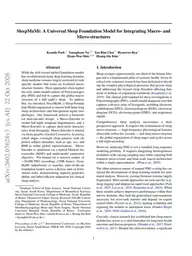
While the shift toward unified foundation models has revolutionized many deep learning domains, sleep medicine remains largely restricted to task-specific models that focus on localized micro-structure features. These approaches often neglect the rich, multi-modal context of Polysomnography (PSG) and fail to capture the global macro-structure of a full night's sleep. To address this, we introduce SleepMaMi , a Sleep Foundation Model engineered to master both hour-long sleep architectures and fine-grained signal morphologies. Our framework utilizes a hierarchical dual-encoder design: a Macro-Encoder to model full-night temporal dependencies and a Micro-Encoder to capture short-term characteristics from biosignals. Macro-Encoder is trained via Demographic-Guided Contrastive Learning, which aligns overnight sleep patterns with objective subject metadata, such as age, sex and BMI to refine global representations. Micro-Encoder is optimized via a hybrid Masked Autoencoder (MAE) and multi-modal contrastive objective. Pre-trained on a massive corpus of >20,000 PSG recordings (158K hours),SleepMaMi outperforms or matches state-of-the-art existing foundation models across a diverse suite of downstream tasks, demonstrating superior generalizability and label-efficient adaptation for clinical sleep analysis.
Verbatim from arXiv (opens in a new tab) · arXiv metadata (abstracts are released under CC0)
Results on ChatPPG leaderboards · 2
All leaderboards| Leaderboard | Method | Result | Rank |
|---|---|---|---|
| Cleveland Family Study (CFS) macro-F1Sleep staging | SleepMaMi | 71.2macro-F1, higher is better | #1 of 1 |
| SHHS, NSRR macro-F1Sleep staging | SleepMaMi | 74.1macro-F1, higher is better | #1 of 1 |
2 rows are credited to this paper. Ranks apply within each leaderboard only, as reported by the source.
Tasks & signals
Tasks
Signals
Keywords
Datasets
- Cleveland Family Study (CFS)NSRR family sleep-apnea PSG2,284 subjects · PPG · PSG
- MESA SleepNSRR polysomnography + wrist actigraphy (Multi-Ethnic Study of Atherosclerosis)2,237 subjects · PPG · ECG · IMU
- MrOS Sleep Study (Osteoporotic Fractures in Men, NSRR)ECG · SpO₂ · Resp
- Sleep Heart Health Study (SHHS, NSRR)ECG · SpO₂ · Resp
Models

How it works
Cite this paper
APA
Park, K., Na, Y., Choi, Y. R., Ryu, H., Shin, H.-W., & Kim, H.-S. (2026). SleepMaMi: A Universal Sleep Foundation Model for Integrating Macro- and Micro-structures. ICML 2026. https://arxiv.org/abs/2602.07628
BibTeX
@inproceedings{park2026sleepmami,
  title         = {{SleepMaMi: A Universal Sleep Foundation Model for Integrating Macro- and Micro-structures}},
  author        = {Park, Keondo and Na, Younghoon and Choi, You Rim and Ryu, Hyunwoo and Shin, Hyun-Woo and Kim, Hyung-Sin},
  year          = {2026},
  booktitle     = {ICML 2026},
  eprint        = {2602.07628},
  archivePrefix = {arXiv}
}
Built from the hub record. Check it against the publisher before submitting.
Added to the ChatPPG research hub