PaperarXiv:2408.15253
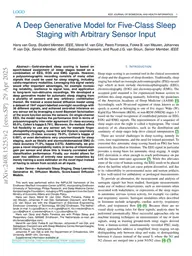
A Deep Generative Model for Five-Class Sleep Staging with Arbitrary Sensor Input
IEEE Journal of Biomedical and Health Informatics (arXiv eess.SP / cs.LG)
TL;DR
Score-based diffusion generative model for 5-class sleep staging from any arbitrary sensor combination (trained on 1947 overnight recordings, 36 signals) with Bayesian score factorization enabling zero-shot sensor sets. Finger PPG + nasal flow + thoracic effort reaches 5-class accuracy 79.0%, κ 0.697; single-channel EEG approaches inter-rater limit (85.6%, κ 0.791). Supports post-hoc addition of new modalities without full retraining.
- Form factor: finger
Abstract
Gold-standard sleep scoring is based on epoch-based assignment of sleep stages based on a combination of EEG, EOG and EMG signals. However, a polysomnographic recording consists of many other signals that could be used for sleep staging, including cardio-respiratory modalities. Leveraging this signal variety would offer important advantages, for example increasing reliability, resilience to signal loss, and application to long-term non-obtrusive recordings. We developed a deep generative model for automatic sleep staging from a plurality of sensors and any – arbitrary – combination thereof. We trained a score-based diffusion model using a dataset of 1947 expert-labelled overnight recordings with 36 different signals, and achieved zero-shot inference on any sensor set by leveraging a novel Bayesian factorization of the score function across the sensors. On single-channel EEG, the model reaches the performance limit in terms of polysomnography inter-rater agreement (5-class accuracy 85.6%, Cohen's kappa 0.791). Moreover, the method offers full flexibility to use any sensor set, for example finger photoplethysmography, nasal flow and thoracic respiratory movements, (5-class accuracy 79.0%, Cohen's kappa of 0.697), or even derivations very unconventional for sleep staging, such as tibialis and sternocleidomastoid EMG (5-class accuracy 71.0%, kappa 0.575). Additionally, we propose a novel interpretability metric in terms of information gain per sensor and show this is linearly correlated with classification performance. Finally, our model allows for post-hoc addition of entirely new sensor modalities by merely training a score estimator on the novel input instead of having to retrain from scratch on all inputs.
Verbatim from arXiv (opens in a new tab) · arXiv metadata (abstracts are released under CC0)
Results on ChatPPG leaderboards
All leaderboardsNo results from this paper on ChatPPG leaderboards yet. Browse the leaderboards.
Tasks & signals
Tasks
Signals
Keywords
How it works
Cite this paper
APA
van Gorp, H., van Gilst, M. M., Fonseca, P., van Meulen, F. B., van Dijk, J. P., Overeem, S., & van Sloun, R. J. G. (2025). A Deep Generative Model for Five-Class Sleep Staging with Arbitrary Sensor Input. IEEE Journal of Biomedical and Health Informatics. https://doi.org/10.1109/JBHI.2025.3565034
BibTeX
@article{gorp2025deep,
  title         = {{A Deep Generative Model for Five-Class Sleep Staging with Arbitrary Sensor Input}},
  author        = {van Gorp, Hans and van Gilst, Merel M. and Fonseca, Pedro and van Meulen, Fokke B. and van Dijk, Johannes P. and Overeem, Sebastiaan and van Sloun, Ruud J. G.},
  year          = {2025},
  journal       = {IEEE Journal of Biomedical and Health Informatics},
  doi           = {10.1109/JBHI.2025.3565034},
  eprint        = {2408.15253},
  archivePrefix = {arXiv}
}
Built from the hub record. Check it against the publisher before submitting.
Added to the ChatPPG research hub