PaperarXiv:2605.22759
SensorFM: Toward a General Intelligence and Interface for Wearable Health Data

arXiv preprint
TL;DR
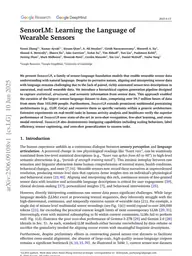
Google's SensorFM is a wearable health foundation model pretrained on more than one trillion minutes of unlabelled sensor data from five million participants. Scaling model size and data together steadily improved results across 35 health prediction tasks in cardiovascular, metabolic, sleep and mental health, lifestyle and demographics.
- Pretraining: 1 trillion+ minutes of sensor data
- Evaluation: 35 health prediction tasks
Abstract
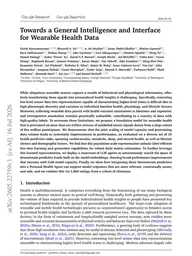
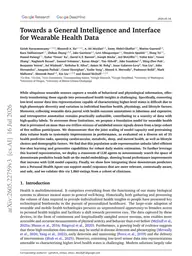
While ubiquitous wearable sensors capture a wealth of behavioral and physiological information, effectively transforming these signals into personalized health insights is challenging. Specifically, converting low-level sensor data into representations capable of characterizing higher-level states is difficult due to high phenotypic diversity and variation in individual baseline health, physiology, and lifestyle factors. Moreover, collecting wearable data paired with health outcome annotations is laborious and expensive, and retrospective annotation remains practically unfeasible, contributing to a scarcity of data with high-quality labels. To overcome these limitations, we propose a foundation model for wearable health that is pretrained on more than one trillion minutes of unlabeled sensor signals drawn from a large cohort of five million participants. We demonstrate that the joint scaling of model capacity and pretraining data volume leads to systematic improvements in performance, as evaluated on a diverse set of 35 health prediction tasks, spanning cardiovascular, metabolic, sleep, and mental health, as well as lifestyle choices and demographic factors. We find that this population scale representation unlocks label-efficient few-shot learning and generative capabilities for robust daily metric estimation. To further leverage this learned representation, we deploy a classroom of LLM agents to autonomously search the space of downstream predictive heads built on the model embeddings, showing broad performance improvements that increase with LLM model capacity. Finally, we show how integrating these downstream predictors into a Personal Health Agent can support model responses that are more relevant, contextually aware, and safe, and we validate this via 1,860 ratings from a cohort of clinicians.
Verbatim from arXiv (opens in a new tab) · arXiv metadata (abstracts are released under CC0)
Results on ChatPPG leaderboards
All leaderboardsNo results from this paper on ChatPPG leaderboards yet. Browse the leaderboards.
Tasks & signals
Keywords
Models
How it works
- Cohort
- 5 million participants
Cite this paper
Narayanswamy, G., Xu, M. A., Heydari, A. A., Abdel-Ghaffar, S., Guerard, M., Vaillancourt, K., Zhang, Z., Garrison, J., Albuquerque, L., Spathis, D., Yu, H., Palangi, H., et al. (2026). SensorFM: Toward a General Intelligence and Interface for Wearable Health Data. arXiv preprint. https://arxiv.org/abs/2605.22759
Narayanswamy, Girish, Maxwell A. Xu, A. Ali Heydari, Samy Abdel-Ghaffar, Marius Guerard, Kara Vaillancourt, and Zhihan Zhang, et al. 2026. "SensorFM: Toward a General Intelligence and Interface for Wearable Health Data." arXiv preprint. https://arxiv.org/abs/2605.22759.
Narayanswamy, G., Xu, M. A., Heydari, A. A., Abdel-Ghaffar, S., Guerard, M., Vaillancourt, K. and Zhang, Z. et al. (2026) 'SensorFM: Toward a General Intelligence and Interface for Wearable Health Data', arXiv preprint. Available at: https://arxiv.org/abs/2605.22759
Narayanswamy, Girish, et al. "SensorFM: Toward a General Intelligence and Interface for Wearable Health Data." arXiv preprint, 2026. https://arxiv.org/abs/2605.22759.
G. Narayanswamy et al., "SensorFM: Toward a General Intelligence and Interface for Wearable Health Data," arXiv preprint, 2026, [Online]. Available: https://arxiv.org/abs/2605.22759.
@misc{narayanswamy2026sensorfm,
  title         = {{SensorFM: Toward a General Intelligence and Interface for Wearable Health Data}},
  author        = {Narayanswamy, Girish and Xu, Maxwell A. and Heydari, A. Ali and Abdel-Ghaffar, Samy and Guerard, Marius and Vaillancourt, Kara and Zhang, Zhihan and Garrison, Jake and Albuquerque, Levi and Spathis, Dimitris and Yu, Hong and Palangi, Hamid and others},
  year          = {2026},
  howpublished  = {arXiv preprint},
  eprint        = {2605.22759},
  archivePrefix = {arXiv}
}