PaperarXiv:2410.13638
Scaling Wearable Foundation Models (LSM)



ICLR 2025
TL;DR
LSM (Large Sensor Model) is a Google study of how wearable foundation models scale with compute, data and model size. It used up to 40 million hours of per-minute heart rate, HRV, electrodermal activity, accelerometer, skin temperature and altimeter data from more than 165,000 people. The authors report scaling laws for imputation, interpolation and extrapolation, and show sample-efficient learning for exercise and activity recognition.
- Data: up to 40 million hours, 165,000+ people
- Tasks: imputation, interpolation, extrapolation, activity recognition
Abstract
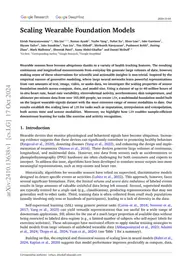
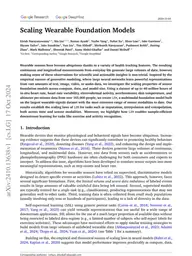
Wearable sensors have become ubiquitous thanks to a variety of health tracking features. The resulting continuous and longitudinal measurements from everyday life generate large volumes of data; however, making sense of these observations for scientific and actionable insights is non-trivial. Inspired by the empirical success of generative modeling, where large neural networks learn powerful representations from vast amounts of text, image, video, or audio data, we investigate the scaling properties of sensor foundation models across compute, data, and model size. Using a dataset of up to 40 million hours of in-situ heart rate, heart rate variability, electrodermal activity, accelerometer, skin temperature, and altimeter per-minute data from over 165,000 people, we create LSM, a multimodal foundation model built on the largest wearable-signals dataset with the most extensive range of sensor modalities to date. Our results establish the scaling laws of LSM for tasks such as imputation, interpolation and extrapolation, both across time and sensor modalities. Moreover, we highlight how LSM enables sample-efficient downstream learning for tasks like exercise and activity recognition.
Verbatim from arXiv (opens in a new tab) · arXiv metadata (abstracts are released under CC0)
Results on ChatPPG leaderboards
All leaderboardsNo results from this paper on ChatPPG leaderboards yet. Browse the leaderboards.
Tasks & signals
Signals
Keywords
Models
How it works
Cite this paper
Scaling Wearable Foundation Models (LSM). (2024). ICLR 2025. https://arxiv.org/abs/2410.13638
@inproceedings{lsmscalingwearab2024scaling,
  title         = {{Scaling Wearable Foundation Models (LSM)}},
  year          = {2024},
  booktitle     = {ICLR 2025},
  eprint        = {2410.13638},
  archivePrefix = {arXiv}
}