PaperarXiv:2611.32548
SetCon: Setup-Conditioned IMU-Language Learning from 3D Human Motion
arXiv preprint (cs.CV), 2026-11-24
TL;DR
IMU-language models usually make the encoder fully invariant to how a device is mounted. That also throws away the device's orientation relative to the body (for example the gravity direction that separates sitting, standing and lying). SetCon uses selective invariance instead: from a few unlabeled windows it estimates each device's mounting on its known body site, then conditions the encoder on that estimate.
- Form factor: multi-site IMU (wrist, other body sites)
Abstract
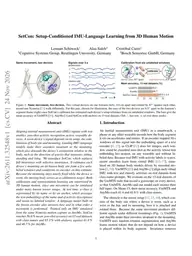
Aligning inertial measurement unit (IMU) signals with text enables zero-shot activity recognition across wearable devices. A worn device's signal depends on its setup, the combination of body site and mounting. Leading IMU-language models make their encoders invariant to the mounting, which also discards the device's orientation relative to the body, such as the direction of gravity that separates sitting, standing and lying. We introduce SetCon, which replaces full invariance with selective invariance. It estimates each device's mounting on its known body site from a few unlabeled windows and conditions its encoder on this estimate. Because the mounting stays nearly fixed while the device is worn, the moving body serves as a calibration target. Both calibration and representation learning are supervised by 3D human motion, since one movement can be simulated under many known sensor setups. At test time, a class is represented by its name or by an anchor, which averages the text embeddings of the name and of activity descriptions and needs no labeled window. A language model built on the frozen encoder also answers how and in what order a movement is performed. Trained only on IMU simulated from the same Nymeria motion capture as AnyMo, SetCon reaches 56.6% mean zero-shot accuracy on 13 real datasets with class names and 65.3% with anchors, against 41.8% and 46.7% for AnyMo.
Verbatim from arXiv (opens in a new tab) · arXiv metadata (abstracts are released under CC0)
Results on ChatPPG leaderboards
All leaderboardsNo results from this paper on ChatPPG leaderboards yet. Browse the leaderboards.
Tasks & signals
Tasks
Signals
Keywords
Datasets used

How it works
Cite this paper
Schiweck, L., Saleh, A., & Curio, C. (2026). SetCon: Setup-Conditioned IMU-Language Learning from 3D Human Motion. arXiv preprint. https://arxiv.org/abs/2611.32548
Schiweck, Lennart, Alaa Saleh, and Cristóbal Curio. 2026. "SetCon: Setup-Conditioned IMU-Language Learning from 3D Human Motion." arXiv preprint. https://arxiv.org/abs/2611.32548.
Schiweck, L., Saleh, A. and Curio, C. (2026) 'SetCon: Setup-Conditioned IMU-Language Learning from 3D Human Motion', arXiv preprint. Available at: https://arxiv.org/abs/2611.32548
Schiweck, Lennart, et al. "SetCon: Setup-Conditioned IMU-Language Learning from 3D Human Motion." arXiv preprint, 2026. https://arxiv.org/abs/2611.32548.
L. Schiweck, A. Saleh, and C. Curio, "SetCon: Setup-Conditioned IMU-Language Learning from 3D Human Motion," arXiv preprint, 2026, [Online]. Available: https://arxiv.org/abs/2611.32548.
@misc{schiweck2026setcon,
  title         = {{SetCon: Setup-Conditioned IMU-Language Learning from 3D Human Motion}},
  author        = {Schiweck, Lennart and Saleh, Alaa and Curio, Cristóbal},
  year          = {2026},
  howpublished  = {arXiv preprint},
  eprint        = {2611.32548},
  archivePrefix = {arXiv}
}Added to the ChatPPG research hub