Paper
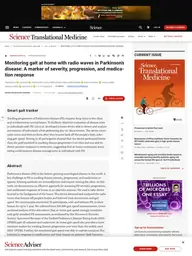
Monitoring Gait at Home with Radio Waves in Parkinson's Disease: a Marker of Severity, Progression, and Medication Response
Science Translational Medicine 2022
TL;DR
This Science Translational Medicine study tracked gait speed at home with a radio device that senses radio waves reflected off people's bodies. Fifty people with and without Parkinson's disease were monitored for up to a year, giving more than 200,000 gait speed measurements. Home gait speed correlated strongly with MDS-UPDRS scores, tracked progression more sensitively than the rating scale and captured responses to medication.
- Sensing: in-home radio waves (contactless)
- Data: 200,000+ gait speed measurements
- Result: gait speed correlates with MDS-UPDRS part III and total
Abstract
Parkinson’s disease (PD) is the fastest-growing neurological disease in the world. A key challenge in PD is tracking disease severity, progression, and medication response. Existing methods are semisubjective and require visiting the clinic. In this work, we demonstrate an effective approach for assessing PD severity, progression, and medication response at home, in an objective manner. We used a radio device located in the background of the home. The device detected and analyzed the radio waves that bounce off people’s bodies and inferred their movements and gait speed. We continuously monitored 50 participants, with and without PD, in their homes for up to 1 year. We collected over 200,000 gait speed measurements. Cross-sectional analysis of the data shows that at-home gait speed strongly correlates with gold-standard PD assessments, as evaluated by the Movement Disorder Society-Sponsored Revision of the Unified Parkinson’s Disease Rating Scale (MDS-UPDRS) part III subscore and total score. At-home gait speed also provides a more sensitive marker for tracking disease progression over time than the widely used MDS-UPDRS. Further, the monitored gait speed was able to capture symptom fluctuations in response to medications and their impact on patients’ daily functioning. Our study shows the feasibility of continuous, objective, sensitive, and passive assessment of PD at home and hence has the potential of improving clinical care and drug clinical trials.
Verbatim from the publisher's DOI record (opens in a new tab) · Abstract as deposited by the publisher with Crossref; © the authors/publisher
Results on ChatPPG leaderboards
All leaderboardsNo results from this paper on ChatPPG leaderboards yet. Browse the leaderboards.
Tasks & signals
Tasks
Signals
Keywords
How it works
- Cohort
- 50 participants, up to 1 year
Cite this paper
Monitoring Gait at Home with Radio Waves in Parkinson's Disease: a Marker of Severity, Progression, and Medication Response. (2022). Science Translational Medicine 2022. https://www.science.org/doi/10.1126/scitranslmed.adc9669
@article{rfgaitparkinsons2022monitoring,
  title         = {{Monitoring Gait at Home with Radio Waves in Parkinson's Disease: a Marker of Severity, Progression, and Medication Response}},
  year          = {2022},
  journal       = {Science Translational Medicine 2022},
  url           = {https://www.science.org/doi/10.1126/scitranslmed.adc9669}
}