P2E-VQ: ECG-linked representation augmentation for PPG via discrete patch retrieval
Activity counts measure attention, not model quality. Missing counts are unknown. Publication status follows the linked source; a listed venue alone does not confirm peer review.
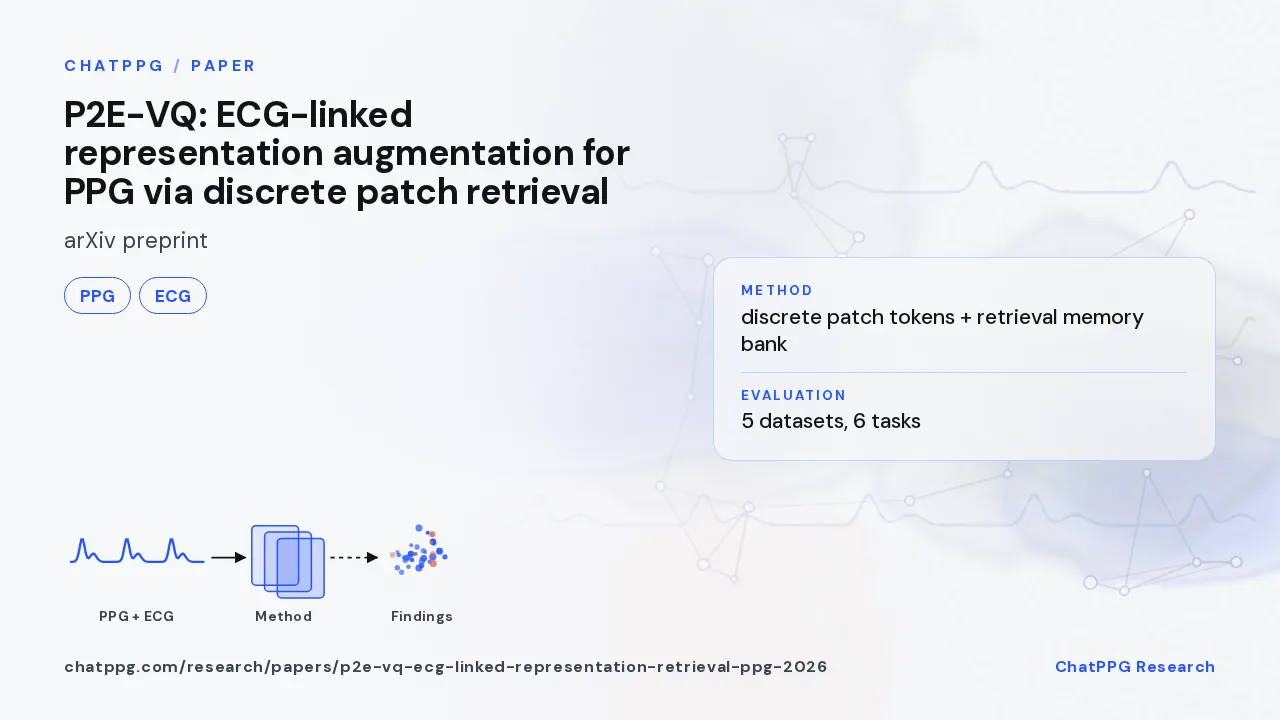
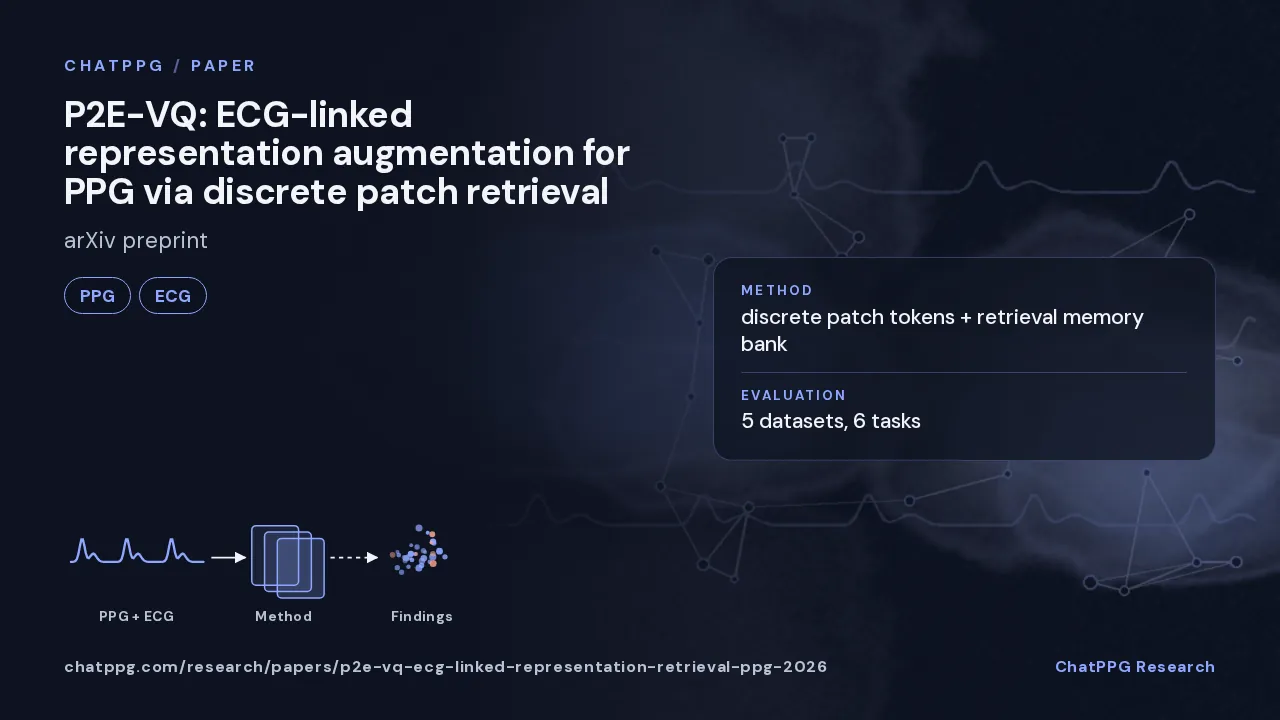
P2E-VQ helps PPG models pick up cardiac information that normally needs ECG. It turns PPG patches into discrete tokens and retrieves ECG-linked information from a memory bank built from training data, instead of reconstructing ECG waveforms. Across five datasets and six tasks it beat pretrained baselines under frozen linear probing.
- Signals: PPG (ECG-linked retrieval)
- Evaluation: 5 datasets, 6 tasks
- Venue
- arXiv preprint
- Published
- 2026
- DOI
- Not reported
- PMID
- Not reported
- Licence
- Not reported
- Form factor
- Not reported
- Subjects
- Not reported
- Code
- Not reported
- Added
- Oct 11, 2026
Abstract
Photoplethysmography (PPG) is widely used in consumer wearables because of its low cost and ease of acquisition. However, unlike electrocardiography (ECG), PPG measures peripheral pulse dynamics rather than cardiac electrical activity, limiting its ability to predict cardiac conditions that rely on ECG-specific morphological cues. Existing methods attempt to bridge this gap by reconstructing ECG signals from PPG signals. However, this inverse mapping is inherently ill-posed, and faithful waveform reconstruction does not necessarily translate into improved downstream performance. To address this challenge, we propose P2E-VQ, a retrieval-augmented framework that replaces ECG waveform reconstruction with ECG-linked representation retrieval. Specifically, P2E-VQ converts PPG patches into discrete tokens and retrieves ECG-linked information from a memory bank constructed exclusively from the training data. This process augments PPG representations while requiring only PPG signals during inference. Extensive experiments on five public datasets covering six downstream tasks, including clinical endpoint prediction and affective state recognition, demonstrate that P2E-VQ consistently outperforms pretrained baselines under a unified frozen-feature linear-probing protocol.
Verbatim fromarXiv· arXiv metadata (abstracts are released under CC0)
How it works
- Method
- discrete patch tokens + retrieval memory bank
Cite
@article{p2evqecglinkedrepresenta2026,
  title = {{P2E-VQ: ECG-linked representation augmentation for PPG via discrete patch retrieval}},
  author = {Zhongli Wu and Zhuangzhi Gao and He Zhao and Feixiang Zhou and Fu Wang and Jinru Ding and Yuankai Wang and Hongyi Qin and Gregory Y. H. Lip and Bil Kirmani and Yalin Zheng},
  year = {2026},
  journal = {arXiv preprint},
  eprint = {2608.14656}
}History
Added to the ChatPPG research hub
More on ChatPPG
- LIMA-Mamba: A lightweight and distribution-robust Mamba network for PPG-based biometrics
From the title only, it is a Mamba (selective state-space) network for PPG-based biometric recogniti
- A Comparative Study of Signal Representations Methods and Deep Learning Architectures for PPG-Based Cuffless Blood Pressure Estimation
Seven 1D→2D transforms × several CNN variants on the UCI BP database. Best: CWT, errors reported as
- A meta-learning method with reduced data requirements for training and updating deep learning models on wearable devices
This paper proposes a meta-learning method that cuts how much labelled data a new wearable needs bef