PaperarXiv:2602.03886
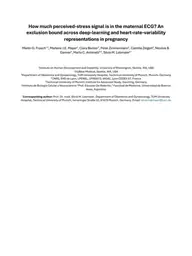
How much perceived-stress signal is in the maternal ECG? Exclusion bound across 21 SSL / foundation-model / HRV architectures (FELICITy, n=144; best AUC 0.604)
arXiv v4 (submitted to Scientific Reports); v1 2026-02-03
 (opens in a new tab)
Frasch, Martin G. et al., "How much perceived-stress signal is in the maternal ECG? An exclusion bound across deep-learning and heart-rate-variability representations in pregnancy", arXiv:2602.03886, CC BY-NC-ND 4.0
TL;DR
Preprint (v4, submitted to Scientific Reports) from TU Munich and collaborators testing whether a single maternal ECG recording carries perceived-stress information. In 144 pregnant women, with every split over participants, 94 analysis arms spanning 21 self-supervised, foundation-model (incl. ECGFounder and a transformer pretrained on 1.4 M ECGs) and HRV architectures, the best AUC for moderate-to-high stress (PSS-10 ≥ 19) was 0.604 (95% CI 0.511–0.696), and AUC ≥ 0.70 was rejected in all eleven arms tested.
Abstract
Deep learning can read physiological states from the electrocardiogram (ECG), prompting attempts to detect psychological stress. We asked how much information about perceived stress the maternal ECG carries. In 144 pregnant women, with every cross-validation split taken over participants, across 94 arms spanning 21 self-supervised, foundation-model, and heart-rate-variability architectures, the best discrimination of moderate-to-high stress (PSS-10 >= 19) was AUC 0.604 (95% CI 0.511-0.696), and AUC >= 0.70 was rejected in all eleven arms tested. Three pre-registered tests in a second cohort from the same center, recorded on different hardware, were null, at 30% power. Which of the three simultaneously recorded ECG channels was analyzed accounted for 96% of the predicted score's variance, against 4% between women; across 20 combinations of channel rule, label variant, and visit, the external correlation with perceived stress ranged from r = -0.095 to r = +0.307, a spread no larger than such a search produces by chance (raw one-sided p of the maximum 0.011; calibrated max-statistic p = 0.583). Hair cortisol was not predicted either. In the second cohort, PSS-10 scores were not stable across administrations spanning pregnancy and the postpartum period (ICC 0.06-0.16), so one administration is a weak measure of a woman's stress level at another visit. A single-recording ECG screener for perceived stress is excluded in this population, and multi-channel studies must pre-register their channel rule.
Verbatim from arXiv (opens in a new tab) · arXiv metadata (abstracts are released under CC0)
Results on ChatPPG leaderboards
All leaderboardsNo results from this paper on ChatPPG leaderboards yet. Browse the leaderboards.
Tasks & signals
Tasks
Signals
Keywords
How it works
Cite this paper
Frasch, M. G., Mayer, M. J. E., Becker, C., Zimmermann, P., Zelgert, C., Garnier, N. B., Antonelli, M. C., & Lobmaier, S. M. (2026). How much perceived-stress signal is in the maternal ECG? Exclusion bound across 21 SSL / foundation-model / HRV architectures (FELICITy, n=144; best AUC 0.604). arXiv v4. https://arxiv.org/abs/2602.03886
Frasch, Martin G., Marlene J. E. Mayer, Clara Becker, Peter Zimmermann, Camilla Zelgert, Nicolas B. Garnier, Marta C. Antonelli, and Silvia M. Lobmaier. 2026. "How much perceived-stress signal is in the maternal ECG? Exclusion bound across 21 SSL / foundation-model / HRV architectures (FELICITy, n=144; best AUC 0.604)." arXiv v4. https://arxiv.org/abs/2602.03886.
Frasch, M. G., Mayer, M. J. E., Becker, C., Zimmermann, P., Zelgert, C., Garnier, N. B., Antonelli, M. C. and Lobmaier, S. M. (2026) 'How much perceived-stress signal is in the maternal ECG? Exclusion bound across 21 SSL / foundation-model / HRV architectures (FELICITy, n=144; best AUC 0.604)', arXiv v4. Available at: https://arxiv.org/abs/2602.03886
Frasch, Martin G., et al. "How much perceived-stress signal is in the maternal ECG? Exclusion bound across 21 SSL / foundation-model / HRV architectures (FELICITy, n=144; best AUC 0.604)." arXiv v4, 2026. https://arxiv.org/abs/2602.03886.
M. G. Frasch et al., "How much perceived-stress signal is in the maternal ECG? Exclusion bound across 21 SSL / foundation-model / HRV architectures (FELICITy, n=144; best AUC 0.604)," arXiv v4, 2026, [Online]. Available: https://arxiv.org/abs/2602.03886.
@misc{frasch2026much,
  title         = {{How much perceived-stress signal is in the maternal ECG? Exclusion bound across 21 SSL / foundation-model / HRV architectures (FELICITy, n=144; best AUC 0.604)}},
  author        = {Frasch, Martin G. and Mayer, Marlene J. E. and Becker, Clara and Zimmermann, Peter and Zelgert, Camilla and Garnier, Nicolas B. and Antonelli, Marta C. and Lobmaier, Silvia M.},
  year          = {2026},
  howpublished  = {arXiv v4},
  eprint        = {2602.03886},
  archivePrefix = {arXiv}
}Added to the ChatPPG research hub