PaperarXiv:2508.11682
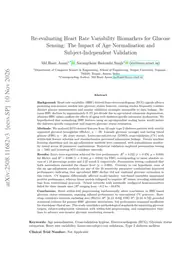
Re-evaluating Heart Rate Variability Biomarkers for Glucose Sensing: The Impact of Age Normalisation and Subject-Independent Validation
BMC Medical Informatics and Decision Making 26, 166 (2026); arXiv 2508.11682v3
 (opens in a new tab)
Azam, Md Basit et al., "Re-evaluating Heart Rate Variability Biomarkers for Glucose Sensing: The Impact of Age Normalisation and Subject-Independent Validation", arXiv:2508.11682, CC BY 4.0
TL;DR
A leakage-free re-test of HRV-to-glucose estimation in 43 men with type 2 diabetes. Under leave-one-subject-out with within-fold feature selection, the best model explains 22% of HbA1c and 9% of fasting-glucose variance. Age normalisation of HRV gave no gain in any of 6 methods or 20 settings.
Abstract
Heart rate variability (HRV) from electrocardiogram (ECG) signals may indicate glycemic status, but prior studies often combine distinct glucose targets and use validation strategies vulnerable to data leakage. Since HRV declines with age, aging may be confounded with diabetes-related autonomic dysfunction. We tested whether age-dependent HRV normalisation improves glycemic estimation. We analysed ECG features from 43 male patients with type 2 diabetes. Outcomes were glycated hemoglobin (HbA1c; n=29) and fasting blood glucose (FBG; n=38). We used leave-one-subject-out cross-validation, with feature selection and standardisation within each training fold. We compared 20 machine-learning algorithms, six age-adjustment methods, and 20 normalisation parameter combinations. Validation included 500 permutations and bootstrap confidence intervals. Extra Trees regression performed best: R2=0.222 (r=0.476, p=0.009) for HbA1c and R2=0.086 (r=0.344, p=0.034) for FBG. Mean absolute errors were 1.18 percentage points and 2.27 mmol/L, respectively. Permutation testing supported both associations (p=0.002). Contrary to our hypothesis, no age-adjustment method or parameter combination improved performance. Tree ensembles retained positive performance under strict validation, whereas linear models had negative R2 values; neural networks performed poorly. Strict within-fold preprocessing materially changed model performance and revealed potential inflation from conventional validation. Bootstrap 95% confidence intervals were [0.13, 0.82] for HbA1c R2 and [0.10, 0.72] for FBG R2. Although findings support HRV-glycemic associations, performance remains insufficient for standalone clinical use. The study highlights the importance of separating glycemic targets, subject-independent validation, within-fold preprocessing, and comprehensive baselines in non-invasive glycemic monitoring research.
Verbatim from arXiv (opens in a new tab) · arXiv metadata (abstracts are released under CC0)
Results on ChatPPG leaderboards
All leaderboardsNo results from this paper on ChatPPG leaderboards yet. Browse the leaderboards.
Tasks & signals
Tasks
Signals
Keywords
How it works
Cite this paper
Azam, M. B., & Singh, S. I. (2026). Re-evaluating Heart Rate Variability Biomarkers for Glucose Sensing: The Impact of Age Normalisation and Subject-Independent Validation. BMC Medical Informatics and Decision Making 26, 166. https://doi.org/10.1186/s12911-026-03455-8
Azam, Md Basit and Sarangthem Ibotombi Singh. 2026. "Re-evaluating Heart Rate Variability Biomarkers for Glucose Sensing: The Impact of Age Normalisation and Subject-Independent Validation." BMC Medical Informatics and Decision Making 26, 166. https://doi.org/10.1186/s12911-026-03455-8.
Azam, M. B. and Singh, S. I. (2026) 'Re-evaluating Heart Rate Variability Biomarkers for Glucose Sensing: The Impact of Age Normalisation and Subject-Independent Validation', BMC Medical Informatics and Decision Making 26, 166. doi: 10.1186/s12911-026-03455-8.
Azam, Md Basit, and Sarangthem Ibotombi Singh "Re-evaluating Heart Rate Variability Biomarkers for Glucose Sensing: The Impact of Age Normalisation and Subject-Independent Validation." BMC Medical Informatics and Decision Making 26, 166, 2026. https://doi.org/10.1186/s12911-026-03455-8.
M. B. Azam and S. I. Singh, "Re-evaluating Heart Rate Variability Biomarkers for Glucose Sensing: The Impact of Age Normalisation and Subject-Independent Validation," BMC Medical Informatics and Decision Making 26, 166, 2026, doi: 10.1186/s12911-026-03455-8.
@article{azam2026reevaluating,
  title         = {{Re-evaluating Heart Rate Variability Biomarkers for Glucose Sensing: The Impact of Age Normalisation and Subject-Independent Validation}},
  author        = {Azam, Md Basit and Singh, Sarangthem Ibotombi},
  year          = {2026},
  journal       = {BMC Medical Informatics and Decision Making 26, 166},
  doi           = {10.1186/s12911-026-03455-8},
  eprint        = {2508.11682},
  archivePrefix = {arXiv}
}Added to the ChatPPG research hub