PreprintCatalog paper date: Nov 19, 2026Added to atlas: Nov 20, 2026Source
Activity counts measure attention, not model quality. Missing counts are unknown. Publication status follows the linked source; a listed venue alone does not confirm peer review.
Class-conditional generators that synthesise HAR training data in the embedding space of the frozen Bio-PM encoder rather than as raw signals. TSTR macro-F1 0.68 (diffusion); synthetic-token augmentation lifts WISDM LOSO macro-F1 0.729 → 0.809 (51 subjects). Paper: the Bio-PM-Guided Synthetic IMU Generation paper. Base model: bio-pm.
Signals
IMU
License
none released
Year
2026
Architecture
Frozen Bio-PM encoder tokenises 10-s IMU windows; class-conditional autoregressive transformer or diffusion decoder generates token sequences; PatchDecoder approximately reconstructs raw waveforms (abstract)
Pretraining data
uses frozen Bio-PM; decoders trained on WISDM (51 subjects)
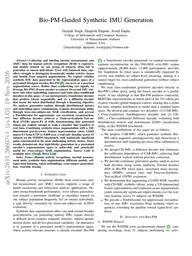
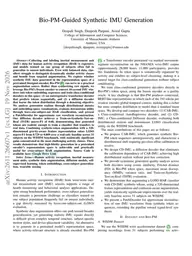
Collecting and labeling inertial measurement unit (IMU) data for human activity recognition (HAR) is expensive, and models trained on one group of subjects often fail to generalize to unseen individuals. Even with balanced data, classifiers struggle to distinguish dynamically similar activity classes and benefit from targeted augmentation. We explore whether synthetic IMU data generated in the representation space of a pretrained biosignal encoder, Bio-PM b1, can serve as a practical augmentation source. Rather than synthesizing raw signals, we leverage Bio-PM's frozen encoder to convert 10-second IMU windows into token embedding sequences and train class-conditional decoders in this space: (1) an autoregressive transformer decoder that predicts tokens sequentially, and (2) a diffusion decoder that learns the token distribution through a denoising objective. We analyze generation realism through distributional metrics and embedding-space visualizations, evaluate downstream utility through leave-one-subject-out HAR classification, and present a PatchDecoder for approximate raw waveform reconstruction. Our diffusion decoder achieves a Train-on-Synthetic-Test-on-Real (TSTR) macro-F1 of 0.68, demonstrating that generated tokens are realistic enough to train a classifier that transfers to real data. Combining synthetic-token augmentation with a 320-dimensional gravity-aware feature representation raises LOSO macro-F1 from 0.729 to 0.809 over a real-only baseline across 51 subjects on the WISDM benchmark, with statistically significant gains concentrated in the most challenging activity classes. These results demonstrate that high-fidelity generation in a pretrained encoder's representation space is achievable and practically useful for cross-subject HAR augmentation.
Verbatim fromarXiv· arXiv metadata (abstracts are released under CC0)
D. Singh, D. Parpani, and A. Gupta, "Bio-PM-Guided Synthetic IMU Generation," arXiv preprint, 2026, [Online]. Available: https://arxiv.org/abs/2611.26607.
@misc{singh2026biopmguided,
  title         = {{Bio-PM-Guided Synthetic IMU Generation}},
  author        = {Singh, Deepali and Parpani, Deepesh and Gupta, Aviral},
  year          = {2026},
  howpublished  = {arXiv preprint},
  eprint        = {2611.26607},
  archivePrefix = {arXiv}
}
History
Added to the ChatPPG research hub
Newsletter
Get new PPG datasets, papers and models
Get alerts when Bio-PM token-space synthetic IMU generator (AR + diffusion decoders) is benchmarked on new datasets, plus the weekly digest.
New datasets, papers and models
Practical guides from the hub
Unsubscribe anytime
The waveform is an illustration of a PPG pulse, not a recording.