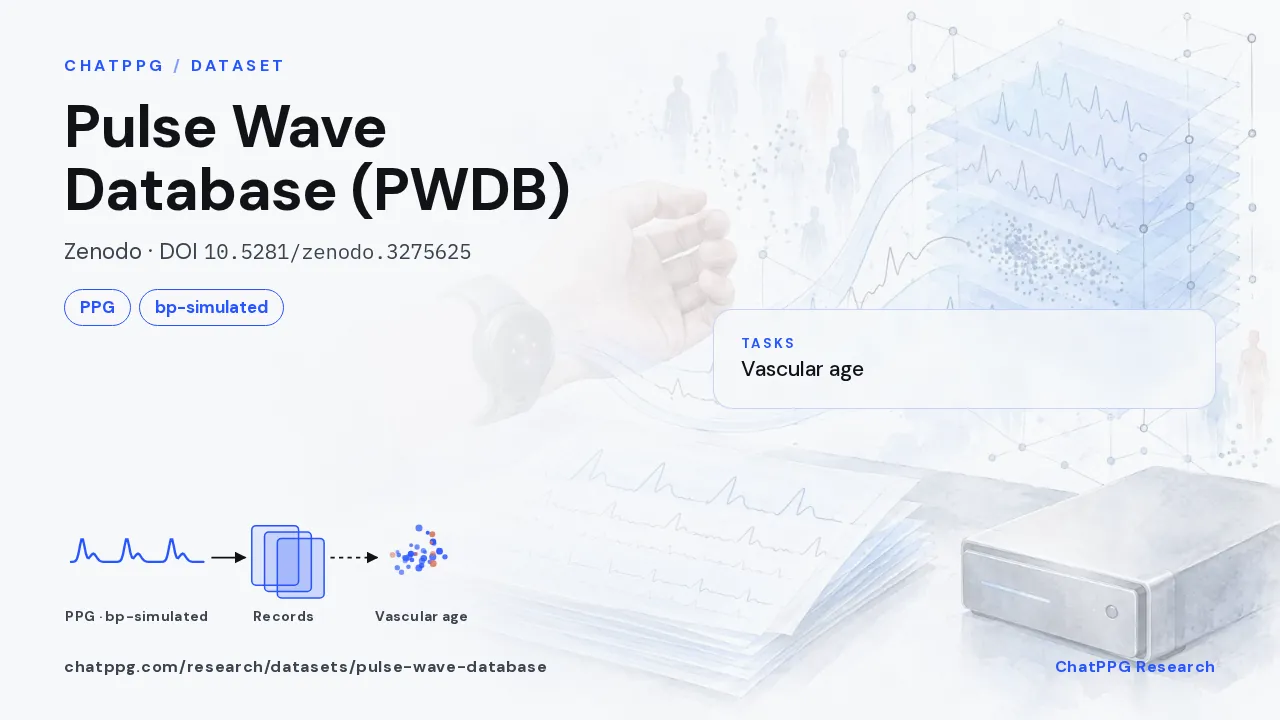
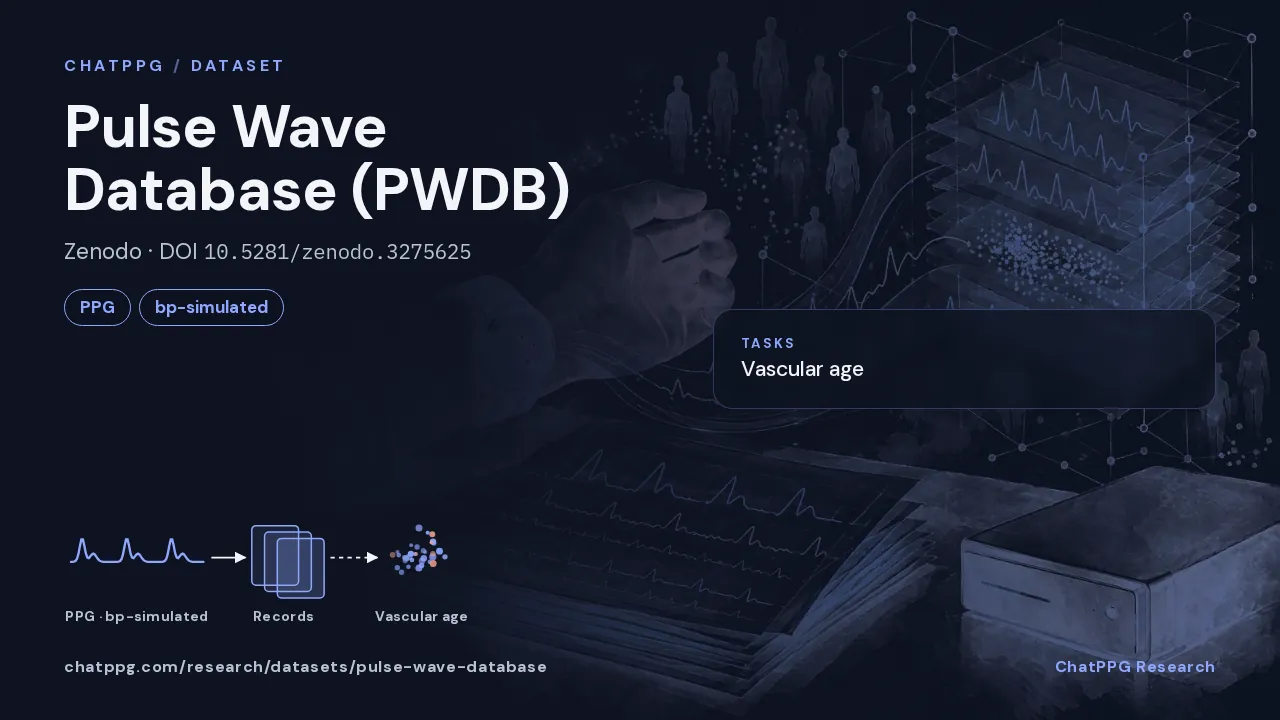
The Pulse Wave Database (PWDB) is a database of simulated arterial pulse waves representative of healthy adults. It was created by Peter H Charlton, Jorge Mariscal Harana, Samuel Vennin, Ye Li, Phil Chowienczyk and Jordi Alastruey and described in "Modeling arterial pulse waves in healthy aging: a database for in silico evaluation of hemodynamics and pulse wave indexes" in the American Journal of Physiology-Heart and Circulatory Physiology 317(5):H1062-H1085 (2019).
Pulse waves are measured by both consumer and clinical devices, but the physical factors that shape them are not fully understood. Developing pulse wave analysis algorithms is also held back by a shortage of datasets with reference cardiovascular measurements. PWDB takes a computational route. The authors reviewed the literature to find typical cardiovascular properties of 25 to 75 year olds, then fed those into a computational model to simulate pulse waves for each age decade.
The database has pulse waves for 4,374 virtual subjects aged 25 to 75 in 10-year steps. Each of the six age groups has a baseline set created from properties typical of healthy subjects at that age, plus 728 further virtual subjects in which properties such as heart rate and arterial stiffness are varied within normal ranges. Four kinds of wave are provided: arterial flow velocity, luminal area, pressure and photoplethysmogram (PPG). They are given at sites including the ascending and descending aorta, carotid, brachial, radial and femoral arteries and the finger.
The simulated waves and derived indexes were checked against in vivo data and agreed well, reproducing age-related changes in haemodynamic parameters and wave shape. The big advantage over clinical data is that the exact cardiovascular properties behind every wave are known. That makes PWDB useful for testing pulse wave analysis algorithms, studying what drives PPG morphology, and pilot work before clinical studies.
Data come in Matlab, CSV and WFDB formats, with a usage guide on the project's GitHub wiki. The Zenodo record (version 0.2.0) totals 44,297,474,196 bytes because of large files with full aortic paths, but the core pulse wave archives are much smaller. It is open access under the Open Data Commons Public Domain Dedication and License (PDDL).
Virtual subjects
4,374, ages 25 to 75 in 10-year increments
Waves
flow velocity, luminal area, pressure, PPG
Sites
aorta, carotid, brachial, radial, femoral, finger
Size
44,297,474,196 bytes on Zenodo; license ODC-PDDL
Paper
Charlton et al., Am J Physiol Heart Circ Physiol 317(5):H1062-H1085 (2019), doi 10.1152/ajpheart.00218.2019
728 further virtual subjects per age group with varied properties
This database of simulated arterial pulse waves is designed to be representative of a sample of pulse waves measured from healthy adults. It contains pulse waves for 4,374 virtual subjects, aged from 25-75 years old (in 10 year increments). The database contains a baseline set of pulse waves for each of the six age groups, created using cardiovascular properties (such as heart rate and arterial stiffness) which are representative of healthy subjects at each age group. It also contains 728 further virtual subjects at each age group, in which each of the cardiovascular properties are varied within normal ranges. This allows for extensive in silico analyses of haemodynamics and the performance of pulse wave analysis algorithms.
Data Description
The database contains the following waves:
arterial flow velocity (U), luminal area (A), pressure (P), and photoplethysmogram (PPG).
These pulse waves are provided at a range of measurement sites, including:
The data are available in three formats: Matlab, CSV and WaveForm Database (WFDB) format. Further details of the formatting and contents of each file are available at: https://github.com/peterhcharlton/pwdb/wiki/Using-the-Pulse-Wave-Database
Accompanying Publication
The database is described in the following publication:
Charlton P.H., Mariscal Harana, J., Vennin, S., Li, Y., Chowienczyk, P. & Alastruey, J., “Modelling arterial pulse waves in healthy ageing: a database for in silico evaluation of haemodynamics and pulse wave indices,” [under review]
Please cite this publication when using the database.
Further Information
Further information on the Pulse Wave Database project can be found at: https://peterhcharlton.github.io/pwdb/
Version History
Version 0.1.0 : provided for peer review of "Modelling arterial pulse waves in healthy ageing: a database for in silico evaluation of haemodynamics and pulse wave indices"
Version 0.2.0 : provided for peer review of "Modelling arterial pulse waves in healthy ageing: a database for in silico evaluation of haemodynamics and pulse wave indices"
The Pulse Wave Database (Charlton et al., Am J Physiol Heart Circ Physiol 2019) contains simulated arterial pulse waves for 4,374 virtual subjects aged 25 to 75, in 10-year steps. Each age group has a baseline subject with typical healthy cardiovascular properties and 728 further subjects in which properties like heart rate and arterial stiffness vary within normal ranges. Waves include pressure, flow velocity, luminal area and PPG at sites from the aorta to the finger.
What's inside
Subjects
4,374 virtual (in silico) adults, 6 age groups 25–75
Waves
Pressure (P), flow velocity (U), luminal area (A), PPG
Sites
Ascending and descending aorta, carotid, brachial, radial, finger, femoral
Parameters
Haemodynamic parameters, pulse wave indices, onset times, model configurations (CSV)
Formats
MATLAB, CSV (PWs_csv.zip, 243 MB) and WFDB (PWs_wfdb.zip, 185 MB)
4,374 virtual subjects (in silico; ages 25–75 in 10-year bands)
Subjects
2
Reference labels
BP, VASCULAR AGE
How it works
No model in the hub reports results on this dataset yet.
Reference labels
bp, vascular age
FAQ
Is the Pulse Wave Database real patient data?
No. It contains simulated pulse waves for 4,374 virtual healthy adults, generated with a 1D model of the arterial tree.
Does PWDB include PPG?
Yes. PPG is provided alongside pressure, flow velocity and luminal area at several sites, including the finger.
What formats is PWDB in?
MATLAB, CSV and WFDB.
What is the PWDB licence?
The Open Data Commons PDDL, so it is effectively public domain.
What is the Pulse Wave Database (PWDB)?
PWDB is a database of simulated arterial pulse waves, including PPG, for 4,374 virtual healthy adults aged 25 to 75, with known cardiovascular properties behind every wave.
How do I download PWDB?
Download it from Zenodo at https://doi.org/10.5281/zenodo.3275625 under ODC-PDDL. The core pulse wave files are available in Matlab, CSV and WFDB formats.
PWDB vs real PPG datasets?
PWDB is simulated, so the exact properties such as arterial stiffness are known for each wave, which real datasets cannot offer. Real datasets such as MIMIC PERform capture noise and disease that simulation does not.
Is there a PWDB benchmark?
PWDB has no leaderboard. The paper uses it for case studies and in silico assessment of pulse wave analysis algorithms, after verifying the simulated waves against in vivo data.
Cite this dataset
This citation is the paper recorded with this dataset. Check it against the publisher before submitting.
Charlton, P. H., Harana, J. M., Vennin, S., Li, Y., Chowienczyk, P., & Alastruey, J. (2019). Modeling arterial pulse waves in healthy aging: a database for in silico evaluation of hemodynamics and pulse wave indexes. American Journal of Physiology-Heart and Circulatory Physiology, 317(5), H1062–H1085. https://doi.org/10.1152/ajpheart.00218.2019
Charlton, Peter H., Jorge Mariscal Harana, Samuel Vennin, Ye Li, Phil Chowienczyk, and Jordi Alastruey. 2019. "Modeling arterial pulse waves in healthy aging: a database for in silico evaluation of hemodynamics and pulse wave indexes." American Journal of Physiology-Heart and Circulatory Physiology 317 (5): H1062–H1085. https://doi.org/10.1152/ajpheart.00218.2019.
Charlton, P. H., Harana, J. M., Vennin, S., Li, Y., Chowienczyk, P. and Alastruey, J. (2019) 'Modeling arterial pulse waves in healthy aging: a database for in silico evaluation of hemodynamics and pulse wave indexes', American Journal of Physiology-Heart and Circulatory Physiology, 317(5), pp. H1062–H1085. doi: 10.1152/ajpheart.00218.2019.
Charlton, Peter H., et al. "Modeling arterial pulse waves in healthy aging: a database for in silico evaluation of hemodynamics and pulse wave indexes." American Journal of Physiology-Heart and Circulatory Physiology, vol. 317, no. 5, 2019, pp. H1062–H1085. https://doi.org/10.1152/ajpheart.00218.2019.
P. H. Charlton, J. M. Harana, S. Vennin, Y. Li, P. Chowienczyk, and J. Alastruey, "Modeling arterial pulse waves in healthy aging: a database for in silico evaluation of hemodynamics and pulse wave indexes," American Journal of Physiology-Heart and Circulatory Physiology, vol. 317, no. 5, pp. H1062–H1085, 2019, doi: 10.1152/ajpheart.00218.2019.
@article{charlton2019modeling,
  title         = {{Modeling arterial pulse waves in healthy aging: a database for in silico evaluation of hemodynamics and pulse wave indexes}},
  author        = {Charlton, Peter H. and Harana, Jorge Mariscal and Vennin, Samuel and Li, Ye and Chowienczyk, Phil and Alastruey, Jordi},
  year          = {2019},
  journal       = {American Journal of Physiology-Heart and Circulatory Physiology},
  volume        = {317},
  number        = {5},
  pages         = {H1062--H1085},
  publisher     = {American Physiological Society},
  doi           = {10.1152/ajpheart.00218.2019}
}
Cite the ChatPPG record
Cite the dated snapshot 2026-10 for a fixed, reproducible version. Please also cite the original publications listed above.
APA
ChatPPG. (2026). Pulse Wave Database (PWDB): dataset record (Version 2026-10) [Data set]. ChatPPG Research Hub. https://chatppg.com/research/datasets/pulse-wave-database
BibTeX
@misc{chatppg_dataset_pulse_wave_database,
  author       = {{ChatPPG}},
  title        = {{Pulse Wave Database (PWDB): dataset record}},
  year         = {2026},
  month        = nov,
  version      = {2026-10},
  howpublished = {\url{https://chatppg.com/research/datasets/pulse-wave-database}},
  note         = {ChatPPG Research Hub, Snapshot 2026-10, https://chatppg.com/research/snapshots/2026-10}
}
CITATION.cff
cff-version: 1.2.0
message: "If you use this resource, please cite it as below."
type: dataset
title: "Pulse Wave Database (PWDB): dataset record"
authors:
  - name: "ChatPPG"
url: "https://chatppg.com/research/datasets/pulse-wave-database"
repository-artifact: "https://chatppg.com/research/snapshots/2026-10"
version: "2026-10"
date-released: "2026-11-16"
History
Record updated
Newsletter
Get new PPG datasets, papers and models
Get alerts when new models are benchmarked on Pulse Wave Database (PWDB), plus the weekly digest.
New datasets, papers and models
Practical guides from the hub
Unsubscribe anytime
The waveform is an illustration of a PPG pulse, not a recording.