Dataset

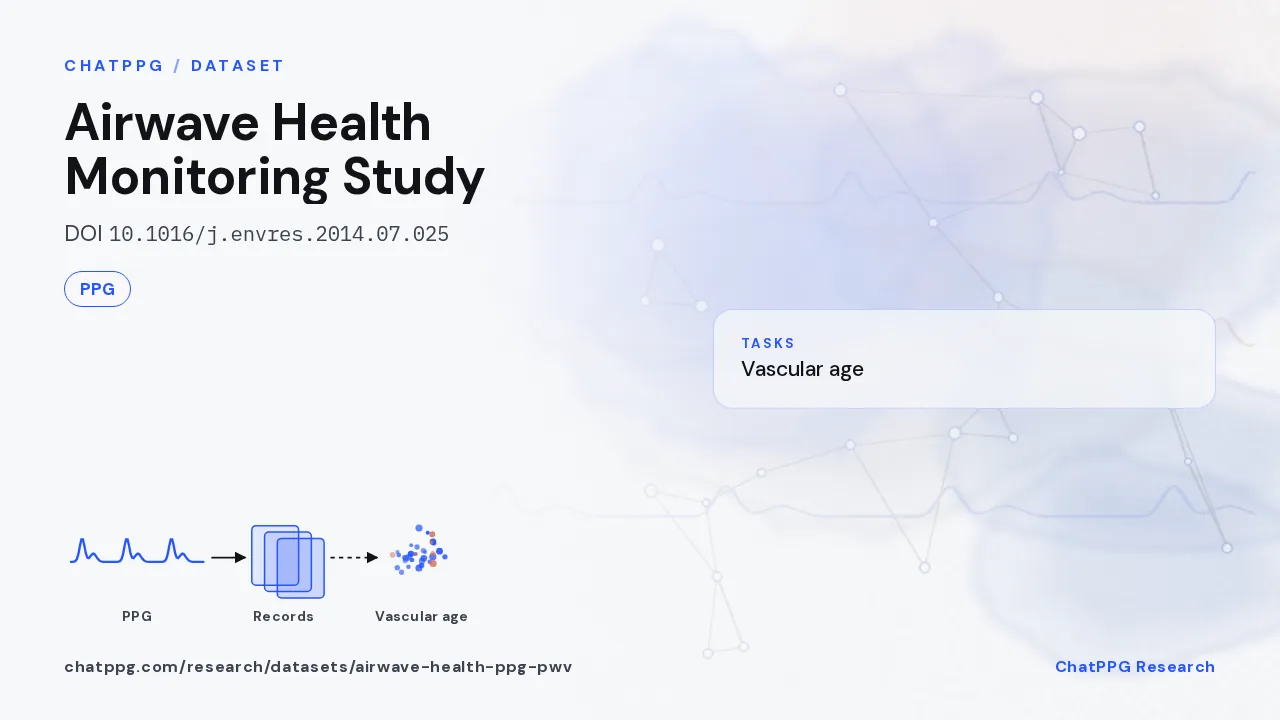
Airwave Health Monitoring Study

clinic finger PPG + Vicorder PWV (Imperial / Elliott)

The Airwave Health Monitoring Study was set up to check for possible health risks from TETRA, the digital radio system used by British police and emergency services since 2001, and later widened to the general health of that workforce. Enrolment started in 2004, either by questionnaire or by a local health screening. By the end of 2012 it had recruited 42,112 participants, and 35,199 of them (83.6%) attended the screening.

Published
Environmental Research, 2014
Cohort
42,112 participants recruited by end of 2012
Health screening
35,199 participants (83.6%)
Population
about two thirds men; 71% of them TETRA users
License
CC BY-NC-ND 3.0
At a glance
Type
Dataset
Access
Not reported
Subjects
Not reported
Signals
PPG
PPG sites
Finger
Setting
Not reported
Wrist
No
Raw waveforms
Not reported
Tasks
Vascular Age
Updated
Nov 13, 2026

Original description

BACKGROUND The Airwave Health Monitoring Study was established to evaluate possible health risks associated with use of TETRA, a digital communication system used by police forces and other emergency services in Great Britain since 2001. The study has been broadened to investigate more generally the health of the work force.

METHODS From 2004, participants from each force who agreed to participate were enrolled either with an enrolment questionnaire or a comprehensive health screening performed locally. This includes questionnaire, 7-day food diaries, anthropometry, measurements of cardiovascular and cognitive function, blood chemistry, coagulation and haematology. Blood and urine samples are stored in vapour phase liquid nitrogen allowing long-term access for biochemical or genetic analysis. Access to the resource is via an access committee and a steering committee, including external scientific advisers as well as representatives of the police officers and staff.

RESULTS By the end of 2012, the study had recruited 42,112 participants, of whom 35,199 (83.6%) had attended the health screening. Almost two thirds of participants were men and 71% of them were a TETRA user. Being in lower ranks (constable/sergeant and staff) was associated with a worse cardio-metabolic risk profile compared to higher ranks (inspector or chief inspector, superintendent and above).

CONCLUSION The Airwave Health Monitoring Study is the only large-scale cohort study of police employees worldwide. The specificities of this sample, such as its well-defined job hierarchy, make it a particularly valuable occupational cohort. Participants have consented to the use of their data and samples for future, currently unspecified, research purposes.
Verbatim fromSemantic Scholar· Abstract via Semantic Scholar; © the authors/publisher

Airwave Health Monitoring Study: ChatPPG research summary card

Key numbers

3
Reference labels
PWV, CUFF BP, VASCULAR AGE

How it works

How Airwave Health Monitoring Study works: Devices & body sites → Signals recorded → TasksDevices & body sites: Finger (PPG site). Signals recorded: Airwave Health Monitoring Study, signals PPG. Tasks: Vascular age.Devices & body sitesFinger: PPG siteFingerPPG siteSignals recordedAirwave Health Monitoring StudyPPGTasksVascular ageVascular age

No model in the hub reports results on this dataset yet.

Reference labels
pwv, cuff bp, vascular age
Device roles
Clinical reference (BP)

FAQ

What signals does Airwave Health Monitoring Study include?

Airwave Health Monitoring Study includes PPG data.

What can Airwave Health Monitoring Study be used for?

Research tasks it supports: vascular age. Reference labels: pulse wave velocity, cuff blood pressure and vascular age.

How do I get Airwave Health Monitoring Study, and what is its licence?

It is available from https://police-health.org.uk/. Licence: CC BY-NC-ND 3.0.

Cite this dataset

Cite this dataset with the fields recorded here. Check it against the publisher before submitting.

Airwave Health Monitoring Study [Data set]. (n.d.). imperial-airwave. https://doi.org/10.1016/j.envres.2014.07.025
@misc{airwavehealthppgairwave,
  title         = {{Airwave Health Monitoring Study}},
  howpublished  = {imperial-airwave},
  doi           = {10.1016/j.envres.2014.07.025}
}

Cite the ChatPPG record

Cite the dated snapshot 2026-10 for a fixed, reproducible version. Please also cite the original publications listed above.

APA

ChatPPG. (2026). Airwave Health Monitoring Study: dataset record (Version 2026-10) [Data set]. ChatPPG Research Hub. https://chatppg.com/research/datasets/airwave-health-ppg-pwv

BibTeX
@misc{chatppg_dataset_airwave_health_ppg_pwv,
  author       = {{ChatPPG}},
  title        = {{Airwave Health Monitoring Study: dataset record}},
  year         = {2026},
  month        = nov,
  version      = {2026-10},
  howpublished = {\url{https://chatppg.com/research/datasets/airwave-health-ppg-pwv}},
  note         = {ChatPPG Research Hub, Snapshot 2026-10, https://chatppg.com/research/snapshots/2026-10}
}
CITATION.cff
cff-version: 1.2.0
message: "If you use this resource, please cite it as below."
type: dataset
title: "Airwave Health Monitoring Study: dataset record"
authors:
  - name: "ChatPPG"
url: "https://chatppg.com/research/datasets/airwave-health-ppg-pwv"
repository-artifact: "https://chatppg.com/research/snapshots/2026-10"
version: "2026-10"
date-released: "2026-11-13"

History

  1. Record updated