Paperdoi:10.3389/fdgth.2026.1909802
Agreement of consumer wearable pulse oximeters across activity conditions and skin pigmentation
Frontiers in Digital Health, published 2026-10-30
 (opens in a new tab)
Kailey Miller et al., "Agreement of consumer wearable pulse oximeters across activity conditions and skin pigmentation", doi:10.3389/fdgth.2026.1909802, CC BY 4.0
TL;DR
49 adults, four consumer wearable pulse oximeters (named in the abstract: Garmin, Wellue, Apple Watch; the fourth needs the full text) against two clinical comparators (GE Dash named), across seated rest, treadmill walking and seated recovery. Skin tone was scored both by visual Fitzpatrick and by objective Individual Typology Angle (ITA). Analysis used signed and absolute error, GEE for repeated measures and repeated-measures Bland–Altman.
- Form factor: wrist
Abstract
Introduction
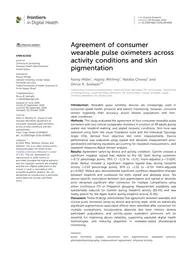
Wearable pulse oximetry devices are increasingly used in consumer-grade health products and patient monitoring; however, concerns remain regarding their accuracy across diverse populations and non-ideal conditions.
Methods
This study evaluated the agreement of four consumer wearable pulse oximeters with two clinical comparator monitors in a cohort of 49 adults during seated rest, treadmill walking, and seated recovery conditions. Skin tone was assessed using both the visual Fitzpatrick scale and the Individual Typology Angle (ITA), derived from objective skin color measurements. Device performance was evaluated using signed and absolute measurement error, generalized estimating equations accounting for repeated measurements, and repeated-measures Bland–Altman analysis.
Results
Agreement varied by device and activity condition. Garmin showed a significant negative signed bias relative to the GE Dash during cooldown (−0.72 percentage points, 95% CI −1.19 to −0.25; Holm-adjusted p = 0.028), while Wellue showed a significant negative signed bias during treadmill activity (−1.03 percentage points, 95% CI −1.52 to −0.53; Holm-adjusted p
Discussion
These findings demonstrate that agreement between wearable and clinical pulse oximeters varies by device and activity state, while no statistically significant pigmentation-associated effects were identified after correction for multiple comparisons. Incorporating objective skin tone metrics, diverse participant populations, and activity-aware evaluation protocols will be essential for improving device reliability, supporting equitable digital health technologies, and reducing disparities in wearable-based physiological monitoring.
Verbatim from the publisher's DOI record (opens in a new tab) · Publisher licence: https://creativecommons.org/licenses/by/4.0/
Results on ChatPPG leaderboards
All leaderboardsNo results from this paper on ChatPPG leaderboards yet. Browse the leaderboards.
Tasks & signals
Tasks
Signals
Keywords
How it works
Cite this paper
Miller, K., Whitney, H., Chavez, N., & Seshadri, D. R. (2026). Agreement of consumer wearable pulse oximeters across activity conditions and skin pigmentation. Frontiers in Digital Health. https://doi.org/10.3389/fdgth.2026.1909802
Miller, Kailey, Hayley Whitney, Natalia Chavez, and Dhruv R. Seshadri. 2026. "Agreement of consumer wearable pulse oximeters across activity conditions and skin pigmentation." Frontiers in Digital Health. https://doi.org/10.3389/fdgth.2026.1909802.
Miller, K., Whitney, H., Chavez, N. and Seshadri, D. R. (2026) 'Agreement of consumer wearable pulse oximeters across activity conditions and skin pigmentation', Frontiers in Digital Health. doi: 10.3389/fdgth.2026.1909802.
Miller, Kailey, et al. "Agreement of consumer wearable pulse oximeters across activity conditions and skin pigmentation." Frontiers in Digital Health, 2026. https://doi.org/10.3389/fdgth.2026.1909802.
K. Miller, H. Whitney, N. Chavez, and D. R. Seshadri, "Agreement of consumer wearable pulse oximeters across activity conditions and skin pigmentation," Frontiers in Digital Health, 2026, doi: 10.3389/fdgth.2026.1909802.
@article{miller2026agreement,
  title         = {{Agreement of consumer wearable pulse oximeters across activity conditions and skin pigmentation}},
  author        = {Miller, Kailey and Whitney, Hayley and Chavez, Natalia and Seshadri, Dhruv R.},
  year          = {2026},
  journal       = {Frontiers in Digital Health},
  doi           = {10.3389/fdgth.2026.1909802}
}Added to the ChatPPG research hub