Pulse Oximeter for COPD: How to Use SpO2 Readings Safely
A COPD-focused guide to using pulse oximeter readings safely, including common SpO2 targets, walking caveats, device limits, and when to seek care.
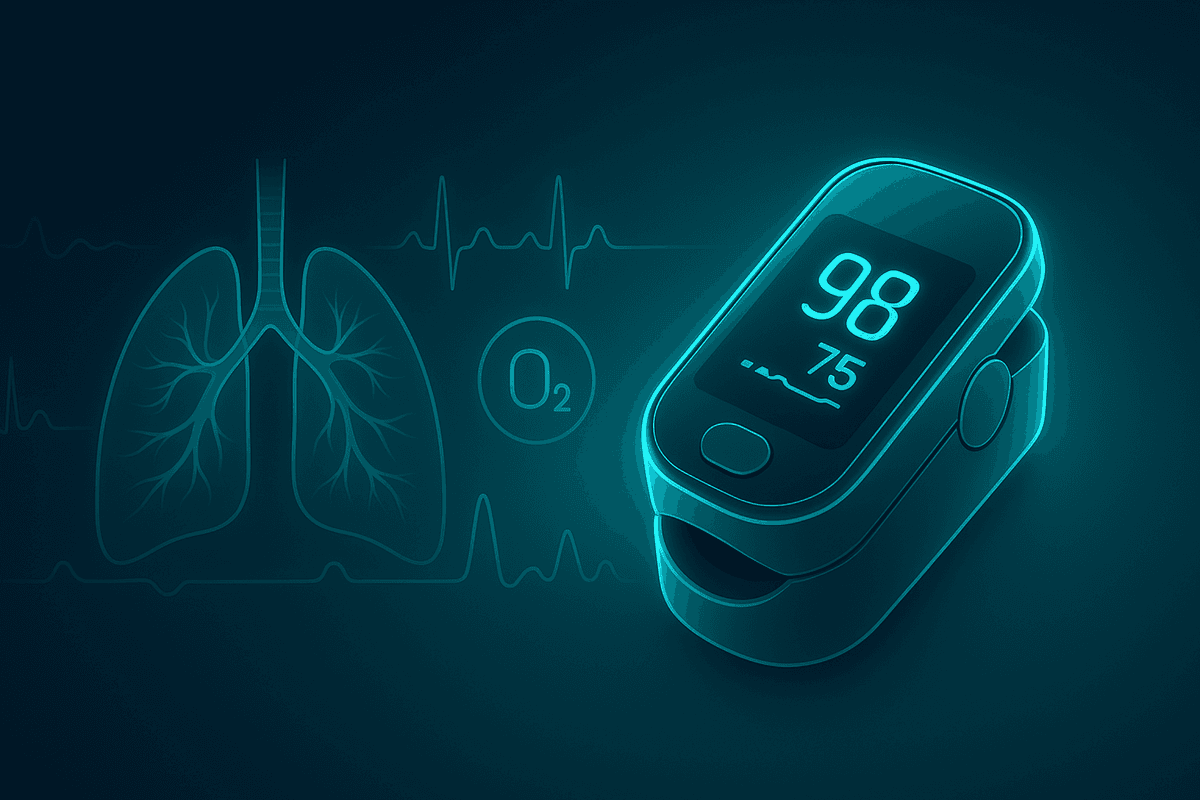
A pulse oximeter can be useful in COPD, but it should be treated as a trend monitor, not a final diagnosis. In many COPD scenarios, clinicians use SpO2 readings to screen for hypoxemia and to guide next steps, but the safest interpretation depends on your baseline, whether you use oxygen, how you feel, and whether the reading was taken at rest or during activity.
COPD makes pulse oximetry harder than a simple “normal is above X” rule. Some patients desaturate only with walking, some run chronically lower than healthy adults, and some have borderline readings that look acceptable on a fingertip device but still need arterial blood gas testing.
What a pulse oximeter can and cannot do in COPD
A pulse oximeter estimates peripheral oxygen saturation, or SpO2, by shining light through tissue and measuring how pulsatile blood absorbs it. In COPD, that estimate can help with three practical questions:
- Are you stable at rest compared with your usual baseline?
- Do you drop with exertion, such as walking, stair climbing, or a formal six-minute walk test?
- Are you having a flare where low oxygen is part of the picture and needs escalation?
What it cannot do is tell you everything that matters in COPD. It does not measure carbon dioxide retention. It does not tell you why a reading changed. It does not replace an arterial blood gas when treatment decisions depend on accurate oxygenation data.
That limitation matters because COPD care often involves decisions about long-term oxygen therapy, ambulatory oxygen, or evaluation during an exacerbation. A recent AnnalsATS study on long-term oxygen therapy assessment in stable COPD found that pulse oximetry did not reliably identify every patient who met arterial blood gas criteria for severe resting hypoxemia. A reassuring fingertip number does not always mean oxygenation is truly adequate, especially when symptoms, smoking status, or recent activity make the reading harder to trust.
What SpO2 number is “good” in COPD?
There is no single COPD number that fits everyone.
Still, a few reference points are useful:
- In many acute COPD settings, especially when clinicians are trying to avoid both hypoxemia and excessive oxygen exposure, a target SpO2 range of 88% to 92% is commonly used.
- In stable outpatients being evaluated for hypoxemia, a resting SpO2 at or below about 92% is often a reason to consider arterial blood gas testing rather than relying on the oximeter alone.
- For long-term oxygen therapy eligibility, the important threshold is not just SpO2. It is whether arterial oxygen values meet formal criteria.
The key distinction is this: a treatment target is not the same as a screening threshold. The 88% to 92% range is often used when oxygen is being titrated in patients at risk of hypercapnia. It is not a universal home target for every person with COPD. If your clinician has given you a personal oxygen goal, that plan matters more than a generic internet cutoff.
For patients on home oxygen, the safest question is usually, “Am I staying in the range my clinician gave me at rest and during usual activity?” For patients not on oxygen, the better question is, “Is this reading lower than my baseline, persistent, and consistent with worsening symptoms?”
Why walking readings matter more than a couch reading for some patients
COPD can look deceptively stable at rest. A patient may sit at 93% or 94% in a chair, then fall with walking, bathing, dressing, or stair climbing. That is why exertional desaturation matters.
Research in COPD has shown that six-minute walk testing and ambulatory monitoring can reveal oxygen drops that a resting spot check misses. At the same time, one low number during motion is not enough to make a long-term oxygen decision. The Long-Term Oxygen Treatment Trial, which studied COPD patients with moderate resting or exercise-related desaturation, did not show outcome benefit from routine long-term supplemental oxygen for that broader moderate-desaturation group.
So how should you think about walking readings at home? Use them as signals, not verdicts.
A practical approach looks like this:
- Check after sitting quietly for several minutes.
- Check again after a repeatable activity, like a short hallway walk.
- Note how low the reading goes, how long it stays down, and whether you recover quickly with rest.
- Write down symptoms at the same time, especially breathlessness out of proportion to usual, dizziness, chest discomfort, confusion, or cyanosis.
If the reading drops only during movement, that does not automatically mean you need oxygen. It does mean your clinician may want a structured exertional assessment rather than a single resting measurement.
Why pulse oximeters can be wrong in COPD
COPD does not break pulse oximeters by itself, but it creates situations where accuracy becomes more fragile.
1. Motion artifact
Walking, trembling, coughing, repositioning your hand, or trying to read the screen while moving can disrupt the pulsatile signal. Motion artifact is a well-known source of pulse oximetry error. If you are checking during or right after exertion, wait for the signal to settle before interpreting the number.
2. Poor perfusion
Cold fingers, vasoconstriction, low blood pressure, dehydration, or shock can weaken the signal. When perfusion is poor, a finger clip may underperform or fail to lock onto a stable reading.
3. Borderline readings near decision points
In COPD, small numerical differences can matter. A reading of 89% versus 92% may change whether a clinician orders further testing. That is why pulse oximetry is useful for screening, but risky as the only basis for oxygen qualification.
4. Device and site limitations
Cheap consumer devices vary in quality. Finger placement, nail polish, artificial nails, ambient light, and weak pulsations can all affect performance. If a pulse oximeter gives a number that does not match how you feel, distrust the device before you distrust your symptoms.
A safe home method for checking SpO2 in COPD
If you want your home readings to be useful, standardize how you take them.
At rest
- Sit quietly for at least five minutes.
- Warm your hands if they are cold.
- Place the probe fully on a clean finger.
- Keep the hand still.
- Wait until the reading stops bouncing.
- Record both SpO2 and pulse rate.
With activity
- Start with a seated baseline.
- Do the same short activity each time, such as a hallway walk.
- Recheck immediately after stopping, then again during recovery.
- Record the lowest stable reading you see, not a split-second flicker.
In your log
Write down:
- date and time
- resting SpO2
- activity-related SpO2 if checked
- pulse rate
- whether you were on oxygen and at what flow setting
- symptoms
- any flare features such as increased cough, sputum, wheeze, fever, or chest tightness
This kind of log is much more useful to a COPD clinician than isolated screenshots of one low number.
When to escalate care
Pulse oximetry is most helpful when it changes what you do next.
Call your clinician soon if:
- your resting SpO2 is persistently below your usual baseline
- you are drifting into the low 90s or below and that is new for you
- you now desaturate with routine walking when you did not before
- you need more oxygen than usual to stay in your prescribed range
- you have a COPD flare with worsening breathlessness, cough, sputum, or fatigue
Seek urgent or emergency care if:
- you are severely short of breath at rest
- you cannot speak full sentences
- you are confused, unusually sleepy, blue around the lips, or feel faint
- your reading stays very low and does not recover with rest or your prescribed oxygen plan
- you have chest pain, new arrhythmia symptoms, or signs of respiratory distress
Do not let a “not terrible” SpO2 delay care if the patient looks ill. In COPD, carbon dioxide retention, work of breathing, and fatigue can become dangerous before a fingertip number fully reflects the problem.
The practical takeaway for COPD patients and caregivers
A pulse oximeter is worth having in COPD if you use it with discipline. It helps you detect change, document exertional drops, and decide when to call for help. It is not strong enough to stand alone when the question is whether oxygen therapy is truly indicated or whether symptoms and numbers disagree.
The safest mindset is simple:
- know your baseline
- check readings in a repeatable way
- respect exertional desaturation
- watch symptoms as closely as the number
- escalate when the trend is worsening or the clinical picture looks wrong
FAQs
Should a person with COPD always stay above 90% on a pulse oximeter?
Not always. Some COPD patients, especially in acute care oxygen titration, may have individualized targets such as 88% to 92%. The right range depends on the clinical situation, whether oxygen is prescribed, and the clinician's plan.
Is 88% dangerous in COPD?
It can be. A reading around 88% may represent significant hypoxemia, especially if it is persistent, new, or associated with worsening symptoms. In some treated COPD settings, clinicians may target the high 80s to low 90s deliberately, but that should come from a medical plan, not guesswork at home.
Can a pulse oximeter tell if COPD is causing carbon dioxide retention?
No. Pulse oximetry estimates oxygen saturation only. It does not measure carbon dioxide, pH, or ventilatory failure.
Why does my oxygen look okay sitting down but drop when I walk?
That pattern is common in COPD. Resting measurements can miss exertional desaturation, which is why structured walking assessments are often more informative than a seated spot check.
Should I change my oxygen flow rate based only on my home pulse oximeter?
Not unless your clinician has given you a specific titration plan. Changing oxygen without a plan can be risky in COPD, especially if you are prone to hypercapnia.
What is the best finger to use for a COPD pulse oximeter check?
There is no universal best finger, but the most important factors are warm skin, a good pulse signal, and stillness. If one finger gives unstable readings, try another warm finger and repeat the check under the same conditions.
Sources and further reading
- Garnet F, et al. Accuracy of Pulse Oximetry for Long-Term Oxygen Therapy Assessment in Chronic Obstructive Pulmonary Disease. Ann Am Thorac Soc. 2023. DOI: https://doi.org/10.1513/AnnalsATS.202209-837OC
- Jacobs SS. Pulse Oximetry Misclassifies Need for Long-Term Oxygen Therapy in Chronic Obstructive Pulmonary Disease. Ann Am Thorac Soc. 2023. DOI: https://doi.org/10.1513/annalsats.202309-754ed
- The Long-Term Oxygen Treatment Trial Research Group. A Randomized Trial of Long-Term Oxygen for COPD with Moderate Desaturation. N Engl J Med. 2016. DOI: https://doi.org/10.1056/NEJMoa1604344
- Jubran A. Pulse oximetry. Critical Care. 2015. DOI: https://doi.org/10.1186/s13054-015-0984-8
- Emtner M, et al. Time to desaturation in the 6-min walking distance test predicts 24-hour oximetry in COPD patients with a PO2 between 60 and 70 mmHg. Respir Med. 2008. DOI: https://doi.org/10.1016/j.rmed.2008.02.004
- Ejiofor SI, et al. Ambulatory Oxygen for Exercise-Induced Desaturation and Dyspnea in Chronic Obstructive Pulmonary Disease (COPD): Systematic Review and Meta-Analysis. Chronic Obstr Pulm Dis. 2016. DOI: https://doi.org/10.15326/jcopdf.3.1.2015.0146
For broader background on optical sensing and monitoring workflows, see Learn, the algorithms hub, the conditions hub, the wearables hub, and the main blog.
Frequently Asked Questions
- Should a person with COPD always stay above 90% on a pulse oximeter?
- Not always. Some COPD patients, especially in acute care oxygen titration, may have individualized targets such as 88% to 92%. The right range depends on the clinical situation, whether oxygen is prescribed, and the clinician's plan.
- Is 88% dangerous in COPD?
- It can be. A reading around 88% may represent significant hypoxemia, especially if it is persistent, new, or associated with worsening symptoms. In some treated COPD settings, clinicians may target the high 80s to low 90s deliberately, but that should come from a medical plan, not guesswork at home.
- Can a pulse oximeter tell if COPD is causing carbon dioxide retention?
- No. Pulse oximetry estimates oxygen saturation only. It does not measure carbon dioxide, pH, or ventilatory failure.
- Why does my oxygen look okay sitting down but drop when I walk?
- That pattern is common in COPD. Resting measurements can miss exertional desaturation, which is why structured walking assessments are often more informative than a seated spot check.
- Should I change my oxygen flow rate based only on my home pulse oximeter?
- Not unless your clinician has given you a specific titration plan. Changing oxygen without a plan can be risky in COPD, especially if you are prone to hypercapnia.
- What is the best finger to use for a COPD pulse oximeter check?
- There is no universal best finger, but the most important factors are warm skin, a good pulse signal, and stillness. If one finger gives unstable readings, try another warm finger and repeat the check under the same conditions.