Activity counts measure attention, not model quality. Missing counts are unknown. Publication status follows the linked source; a listed venue alone does not confirm peer review.
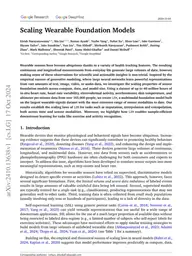
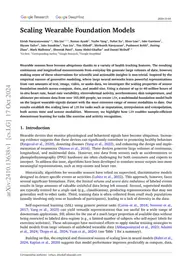
LSM is Google's large sensor model, introduced in "Scaling Wearable Foundation Models" by Girish Narayanswamy, Xin Liu, Kumar Ayush, Yuzhe Yang and colleagues, with Daniel McDuff as the final author. The paper is on arXiv as 2410.13638.
The paper asks whether the scaling behavior seen in language and vision also holds for wearable sensor data. To test it, the team built a dataset of up to 40 million hours of per-minute data from over 165,000 people. The paper says the participants wore Fitbit Sense 2 or Google Pixel Watch 2 devices and consented to research use. The inputs are not raw PPG waveforms. They are minute-level features: heart rate, heart rate variability, electrodermal activity, accelerometer, skin temperature and altimeter signals. The authors describe it as the largest wearable-signals dataset with the widest range of sensor modalities at the time.
LSM is trained as a masked reconstruction model, and the paper reports scaling laws across compute, data and model size for imputation, interpolation and extrapolation, both across time and across sensor modalities. It also shows that LSM makes downstream learning more sample-efficient for tasks such as exercise and activity recognition.
There is no public checkpoint. The arXiv record does not link code or weights, and the training data comes from consenting Fitbit and Pixel Watch users. LSM matters mostly as a reference for how far wearable foundation models scale and as the first step in a line of Google models that includes LSM-2, which handles missing data, and SensorLM, which pairs sensor data with language.
When comparing LSM with PPG models such as PaPaGei or Pulse-PPG, keep the input level in mind. Those models read the PPG waveform itself, while LSM reads per-minute summaries derived by the device, so the two answer different questions.
Signals
IMU, Temp, HR
Devices
Fitbit Sense 2 and Google Pixel Watch 2
Year
2024
Paper
Scaling Wearable Foundation Models (Narayanswamy, Liu, Ayush, Yang et al.), arXiv 2410.13638
Data
up to 40 million hours of per-minute wearable data from over 165,000 people
Wearable sensors have become ubiquitous thanks to a variety of health tracking features. The resulting continuous and longitudinal measurements from everyday life generate large volumes of data; however, making sense of these observations for scientific and actionable insights is non-trivial. Inspired by the empirical success of generative modeling, where large neural networks learn powerful representations from vast amounts of text, image, video, or audio data, we investigate the scaling properties of sensor foundation models across compute, data, and model size. Using a dataset of up to 40 million hours of in-situ heart rate, heart rate variability, electrodermal activity, accelerometer, skin temperature, and altimeter per-minute data from over 165,000 people, we create LSM, a multimodal foundation model built on the largest wearable-signals dataset with the most extensive range of sensor modalities to date. Our results establish the scaling laws of LSM for tasks such as imputation, interpolation and extrapolation, both across time and sensor modalities. Moreover, we highlight how LSM enables sample-efficient downstream learning for tasks like exercise and activity recognition.
Verbatim fromarXiv· arXiv metadata (abstracts are released under CC0)
Key results
40
MAE
Google Large Sensor Model — MAE on ~40M hours / 165k users of minutely aggregated wearable features (not raw waveforms)
LSM (Large Sensor Model) is a wearable foundation model from Google trained on up to 40 million hours of per-minute sensor data from over 165,000 people, described in Scaling Wearable Foundation Models (arXiv 2410.13638).
Can I download Google LSM?
No. The arXiv record does not link code or weights, and the training data comes from consenting Fitbit and Pixel Watch users.
LSM vs LSM-2?
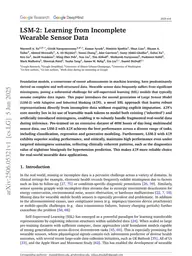
LSM established scaling laws for wearable foundation models on per-minute sensor data. LSM-2 adds Adaptive and Inherited Masking (AIM) so the model can learn directly from incomplete data without imputation, and it was pre-trained on 40M hours of day-long multimodal data.
What are LSM's benchmark results?
The paper reports scaling laws across compute, data and model size for imputation, interpolation and extrapolation, plus sample-efficient downstream learning for exercise and activity recognition.
Cite this model
Cite the publication recorded for this model. Check it against the publisher before submitting.
Narayanswamy, Girish, Xin Liu, Kumar Ayush, Yuzhe Yang, Xuhai Xu, Shun Liao, and Jake Garrison, et al. 2024. "Scaling Wearable Foundation Models." ICLR 2025. https://doi.org/10.48550/ARXIV.2410.13638.
Narayanswamy, G., Liu, X., Ayush, K., Yang, Y., Xu, X., Liao, S. and Garrison, J. et al. (2024) 'Scaling Wearable Foundation Models', ICLR 2025. doi: 10.48550/ARXIV.2410.13638.
Narayanswamy, Girish, et al. "Scaling Wearable Foundation Models." ICLR 2025, 2024. https://doi.org/10.48550/ARXIV.2410.13638.
G. Narayanswamy et al., "Scaling Wearable Foundation Models," ICLR 2025, 2024, doi: 10.48550/ARXIV.2410.13638.
@misc{narayanswamy2024scaling,
  title         = {{Scaling Wearable Foundation Models}},
  author        = {Narayanswamy, Girish and Liu, Xin and Ayush, Kumar and Yang, Yuzhe and Xu, Xuhai and Liao, Shun and Garrison, Jake and Tailor, Shyam and Sunshine, Jake and Liu, Yun and Althoff, Tim and Narayanan, Shrikanth and Kohli, Pushmeet and Zhan, Jiening and Malhotra, Mark and Patel, Shwetak and Abdel-Ghaffar, Samy and McDuff, Daniel},
  year          = {2024},
  howpublished  = {ICLR 2025},
  publisher     = {arXiv},
  doi           = {10.48550/ARXIV.2410.13638},
  eprint        = {2410.13638},
  archivePrefix = {arXiv}
}
History
Record updated
Added to the ChatPPG research hub
Newsletter
Get new PPG datasets, papers and models
Get alerts when Google LSM is benchmarked on new datasets, plus the weekly digest.
New datasets, papers and models
Practical guides from the hub
Unsubscribe anytime
The waveform is an illustration of a PPG pulse, not a recording.