PaperarXiv:2503.07259
COMODO: Cross-Modal Video-to-IMU Distillation for Efficient Egocentric Human Activity Recognition
Proc. ACM IMWUT 10(2), published 2026-06-15 (CC BY 4.0); presented at UbiComp/ISWC 2026 (Shanghai, week of 2026-10-12)
 (opens in a new tab)
Chen, Baiyu et al., "COMODO: Cross-Modal Video-to-IMU Distillation for Efficient Egocentric Human Activity Recognition", arXiv:2503.07259, CC BY 4.0
TL;DR
Teacher/student-agnostic (video: VideoMAE, TimeSformer; time-series: MOMENT, Mantis). Reported to improve downstream egocentric HAR across several datasets, matching or beating fully supervised models, with strong cross-dataset generalisation.
- Form factor: head
Abstract
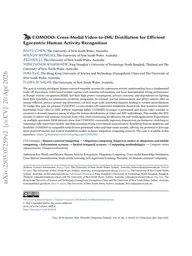
The goal of creating intelligent, human-centered wearable systems for continuous activity understanding faces a fundamental trade-off: Egocentric video-based models capture rich semantic information and have demonstrated strong performance in human activity recognition (HAR), but their high power consumption, privacy concerns, and dependence on lighting limit their feasibility for continuous on-device recognition. In contrast, inertial measurement unit (IMU) sensors offer an energy-efficient, privacy-preserving alternative, yet lack large-scale annotated datasets, leading to weaker generalization. To bridge this gap, we propose COMODO, a cross-modal self-supervised distillation framework that transfers semantic knowledge from video to IMU without requiring labels. COMODO leverages a pretrained and frozen video encoder to construct a dynamic instance queue to align the feature distributions of video and IMU embeddings. This enables the IMU encoder to inherit rich semantic structure from video while maintaining its efficiency for real-world applications. Experiments on multiple egocentric HAR datasets show that COMODO consistently improves downstream performance, matching or surpassing fully supervised models, and demonstrating strong cross-dataset generalization. Benefiting from its simplicity and flexibility, COMODO is compatible with diverse pretrained video and time-series models, offering the potential to leverage more powerful teacher and student foundation models in future ubiquitous computing research. The code is available at this repository: https://github.com/cruiseresearchgroup/COMODO.
Verbatim from arXiv (opens in a new tab) · arXiv metadata (abstracts are released under CC0)
Results on ChatPPG leaderboards
All leaderboardsNo results from this paper on ChatPPG leaderboards yet. Browse the leaderboards.
Tasks & signals
Tasks
Signals
Devices
Keywords
Datasets used
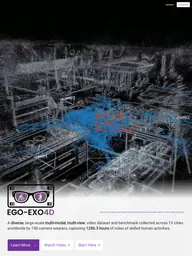 Ego-Exo4D: 1,286 h of synchronised ego (Aria glasses) and exo video of skilled activities from 740 participants, with Aria IMUs740 subjects · IMU · Audio · Video
 Ego4D: 3,670 h of egocentric daily-life video from 931 camera wearers, with head-camera IMU on part of the data931 subjects · IMU · Audio · Video
How it works
Cite this paper
Chen, B., Wongso, W., Li, Z., Khaokaew, Y., Xue, H., & Salim, F. D. (2026). COMODO: Cross-Modal Video-to-IMU Distillation for Efficient Egocentric Human Activity Recognition. Proc. ACM IMWUT 10. https://doi.org/10.1145/3810218
Chen, Baiyu, Wilson Wongso, Zechen Li, Yonchanok Khaokaew, Hao Xue, and Flora D. Salim. 2026. "COMODO: Cross-Modal Video-to-IMU Distillation for Efficient Egocentric Human Activity Recognition." Proc. ACM IMWUT 10. https://doi.org/10.1145/3810218.
Chen, B., Wongso, W., Li, Z., Khaokaew, Y., Xue, H. and Salim, F. D. (2026) 'COMODO: Cross-Modal Video-to-IMU Distillation for Efficient Egocentric Human Activity Recognition', Proc. ACM IMWUT 10. doi: 10.1145/3810218.
Chen, Baiyu, et al. "COMODO: Cross-Modal Video-to-IMU Distillation for Efficient Egocentric Human Activity Recognition." Proc. ACM IMWUT 10, 2026. https://doi.org/10.1145/3810218.
B. Chen, W. Wongso, Z. Li, Y. Khaokaew, H. Xue, and F. D. Salim, "COMODO: Cross-Modal Video-to-IMU Distillation for Efficient Egocentric Human Activity Recognition," Proc. ACM IMWUT 10, 2026, doi: 10.1145/3810218.
@inproceedings{chen2026comodo,
  title         = {{COMODO: Cross-Modal Video-to-IMU Distillation for Efficient Egocentric Human Activity Recognition}},
  author        = {Chen, Baiyu and Wongso, Wilson and Li, Zechen and Khaokaew, Yonchanok and Xue, Hao and Salim, Flora D.},
  year          = {2026},
  booktitle     = {Proc. ACM IMWUT 10},
  doi           = {10.1145/3810218},
  eprint        = {2503.07259},
  archivePrefix = {arXiv}
}Record updated
Added to the ChatPPG research hub