Foundation model

FemWear

From “FemWear: A Parameter-Efficient Wearable Foundation Model for Women's Health”
Year
2026
Form factor
Wrist daily aggregate fitbit class
Wang, Yifan et al., "FemWear: A Parameter-Efficient Wearable Foundation Model for Women's Health", arXiv:2608.08244, CC BY 4.0
PreprintFirst posted: Aug 8, 2026Added to atlas: Sep 26, 2026Source

Activity counts measure attention, not model quality. Missing counts are unknown. Publication status follows the linked source; a listed venue alone does not confirm peer review.

FemWear repurposes a general wearable foundation model for women's health. It freezes the pretrained encoder and trains only 239,236 parameters (1.11% of a 21.54M-parameter encoder) through low-rank adapters and task heads covering menstrual, symptom, mood, sleep, autonomic, activity and pregnancy outcomes. It improved cycle-phase macro-F1 by 8.15% and cut errors for cramps and sleep problems by about 9%.

Published
arXiv preprint, 2026
Signals
PPG, IMU, Temp
Parameters
239,236 trained (1.11% of a 21.54M encoder)
Evaluation
6 cohorts, 63 metrics
Result
cycle-phase macro-F1 +8.15%
Year
2026
Method

low-rank residual adapters on a frozen multimodal wearable backbone

Key results

All results

Results as reported by the authors; not independently reproduced. A SOTA star marks the best value among results reported under the same evaluation protocol; ties go to the earlier publication.

At a glance
Type
Foundation model
Modalities
PPGIMUTemp
Parameters
Not reported
Architecture
PEFT adapters on a frozen OpenMHC wearable-FM backbone
Venue
arXiv preprint
Year
2026
DOI
Not reported
Code
Not released
Weights
Not released
Licence
Not reported
Caveats
Not reported
Datasets
Not reported
Added
Sep 26, 2026
Updated
Sep 26, 2026

Abstract

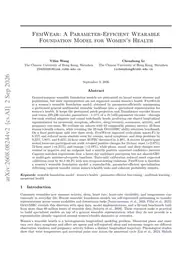
General-purpose wearable foundation models are pretrained on broad sensor streams and populations, but their representations are not organized around women's health. FemWear is a women's wearable foundation model, obtained by parameter-efficiently repurposing a pretrained general multimodal wearable backbone into a specialized representation for women's health. It keeps the pretrained patch projection and Transformer encoder frozen and trains 239,236 encoder parameters - 1.11% of a 21.54M-parameter encoder - through low-rank residual adapters and causal task-family heads, producing one shared longitudinal representation for menstrual, symptom, affective, sleep/recovery, autonomic, activity, and pregnancy outcomes. We evaluate six cohorts with 63 comparable primary metrics, 33 from women's-health cohorts, while retaining the 32-task OpenMHC ability-retention benchmark. On a fixed participant split over three seeds, FemWear improved cycle-phase macro-F1 by 8.15% and reduced mean absolute error for cramps, mood symptoms, and sleep problems by 9.32%, 5.80%, and 9.43%; 24-hour onset AUPRC decreased by 3.40%. A stricter 42-participant nested leave-one-participant-out audit retained positive changes for 24-hour onset (+2.87%), 72-hour onset (+6.35%), and cramps (+2.19%), while phase, mood, and sleep changes were neutral or negative and no endpoint had a strictly positive corrected confidence interval. Capacity-matched experiments beat a latest-day multilayer perceptron but not shared-GRU or multi-gate mixture-of-experts baselines. Train-only calibration reduced onset expected calibration error by 84.2-88.2% with zero temporal-nesting violations. FemWear is therefore a women's wearable foundation model: a reproducible, parameter-efficient specialization delivering targeted transfer across women's-health tasks and coherent probability outputs.
Verbatim fromarXiv· arXiv metadata (abstracts are released under CC0)

Key numbers

8.15%
F1
It improved cycle-phase macro-F1 by 8.15% and cut errors for cramps and sleep problems by about 9%.

How it works

How FemWear works: Input signals → Foundation model → Downstream tasksInput signals: PPG (Photoplethysmogram); IMU (Accelerometer, 3-axis); Temperature (Skin temperature). Foundation model: FemWear (Transformer).Input signalsPPG: PhotoplethysmogramPPGPhotoplethysmogramIMU: Accelerometer, 3-axisxyzIMUAccelerometer, 3-axisTemperature: Skin temperatureTemperatureSkin temperatureFoundation model×NFemWearTransformer
Architecture
PEFT adapters on a frozen OpenMHC wearable-FM backbone
Inputs
PPG, IMU, Temp
Approach
PEFT · womens health · adapters

Datasets used

No public datasets linked yet.

Papers· 1

Authors· 2

Cite this model

Cite the publication recorded for this model. Check it against the publisher before submitting.

FemWear: A Parameter-Efficient Wearable Foundation Model for Women's Health. (2026). arXiv preprint. https://doi.org/10.48550/arXiv.2608.08244
@misc{femwear2026femwear,
  title         = {{FemWear: A Parameter-Efficient Wearable Foundation Model for Women's Health}},
  year          = {2026},
  howpublished  = {arXiv preprint},
  doi           = {10.48550/arXiv.2608.08244},
  eprint        = {2608.08244},
  archivePrefix = {arXiv}
}

History

  1. Added to the ChatPPG research hub