Model

VitalsSight

candidate-aware rPPG HR with an auditable release/review output contract (Research Square 2026)

PreprintCatalog paper date: 2026Source

Activity counts measure attention, not model quality. Missing counts are unknown. Publication status follows the linked source; a listed venue alone does not confirm peer review.

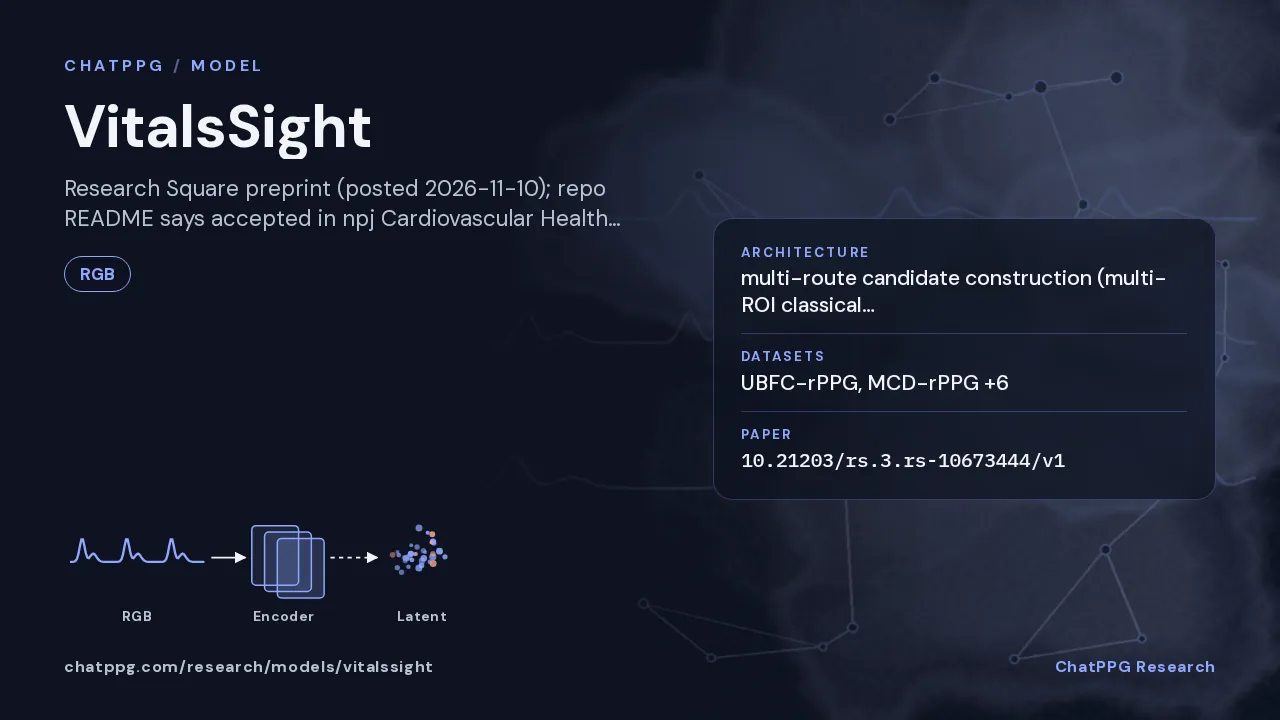
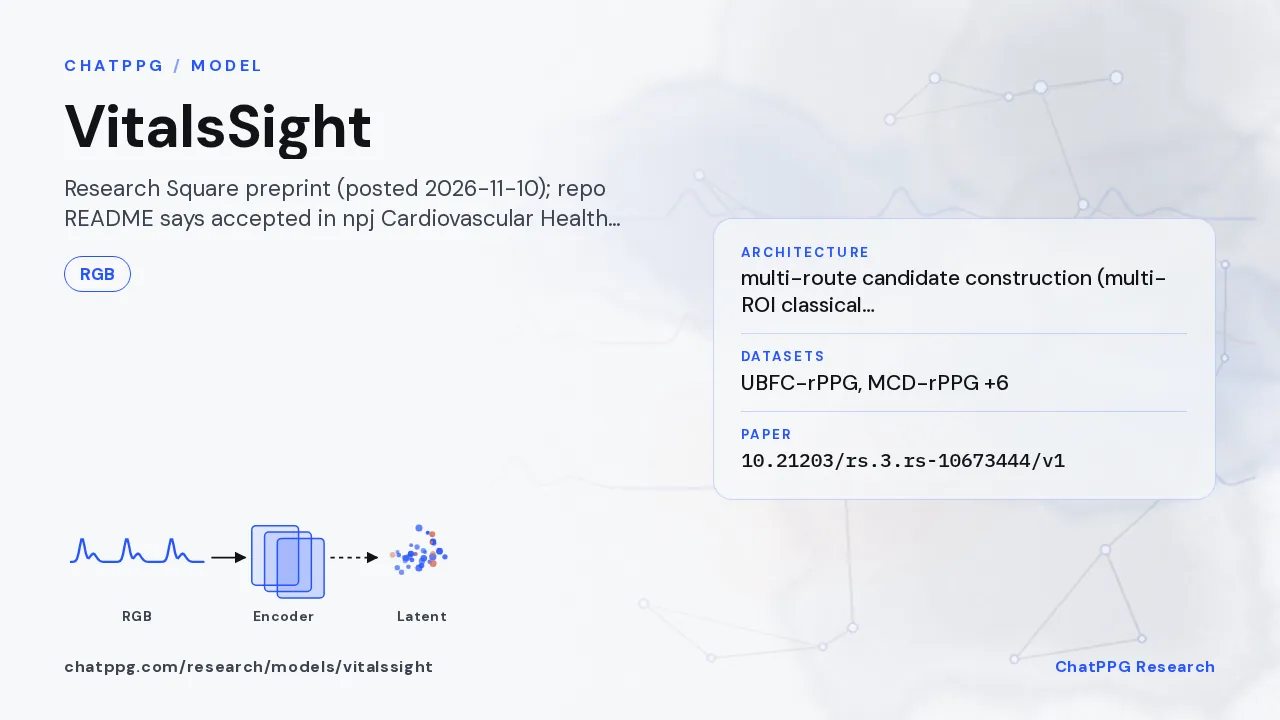
Instead of trusting one rPPG estimator, VitalsSight collects pulse candidates from many routes: multi-ROI classical methods, learned networks and transformers, plus optional temporal-correction candidates. A relation-aware selector then picks one. The output is split into three parts: the selected HR, an evidence packet describing the candidate ambiguity, and a proposed release/review state.

Signals
RGB
Form factor
camera_rppg
License
No software license is granted
Year
2026
Architecture

multi-route candidate construction (multi-ROI classical, learned and transformer rPPG routes, optional temporal-correction candidates) → physiology-aware evidence features → relation-aware set-attention / graph selector (harmonic penalty, KL soft target) → selected HR + evidence packet + proposed release/review state (fixed-coverage gate)

At a glance
Type
Task model
Modalities
RGB
Form factor
Camera rPPG
Parameters
Not reported
Architecture
multi-route candidate construction (multi-ROI classical, learned and transformer rPPG routes, optional temporal-correction candidates) → physiology-aware evidence features → relation-aware set-attention / graph selector (harmonic penalty, KL soft target) → selected HR + evidence packet + proposed release/review state (fixed-coverage gate)
Venue
Research Square preprint (posted 2026-11-10); repo README says accepted in npj Cardiovascular Health (author statement, no DOI yet)
Year
2026
arXiv
Not reported
Code
Not reported
Weights
Not reported
Licence
No software license is granted
Caveats
Not reported
Added
Not reported
Updated
Nov 10, 2026

Abstract

Camera-based contactless heart rate monitoring offers significant potential for clinical care and longitudinal research, yet estimation often fails in challenging windows containing competing pulse candidates, aliases, or motion artifacts. To overcome this deployment bottleneck, we present VitalsSight, a candidate-aware supervised framework that retains pulse candidates across diverse signal routes prior to selection, thereby preserving critical physiological evidence. In internal subject-disjoint evaluations on the University of Bourgogne Franche-Comté remote photoplethysmography (UBFC-rPPG) benchmark dataset (42 participants, 439 windows), VitalsSight achieved a primary window-level mean absolute error of 1.646 ± 0.051 beats per minute, with consistent error reductions across stress datasets including MCD-rPPG and rPPG-10. Crucially, when encountering real-world deployment boundaries—such as severe low light and source shifts—VitalsSight outputs an evidence packet capturing candidate ambiguity to support a transparent release/review contract. Rather than masking errors through forced automated outputs, this auditable mechanism establishes a safer and more pragmatic foundation for the clinical translation of digital vital sign monitoring systems. Code available at https://github.com/ShikiRyo1/VitalsSight-candidate-aware-rPPG.

Verbatim fromthe publisher's DOI record· Publisher licence: https://creativecommons.org/licenses/by/4.0/

VitalsSight: ChatPPG research summary card

Key results

How it works

How VitalsSight works: Input signals → Model → Downstream tasksInput signals: RGB. Datasets: UBFC-rPPG, MCD-rPPG, rPPG-10, SCAMPS, MR-NIRP, UBFC-Phys, 4TU rPPG Benchmark, rPPG-OSF (Kopeliovich). Model: VitalsSight (Transformer · Masked reconstruction). Downstream tasks: Heart rate; Signal quality.Input signalsRGBRGBDatasets: UBFC-rPPG, MCD-rPPG, rPPG-10, SCAMPS, MR-NIRP, UBFC-Phys, 4TU rPPG Benchmark, rPPG-OSF (Kopeliovich)DatasetsUBFC-rPPG, MCD-rPPG +6 moreModel×NVitalsSightTransformer · Masked reconstructionDownstream tasksHeart rateHeart rateSignal qualitySignal quality

Datasets linked in the hub; pretraining vs evaluation roles follow the paper.

Architecture
multi-route candidate construction (multi-ROI classical, learned and transformer rPPG routes, optional temporal-correction candidates) → physiology-aware evidence features → relation-aware set-attention / graph selector (harmonic penalty, KL soft target) → selected HR + evidence packet + proposed release/review state (fixed-coverage gate)
Inputs
RGB
Approach
rppg · model · candidate selection · selective prediction · abstention · signal quality

Devices· 1

Full photo credits, sources and licences are on each device page.

Leaderboard rows· 4

All leaderboards
TaskDatasetMetricValueRank
Rppg hrmcd-rppg stressHR MAE ↓17.231#1 / 1
Rppg hrrPPG-10HR MAE ↓7.136#1 / 1
Rppg hrubfc-phys S1–S14HR MAE ↓12.722#1 / 1
Rppg hrubfc-rppg subject-disjointHR MAE ↓1.646#1 / 1

Datasets used· 5

Cite this model

Cite the publication recorded for this model. Check it against the publisher before submitting.

VitalsSight. (2026). Research Square preprint. https://doi.org/10.21203/rs.3.rs-10673444/v1
@misc{vitalssight2026vitalssight,
  title         = {{VitalsSight}},
  year          = {2026},
  howpublished  = {Research Square preprint},
  doi           = {10.21203/rs.3.rs-10673444/v1}
}

History

  1. Record updated