Model

FusionPhys

multi-source fusion of DeepPhys with Green and POS priors

Cite
Venue listedCatalog paper date: 2026Source

Activity counts measure attention, not model quality. Missing counts are unknown. Publication status follows the linked source; a listed venue alone does not confirm peer review.

FusionPhys combines a DeepPhys appearance/motion network with classical Green and POS pulse estimators as separate branches, then fuses features to predict the standardized first derivative of contact PPG. Heart rate is the dominant spectral peak of that derivative. Paper: Rabarijaona & Rouhafzay, Eng.

Signals
RGB
Form factor
camera_rppg
License
paper CC BY 4.0 (MDPI); code/weights not released
Year
2026
Architecture

three-branch fusion — DeepPhys appearance+motion streams concatenated with separately processed Green and POS classical estimator branches; supervised on standardized first derivative of contact PPG; HR from dominant spectral peak

At a glance
Type
Task model
Modalities
RGB
Form factor
Camera rPPG
Parameters
Not reported
Architecture
three-branch fusion — DeepPhys appearance+motion streams concatenated with separately processed Green and POS classical estimator branches; supervised on standardized first derivative of contact PPG; HR from dominant spectral peak
Venue
Engineering Proceedings 2026, 163, 63 (13th International Electronic Conference on Sensors and Applications, ECSA-13; published 2026-10-30)
Year
2026
arXiv
Not reported
Code
Not reported
Weights
Not reported
Licence
paper CC BY 4.0 (MDPI); code/weights not released
Caveats
Not reported
Datasets
Not reported
Added
Not reported
Updated
Nov 9, 2026

Abstract

Remote photoplethysmography (rPPG) estimates cardiovascular pulse information from facial videos without the use of contact sensors. Considerable research effort has been devoted over the past decade to improve the accuracy of this technology using both classical color-based estimators and learned models. However, most of them remain vulnerable in real-world conditions, including subject movements, lighting variations, or low image quality. To overcome these limitations, we propose FusionPhys, an architecture that exploits three complementary sources of information extracted from facial video: the raw appearance of the face, motion variations between successive frames, and pulse indices provided by classical estimators. The model is trained to predict the standardized first derivative of PPG, from which heart rate is estimated by the dominant spectral peak. Two subject-independent evaluations were performed on UBFC-rPPG. On Dataset 1, leave-one-subject-out evaluation gave heart-rate MAEs of 1.02 BPM for POS, 1.38 BPM for FusionPhys, 2.60 BPM for DeepPhys, and 6.60 BPM for Green. On the larger Dataset 2, using 30/6/6 train/validation/test subjects, MAEs were 1.93, 2.37, 14.17, and 18.45 BPM, respectively. FusionPhys therefore substantially improved upon DeepPhys while remaining close to the strongest classical baseline, and it provided the lowest waveform-derivative RMSE among the evaluated methods.
Verbatim fromOpenAlex· Abstract via OpenAlex (publisher-deposited); © the authors/publisher

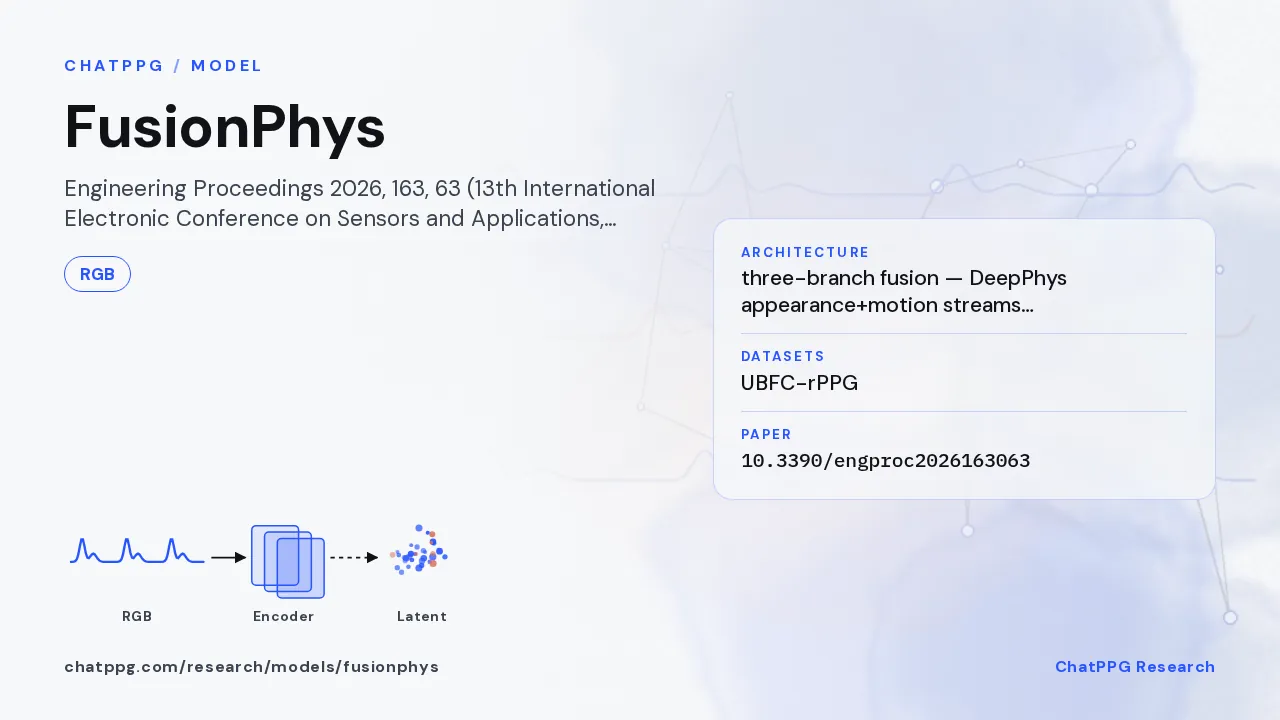
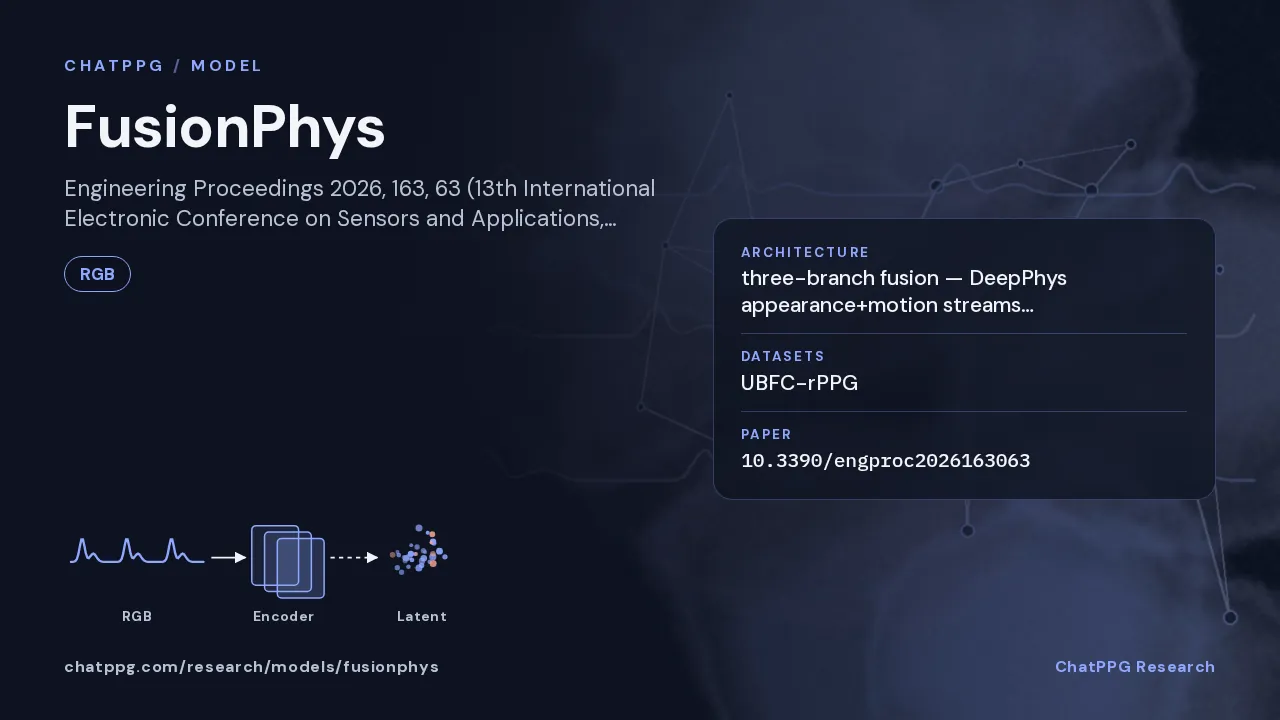
FusionPhys: ChatPPG research summary card

Key results

How it works

How FusionPhys works: Input signals → Model → Downstream tasksInput signals: RGB. Dataset: UBFC-rPPG. Model: FusionPhys. Downstream tasks: Heart rate.Input signalsRGBRGBDataset: UBFC-rPPGDatasetUBFC-rPPGModelFusionPhysDownstream tasksHeart rateHeart rate

Datasets linked in the hub; pretraining vs evaluation roles follow the paper.

Architecture
three-branch fusion — DeepPhys appearance+motion streams concatenated with separately processed Green and POS classical estimator branches; supervised on standardized first derivative of contact PPG; HR from dominant spectral peak
Inputs
RGB
Approach
rppg · model · fusion · deepphys · pos · green

Leaderboard rows· 2

All leaderboards
TaskDatasetMetricValueRank
Rppg hrubfc-rppg Dataset 1 LOSOHR MAE ↓1.38#1 / 1
Rppg hrubfc-rppg Dataset 2 held-out 6 subjectsHR MAE ↓2.37#1 / 1

Datasets used

No public datasets linked yet.

Cite this model

Cite the publication recorded for this model. Check it against the publisher before submitting.

FusionPhys. (2026). Engineering Proceedings 2026, 163, 63. https://doi.org/10.3390/engproc2026163063
@inproceedings{fusionphys2026fusionphys,
  title         = {{FusionPhys}},
  year          = {2026},
  booktitle     = {Engineering Proceedings 2026, 163, 63},
  doi           = {10.3390/engproc2026163063}
}

History

  1. Record updated