Activity counts measure attention, not model quality. Missing counts are unknown. Publication status follows the linked source; a listed venue alone does not confirm peer review.
Task model for pointwise PPG artifact segmentation.
Parameters
0.0014M, 0.0085M, 0.0453M
Signals
PPG
Form factor
Wrist
Year
2023
Architecture
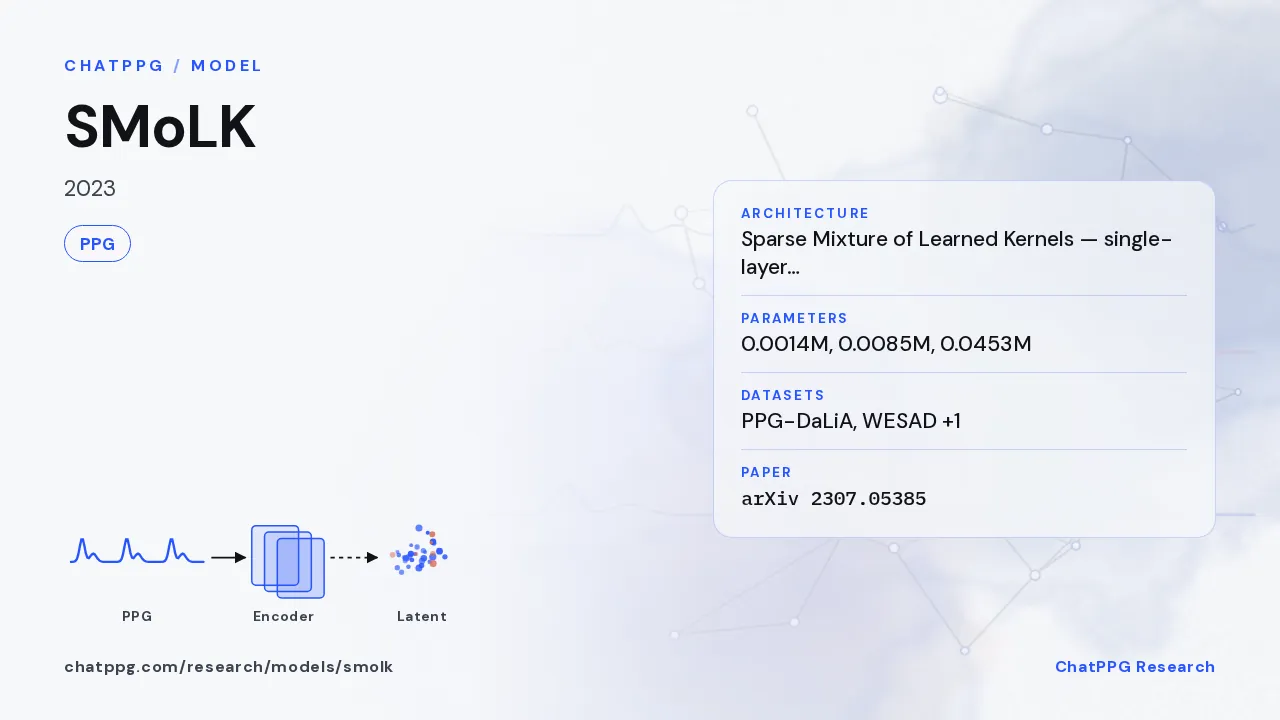
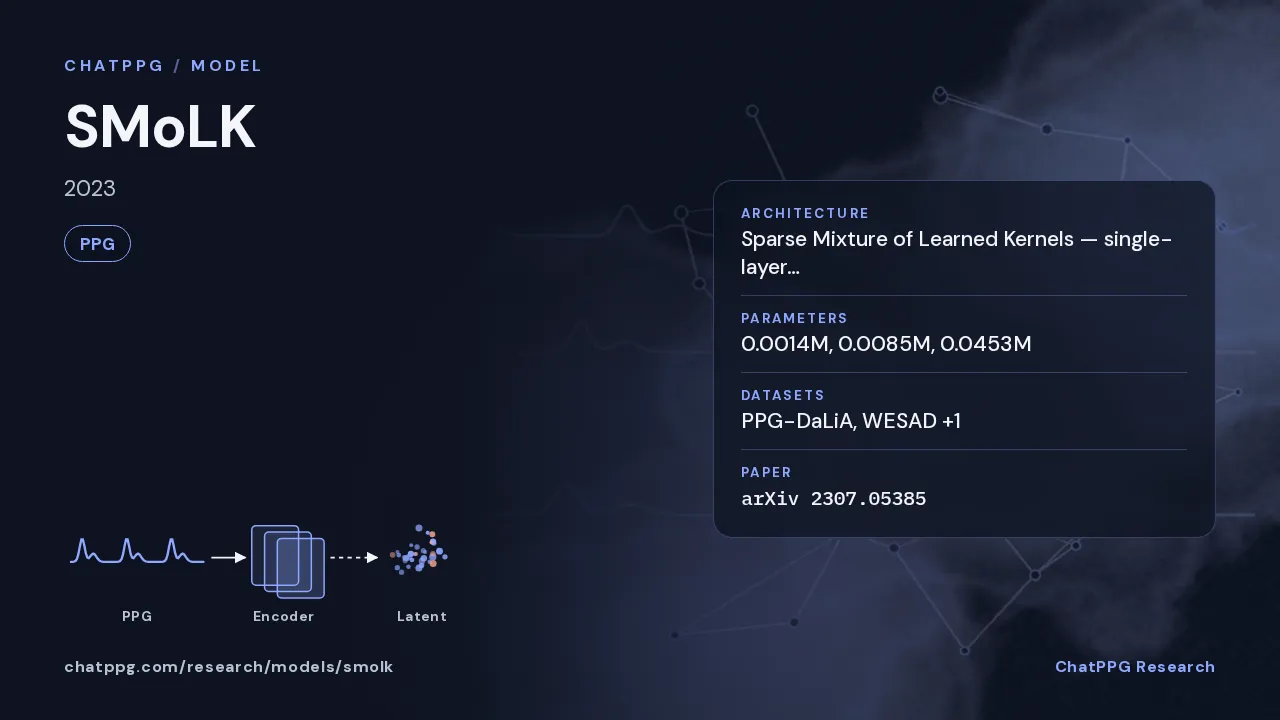
Sparse Mixture of Learned Kernels — single-layer multi-scale 1D Conv kernels + weighted sum + sigmoid + optional Savitzky–Golay
Rapid, reliable, and accurate interpretation of medical time-series signals is crucial for high-stakes clinical decision-making. Deep learning methods offered unprecedented performance in medical signal processing but at a cost: they were compute-intensive and lacked interpretability. We propose Sparse Mixture of Learned Kernels (SMoLK), an interpretable architecture for medical time series processing. SMoLK learns a set of lightweight flexible kernels that form a single-layer sparse neural network, providing not only interpretability, but also efficiency, robustness, and generalization to unseen data distributions. We introduce a parameter reduction techniques to reduce the size of SMoLK's networks while maintaining performance. We test SMoLK on two important tasks common to many consumer wearables: photoplethysmography (PPG) artifact detection and atrial fibrillation detection from single-lead electrocardiograms (ECGs). We find that SMoLK matches the performance of models orders of magnitude larger. It is particularly suited for real-time applications using low-power devices, and its interpretability benefits high-stakes situations.
Verbatim fromarXiv· arXiv metadata (abstracts are released under CC0)
How it works
Datasets linked in the hub; pretraining vs evaluation roles follow the paper.
Architecture
Sparse Mixture of Learned Kernels — single-layer multi-scale 1D Conv kernels + weighted sum + sigmoid + optional Savitzky–Golay
Inputs
PPG
Approach
sqi · motion artifact · edge · ppg only · open code · interpretable
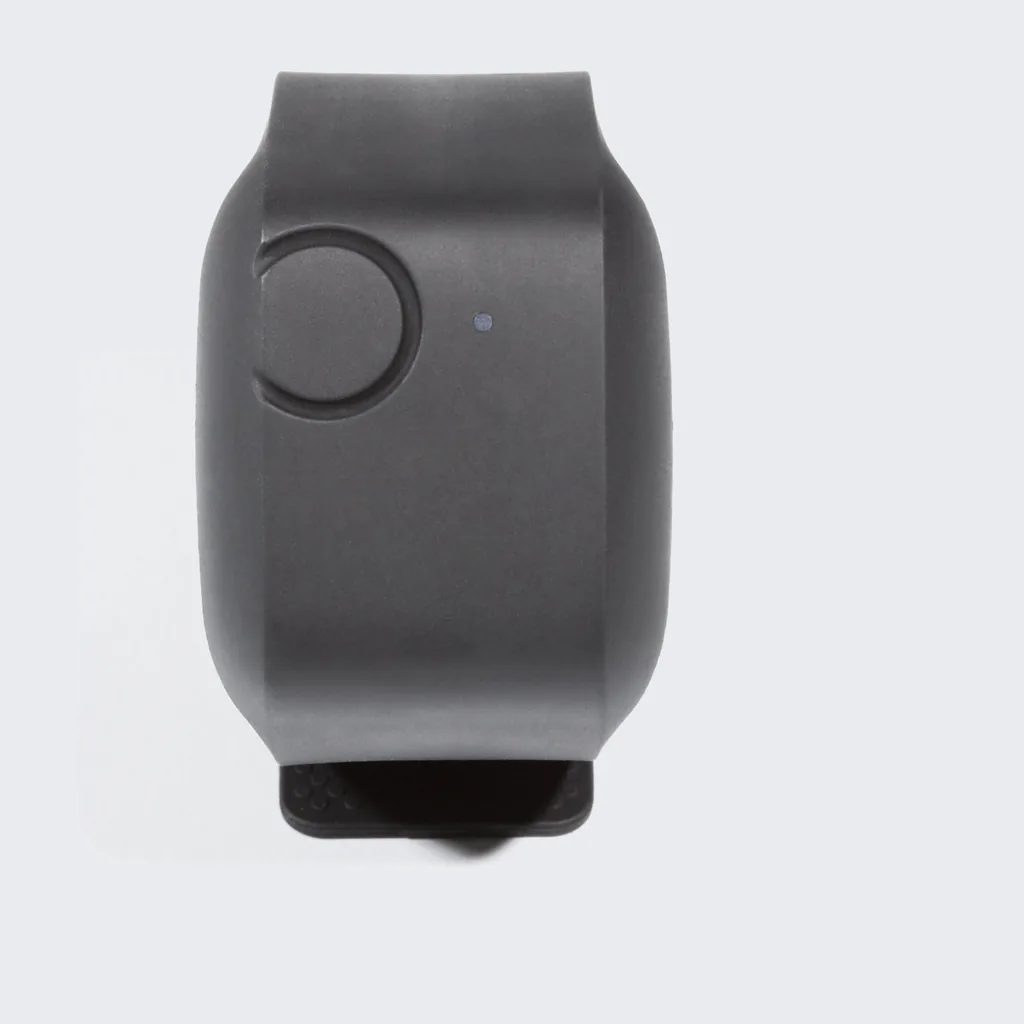
Full photo credits and licences are on each device page. An icon means we have no openly licensed or manufacturer-cleared photo of that exact device yet.
Cite the publication recorded for this model. Check it against the publisher before submitting.
Chen, S. F., Guo, Z., Ding, C., Hu, X., & Rudin, C. (2023). Sparse learned kernels for interpretable and efficient medical time series processing. Nature Machine Intelligence. https://doi.org/10.1038/s42256-024-00898-4
Chen, Sully F., Zhicheng Guo, Cheng Ding, Xiao Hu, and Cynthia Rudin. 2023. "Sparse learned kernels for interpretable and efficient medical time series processing." Nature Machine Intelligence. https://doi.org/10.1038/s42256-024-00898-4.
Chen, S. F., Guo, Z., Ding, C., Hu, X. and Rudin, C. (2023) 'Sparse learned kernels for interpretable and efficient medical time series processing', Nature Machine Intelligence. doi: 10.1038/s42256-024-00898-4.
Chen, Sully F., et al. "Sparse learned kernels for interpretable and efficient medical time series processing." Nature Machine Intelligence, 2023. https://doi.org/10.1038/s42256-024-00898-4.
S. F. Chen, Z. Guo, C. Ding, X. Hu, and C. Rudin, "Sparse learned kernels for interpretable and efficient medical time series processing," Nature Machine Intelligence, 2023, doi: 10.1038/s42256-024-00898-4.
@article{chen2023sparse,
  title         = {{Sparse learned kernels for interpretable and efficient medical time series processing}},
  author        = {Chen, Sully F. and Guo, Zhicheng and Ding, Cheng and Hu, Xiao and Rudin, Cynthia},
  year          = {2023},
  journal       = {Nature Machine Intelligence},
  doi           = {10.1038/s42256-024-00898-4},
  eprint        = {2307.05385},
  archivePrefix = {arXiv}
}
History
Added to the ChatPPG research hub
Newsletter
Get new PPG datasets, papers and models
Get alerts when SMoLK is benchmarked on new datasets, plus the weekly digest.
New datasets, papers and models
Practical guides from the hub
Unsubscribe anytime
The waveform is an illustration of a PPG pulse, not a recording.