PaperarXiv:2610.04407
TimeNet: An Extensible Unified Data Infrastructure for Next-Generation Temporal Foundation Models
arXiv 2610.04407 (cs.AI; v1 submitted 2026-10-03) — preprint
TL;DR
MIT code; datasets keep upstream licences. Not a PPG corpus — demonstrated modalities are ECG/EEG/sleep PSG/HAR accel and non-wearable series.
- Form factor: other
Abstract
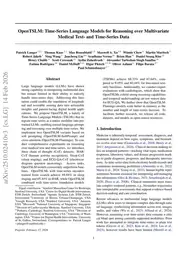
Temporal Foundation Models (TFMs) aim to generalize across domains, datasets, and tasks. Yet, their development remains constrained by fragmented, task-specific data formats, annotations, and processing pipelines. We introduce TimeNet, an open-source data standard and scalable infrastructure that decouples temporal data from task definitions and represents signals, metadata, annotations, and supervision in a shared, extensible data model. TimeNet supports multimodal signals with regular, irregular, or ordinal time axes and expresses different task families (including classification, forecasting, temporal localization, question answering, generation, and editing) as reusable views over the same recordings. This shared representation enables heterogeneous time-series datasets to be combined for large-scale model training across domains, modalities, and tasks. We demonstrate TimeNet by transcoding datasets with 1.5M task instances spanning diverse domains, modalities, temporal scales, and forms of supervision, while retaining practical I/O performance relative to native formats. TimeNet enables an existing TFN training pipeline to support joint training on a configurable number of heterogeneous datasets through configuration changes alone. We show this capability by training TFM across multiple datasets and tasks, obtaining a 14% F1 score improvement compared with models trained on individual datasets. These results show that TimeNet provides the data and systems foundation needed to move beyond task- and dataset-specific TFMs toward models that can learn jointly across heterogeneous domains, modalities, temporal scales, and forms of supervision from a common data model.
Verbatim from arXiv (opens in a new tab) · arXiv metadata (abstracts are released under CC0)
Results on ChatPPG leaderboards
All leaderboardsNo results from this paper on ChatPPG leaderboards yet. Browse the leaderboards.
Tasks & signals
Signals
Devices
Keywords
Datasets used
Models
How it works
Cite this paper
TimeNet: An Extensible Unified Data Infrastructure for Next-Generation Temporal Foundation Models. (2026). arXiv 2610.04407 — preprint. https://arxiv.org/abs/2610.04407
@misc{maritschtimenetu2026timenet,
  title         = {{TimeNet: An Extensible Unified Data Infrastructure for Next-Generation Temporal Foundation Models}},
  year          = {2026},
  howpublished  = {arXiv 2610.04407 — preprint},
  eprint        = {2610.04407},
  archivePrefix = {arXiv}
}Added to the ChatPPG research hub