Activity counts measure attention, not model quality. Missing counts are unknown. Publication status follows the linked source; a listed venue alone does not confirm peer review.
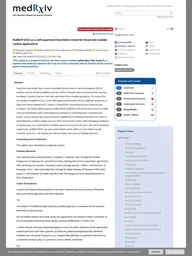
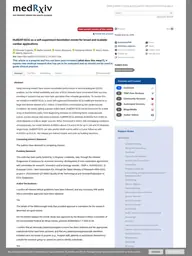
HuBERT-ECG is a self-supervised ECG foundation model from Edoardo Coppola, Mattia Savardi, Mauro Massussi, Marianna Adamo, Marco Metra and Alberto Signoroni. It is described in the medRxiv preprint "HuBERT-ECG as a self-supervised foundation model for broad and scalable cardiac applications" (doi 10.1101/2024.11.14.24317328).
The authors argue that ECG foundation models are often evaluated too narrowly, mostly on rhythm and conduction analysis. HuBERT-ECG was pre-trained on 9.1 million 12-lead ECGs from four countries and diverse patient populations, then fine-tuned and evaluated on 21 independent datasets spanning more than 1.6k diagnostic and prognostic targets in adult and paediatric cohorts, including single-lead settings.
The evaluation groups tasks by how central the ECG is. AUROC ranges from 84% to 99% on tasks where the ECG is the primary diagnostic modality, 76% to 97% where it gives supportive but non-definitive information, 74% to 91% on prognostic prediction, and 88% to 92% on single-lead ECG benchmarks. A large multitask fine-tuning run across 2.4 million subjects and 164 tasks at once raised AUROC further for clinically relevant tasks without extra task-specific supervision.
The model comes in three sizes, which lets the authors study scaling and lets users pick one that fits their compute. Pretrained and fine-tuned models are on Hugging Face under the Edoardo-Coppola account and load with the transformers AutoModel API; the base model is one of the most downloaded ECG models in this hub. Both the model card and the GitHub README (Edoar-do/HuBERT-ECG) state the license as CC BY-NC 4.0, so commercial use is not allowed without other permission. The README also lists Cardio-Learning checkpoints added in June 2026 as a more disease-oriented starting point.
For PPG work, HuBERT-ECG is mostly useful as an ECG encoder in multimodal pipelines and as a reference for how broad a foundation model evaluation can be. Its single-lead results are the most relevant to smartwatch settings.
Signals
ECG
Pre-training
9.1 million 12-lead ECGs from four countries
Evaluation
21 independent datasets, more than 1.6k targets
License
CC BY-NC 4.0
Year
2024
Paper
HuBERT-ECG as a self-supervised foundation model for broad and scalable cardiac applications (Coppola et al.), medRxiv, doi 10.1101/2024.11.14.24317328
AUROC
84% to 99% ECG-primary, 76% to 97% supportive, 74% to 91% prognostic, 88% to 92% single-lead
Three model sizes; Hugging Face weights load with AutoModel
The electrocardiogram (ECG) is a widely accessible tool for cardiovascular assessment, and the growing availability of ECG datasets has enabled the emergence of ECG foundation models. However, such foundation models often lack extensive evaluation across clinically heterogeneous downstream tasks extending beyond conventional rhythm and conduction analysis. We present HuBERT-ECG, a self-supervised foundation ECG model pre-trained on 9.1 million 12-lead ECGs from four countries and diverse patient populations, and evaluated through fine-tuning on 21 independent datasets spanning more than 1.6k diagnostic and prognostic targets across adults and paediatric cohorts, including single-lead settings. These tasks cover conditions for which the ECG is the primary diagnostic modality, provides supportive but non-definitive diagnostic information, or enables acute-care prediction and prognostic modelling. Available in three model sizes to characterise scaling behaviour and support diverse computational constraints, HuBERT-ECG achieves AUROC ranging from 84% to 99% on ECG-primary diagnostic tasks, 76% to 97% on supportive diagnostic tasks, 74% to 91% on prognostic prediction tasks, and 88% to 92% on single-lead ECG benchmarks. Moreover, a large-scale multitask fine-tuning across 2.4 million subjects and 164 tasks simultaneously shows that AUROC further increases for clinically relevant tasks without extra task-specific supervision. We release pretrained models and code as building baselines.
Verbatim fromthe publisher's DOI record· Publisher licence: http://creativecommons.org/licenses/by-nc/4.0/
HuBERT-ECG is a self-supervised ECG foundation model pre-trained on 9.1 million 12-lead ECGs from four countries and evaluated on 21 datasets with more than 1.6k targets.
How do I download HuBERT-ECG?
Pretrained models are on Hugging Face (for example https://huggingface.co/Edoardo-Coppola/hubert-ecg-base) and load with AutoModel. The license is CC BY-NC 4.0.
HuBERT-ECG vs ECGFounder?
HuBERT-ECG is self-supervised on 9.1 million ECGs and released under CC BY-NC 4.0. ECGFounder is trained on over 10 million ECGs with 150 expert label categories and released under MIT.
What are HuBERT-ECG's benchmark results?
AUROC ranges from 84% to 99% on ECG-primary diagnostic tasks, 76% to 97% on supportive tasks, 74% to 91% on prognostic tasks and 88% to 92% on single-lead benchmarks.
Cite this model
Cite the publication recorded for this model. Check it against the publisher before submitting.
Coppola, E., Savardi, M., Massussi, M., Adamo, M., Metra, M., & Signoroni, A. (2024). HuBERT-ECG as a self-supervised foundation model for broad and scalable cardiac applications. medRxiv 2024. https://doi.org/10.1101/2024.11.14.24317328
Coppola, Edoardo, Mattia Savardi, Mauro Massussi, Marianna Adamo, Marco Metra, and Alberto Signoroni. 2024. "HuBERT-ECG as a self-supervised foundation model for broad and scalable cardiac applications." medRxiv 2024. https://doi.org/10.1101/2024.11.14.24317328.
Coppola, E., Savardi, M., Massussi, M., Adamo, M., Metra, M. and Signoroni, A. (2024) 'HuBERT-ECG as a self-supervised foundation model for broad and scalable cardiac applications', medRxiv 2024. doi: 10.1101/2024.11.14.24317328.
Coppola, Edoardo, et al. "HuBERT-ECG as a self-supervised foundation model for broad and scalable cardiac applications." medRxiv 2024, 2024. https://doi.org/10.1101/2024.11.14.24317328.
E. Coppola, M. Savardi, M. Massussi, M. Adamo, M. Metra, and A. Signoroni, "HuBERT-ECG as a self-supervised foundation model for broad and scalable cardiac applications," medRxiv 2024, 2024, doi: 10.1101/2024.11.14.24317328.
@article{coppola2024hubertecg,
  title         = {{HuBERT-ECG as a self-supervised foundation model for broad and scalable cardiac applications}},
  author        = {Coppola, Edoardo and Savardi, Mattia and Massussi, Mauro and Adamo, Marianna and Metra, Marco and Signoroni, Alberto},
  year          = {2024},
  journal       = {medRxiv 2024},
  publisher     = {openRxiv},
  doi           = {10.1101/2024.11.14.24317328}
}
History
Record updated
Added to the ChatPPG research hub
Newsletter
Get new PPG datasets, papers and models
Get alerts when HuBERT-ECG is benchmarked on new datasets, plus the weekly digest.
New datasets, papers and models
Practical guides from the hub
Unsubscribe anytime
The waveform is an illustration of a PPG pulse, not a recording.