PreprintCatalog paper date: 2026Added to atlas: Nov 2, 2026Source
Activity counts measure attention, not model quality. Missing counts are unknown. Publication status follows the linked source; a listed venue alone does not confirm peer review.
Each ECG beat becomes a turning-point visibility graph, which keeps under 14 % of the nodes and storage of an all-points graph. A hierarchical GNN then encodes beat → lead → exam. Lead independence makes it possible to compute exact 12-lead Shapley attributions.
Parameters
0.327M
Signals
ECG
Pretraining data
None (supervised). Trained on CODE100, restricted
Form factor
clinical-12-lead
Year
2026
Architecture
Turning-point visibility graph per beat → GINE beat encoder → GATv2 + attention pooling over beats per lead → pooled 12-lead exam embedding → MLP, 6 logits (1dAVb, RBBB, LBBB, SB, AF, ST)
License
MIT (code, as stated in the paper; not released); no released weights
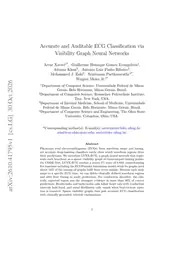
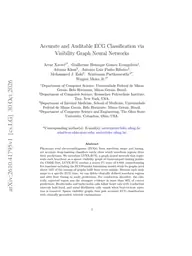
Physicians read electrocardiograms (ECGs) from waveform shape and timing, yet accurate deep-learning classifiers rarely show which waveform regions drive their predictions. We introduce LYNX-ECG, a graph neural network that represents each heartbeat as a sparse visibility graph of timestamped turning points. On CODE-Test, LYNX-ECG reaches a macro F1 score of 0.889, outperforming five baselines including the ECGFounder foundation model, while its graphs need about 14% of the storage of graphs built from every sample. Because each node maps to a specific ECG time, we can delete clinically defined waveform regions and alter beat timing to audit predictions. For conduction disorders, the clinically expected region was the strongest evidence in more than 90% of correct predictions. Bradycardia and tachycardia calls follow heart rate with conduction intervals held fixed, and atrial fibrillation calls vanish when beat-to-beat variation is removed. Sparse visibility graphs thus pair accurate ECG classification with clinically grounded, testable explanations.
Verbatim fromarXiv· arXiv metadata (abstracts are released under CC0)
Cite the publication recorded for this model. Check it against the publisher before submitting.
Xavier, A., Evangelista, G. H. G., Khan, A., Ribeiro, A. L. P., Zaki, M. J., Parthasarathy, S., & Jr, W. M. (2026). Accurate and Auditable ECG Classification via Visibility Graph Neural Networks (LYNX-ECG). arXiv 2610.41795v1. https://arxiv.org/abs/2610.41795
Xavier, Artur, Guilherme Henrique Gomes Evangelista, Aitazaz Khan, Antonio Luiz Pinho Ribeiro, Mohammed J. Zaki, Srinivasan Parthasarathy, and Wagner Meira Jr. 2026. "Accurate and Auditable ECG Classification via Visibility Graph Neural Networks (LYNX-ECG)." arXiv 2610.41795v1. https://arxiv.org/abs/2610.41795.
Xavier, A., Evangelista, G. H. G., Khan, A., Ribeiro, A. L. P., Zaki, M. J., Parthasarathy, S. and Jr, W. M. (2026) 'Accurate and Auditable ECG Classification via Visibility Graph Neural Networks (LYNX-ECG)', arXiv 2610.41795v1. Available at: https://arxiv.org/abs/2610.41795
Xavier, Artur, et al. "Accurate and Auditable ECG Classification via Visibility Graph Neural Networks (LYNX-ECG)." arXiv 2610.41795v1, 2026. https://arxiv.org/abs/2610.41795.
A. Xavier et al., "Accurate and Auditable ECG Classification via Visibility Graph Neural Networks (LYNX-ECG)," arXiv 2610.41795v1, 2026, [Online]. Available: https://arxiv.org/abs/2610.41795.
@misc{xavier2026accurate,
  title         = {{Accurate and Auditable ECG Classification via Visibility Graph Neural Networks (LYNX-ECG)}},
  author        = {Xavier, Artur and Evangelista, Guilherme Henrique Gomes and Khan, Aitazaz and Ribeiro, Antonio Luiz Pinho and Zaki, Mohammed J. and Parthasarathy, Srinivasan and Jr, Wagner Meira},
  year          = {2026},
  howpublished  = {arXiv 2610.41795v1},
  eprint        = {2610.41795},
  archivePrefix = {arXiv}
}