Foundation model

Bio-PM

From “Bio-PM: Bio-Inspired Self-Supervised Learning for Wrist-worn Accelerometer Data”
Parameters
1.4M
Year
2026
Form factor
Wrist accelerometer
Tarale, Prithviraj et al., "Bio-Inspired Self-Supervised Learning for Wrist-worn Accelerometer Data", arXiv:2603.10961, CC BY 4.0
PreprintFirst posted: Mar 11, 2026Added to atlas: Sep 26, 2026Source

Activity counts measure attention, not model quality. Missing counts are unknown. Publication status follows the linked source; a listed venue alone does not confirm peer review.

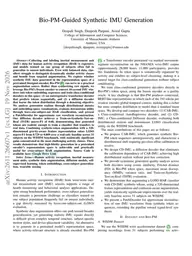
Bio-PM is a self-supervised model for wrist accelerometer data that splits motion into movement segments based on the submovement theory of motor control. A Transformer encoder is pretrained to reconstruct masked segments, which focuses it on how movements are organized rather than on raw waveform shape. Pretrained on about 28,000 hours from 11,000 NHANES participants, it beat strong wearable SSL baselines on six subject-disjoint activity recognition benchmarks.

Signals
IMU
Pretraining data
NHANES, ~28k hours, ~11k participants
Evaluation
6 subject-disjoint HAR benchmarks
Weights
code and pretrained weights released
Year
2026
Architecture

Transformer encoder, masked movement-segment reconstruction

At a glance
Type
Foundation model
Modalities
IMU
Parameters
1.4M
Architecture
Transformer masked reconstruction over zero-crossing movement-segment tokens
Venue
arXiv 2026-03
Year
2026
DOI
Not reported
Code
Open
Weights
Open
Licence
Not reported
Caveats
Not reported
Datasets
Not reported
Added
Sep 26, 2026
Updated
Oct 17, 2026

Abstract

Wearable accelerometers enable large-scale health monitoring, yet learning robust human-activity representations has been constrained by scarce labeled data. While self-supervised learning offers a remedy, existing methods treat sensor streams as unstructured time series, overlooking the underlying biological structure of human movement, a factor we argue is critical for effective Human Activity Recognition (HAR). We introduce a novel tokenization strategy grounded in the submovement theory of motor control, which posits that continuous wrist motion is composed of elementary basis functions called submovements. We define our token as the movement segment, a computationally tractable unit of motion composed of a finite sequence of submovements. By pretraining a Transformer encoder via masked reconstruction of these tokens, we shift the learning focus from local waveform morphology to high-level structural and temporal organization. Pretrained on the NHANES corpus (approximately 28k hours; 11k participants), our representations outperform strong wearable SSL baselines across six subject-disjoint HAR benchmarks. Code and pretrained weights are available at https://prithvitarale.github.io/biopm-site/.
Verbatim fromarXiv· arXiv metadata (abstracts are released under CC0)

Key results

How it works

How Bio-PM works: Input signals → Foundation model → Downstream tasksInput signals: IMU (Accelerometer, 3-axis). Foundation model: Bio-PM, 1.4M parameters (Transformer · Masked reconstruction). Downstream tasks: Activity recognition.Input signalsIMU: Accelerometer, 3-axisxyzIMUAccelerometer, 3-axisFoundation model×NBio-PM1.4M parametersTransformer · Masked reconstructionDownstream tasksActivity recognitionActivity recognition
Architecture
Transformer masked reconstruction over zero-crossing movement-segment tokens
Inputs
IMU
Approach
accelerometer · tokenization · NHANES · movement segment

Leaderboard rows· 1

All leaderboards
TaskDatasetMetricValueRank
Human activity recognition (IMU)har-6bench-avgMacro-F1 ↑0.65#1 / 1

Datasets used

No public datasets linked yet.

Papers· 2

Authors· 7

Cite this model

Cite the publication recorded for this model. Check it against the publisher before submitting.

Bio-PM: Bio-Inspired Self-Supervised Learning for Wrist-worn Accelerometer Data. (2026). arXiv 2026-03. https://doi.org/10.48550/arXiv.2603.10961
@misc{biopm2026biopm,
  title         = {{Bio-PM: Bio-Inspired Self-Supervised Learning for Wrist-worn Accelerometer Data}},
  year          = {2026},
  howpublished  = {arXiv 2026-03},
  doi           = {10.48550/arXiv.2603.10961},
  eprint        = {2603.10961},
  archivePrefix = {arXiv}
}

History

  1. Record updated

  2. Added to the ChatPPG research hub