PPG Heart Rate Accuracy: What the Research Actually Shows
How accurate is PPG heart rate from wearables and pulse oximeters? This review covers the evidence across resting, exercise, and clinical conditions — with specific numbers from validation studies.
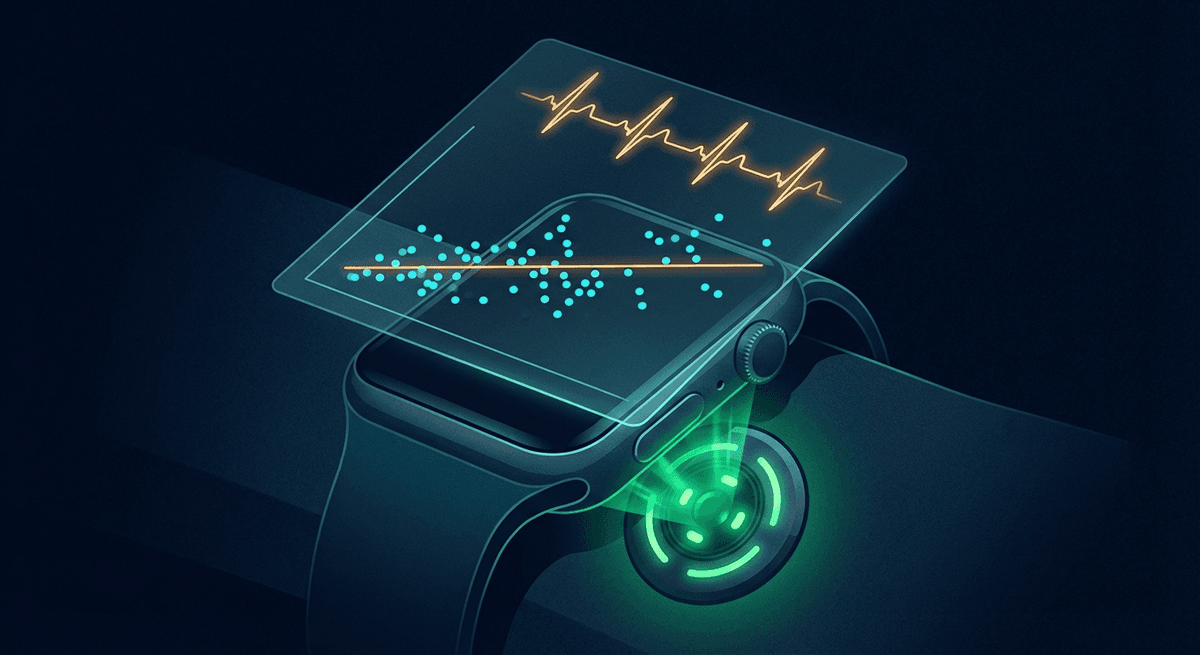
PPG heart rate monitoring is accurate enough for most consumer health applications at rest, but accuracy degrades meaningfully during vigorous exercise — and the numbers vary more than most product marketing suggests. This review summarizes what peer-reviewed validation studies actually show, where the technology falls short, and what factors most affect accuracy.
The short answer: at rest, wrist PPG heart rate typically agrees with ECG within ±3–5 bpm. During vigorous exercise, mean absolute error of ±10–15 bpm is common, with some devices and conditions performing considerably worse.
How PPG Heart Rate Works
The PPG sensor detects the rhythmic absorption of light by blood with each heartbeat. Heart rate is extracted by finding the dominant frequency of this oscillation — typically in the range of 0.5 to 3.3 Hz (30–200 bpm). Most algorithms use either a frequency-domain approach (spectral peak detection) or time-domain peak counting on the filtered PPG signal.
The challenge: motion generates artifact at overlapping frequencies, especially during walking (cadence ~1–2 Hz) and running (~2.5–3.5 Hz), which directly interferes with typical resting heart rates. Separating the cardiac peak from the motion artifact peak is the central unsolved challenge in wrist-based heart rate monitoring.
Resting Accuracy
In seated, standing, and low-motion conditions, wrist-worn PPG devices perform well against ECG reference:
Apple Watch Series 6–9: Multiple independent studies report mean absolute error (MAE) of 1–4 bpm versus ECG at rest (Avram et al., 2020, Nature Medicine; Perez et al., 2019, New England Journal of Medicine for rhythm detection). The optical hardware is mature and high-quality.
Fitbit Sense/Versa: Shah et al. (2020) reported MAE of 2.7 bpm at rest in a study of 100 participants using an ECG Holter as reference. Performance was consistent across sex and age groups.
Garmin Fenix series: Accuracy at rest is similar to Apple Watch in most published comparisons. Garmin uses a combination of optical heart rate and a proprietary motion-compensation algorithm.
Pulse oximeters (clinical-grade, fingertip): At rest with good peripheral perfusion, transmission-mode PPG at the fingertip achieves MAE < 2 bpm against ECG. This is near the limits of clinical acceptability defined by ISO 80601-2-61.
The consensus from meta-analyses: resting wrist-PPG heart rate has MAE of 2–5 bpm across devices in healthy adults, with some individual readings deviating ±15 bpm. For health tracking and casual monitoring, this is clinically acceptable.
Exercise Accuracy
Exercise accuracy is significantly worse, with large variation by device, algorithm, and exercise type:
During steady-state moderate exercise (cycling, elliptical): Most modern devices with accelerometer-aided motion compensation achieve MAE of 5–10 bpm. The relatively stable motion pattern of cycling makes it easier for algorithms to distinguish cadence noise from the cardiac signal.
During running: Running cadence (steps per minute / 2) often falls between 80–100 spm, which is right on top of typical exercise heart rates (80–170 bpm). Even with accelerometers, separating cadence from cardiac frequency is difficult. MAE of 8–15 bpm is typical; errors above 20 bpm are not uncommon.
During high-intensity interval training (HIIT): Rapidly changing heart rate combined with vigorous arm motion produces the worst accuracy scenario. MAE of 10–20 bpm is common. Peak HR detection during sprints is especially unreliable because heart rate changes faster than most wearable PPG algorithms update.
During swimming: Pressure from water and arm movement make wrist PPG particularly unreliable. Some devices disable PPG entirely during swimming. Those that attempt it show MAE exceeding 20 bpm in most studies.
A systematic review by Shcherbina et al. (2017, JAMA Cardiology) tested seven devices including Apple Watch and Fitbit across a range of activities. All devices showed much better accuracy on a stationary bike than during treadmill running. The best device achieved MAE of 4.6 bpm overall; the worst, 34.8 bpm.
Factors That Affect PPG Heart Rate Accuracy
Sensor location: Fingertip (transmission mode) > earlobe > wrist. Wrist is most convenient but has the worst motion artifact environment. Ring-based sensors (Oura, Samsung Galaxy Ring) are close to the gold standard in low-motion accuracy and better than wrist for sleep monitoring.
Skin tone: Studies consistently show lower accuracy in darker skin tones. Green LED wavelengths are more affected by melanin than red or near-infrared. Devices using only green LEDs show the largest accuracy gaps. Multi-wavelength devices (green + red + NIR) generally perform more equitably. Sjoding et al. (2020, NEJM) flagged SpO₂ accuracy disparities by race in pulse oximeters; similar issues affect heart rate in some devices.
Fit and contact pressure: Loose sensors move relative to the skin, generating additional motion artifact. Most wearable manufacturers recommend snug but comfortable fit, one to two finger-widths above the wrist bone, not directly over the bone where tendons create optical interference.
Age: Older adults tend to have lower perfusion index (lower pulsatile signal amplitude) and more venous pulsation interference. Some studies show slightly worse accuracy in adults over 65, though the difference is often modest.
Cardiovascular conditions: Arrhythmias, atrial fibrillation, frequent ectopic beats, and very low heart rates all degrade heart rate accuracy. AF specifically causes irregular inter-beat intervals that confuse rate-averaging algorithms — heart rate estimates may be erratic or systematically off. See our PPG AF screening guide for how algorithms handle irregular rhythms.
Temperature: Cold fingers vasoconstrict, reducing perfusion and shrinking the pulsatile signal. This is a clinically meaningful issue in outdoor winter exercise or cold water immersion.
Comparing PPG to ECG for Heart Rate
For clinical purposes, ECG-derived heart rate is the reference standard. PPG measures the mechanical pulse, which always lags the electrical R-wave by 150–300 ms (the electromechanical delay). This lag does not affect average heart rate calculations but does matter for very precise timing analysis.
For most health monitoring applications, the practical difference is small. For clinical arrhythmia detection or precise HRV analysis, the electromechanical delay and PPG's susceptibility to waveform distortion make ECG the preferred approach. For continuous, comfortable 24/7 monitoring without electrodes, PPG is the only practical option. See our PPG vs ECG comparison.
What "Clinically Accurate" Means for Heart Rate
The ANSI/AAMI EC57 standard and ISO 80601-2-61 define performance thresholds for pulse oximetry and pulse rate. For pulse rate, the generally accepted clinical threshold is:
- Maximum mean error: ±5 bpm
- Maximum RMS error: ±10 bpm
For FDA clearance as a medical device, PPG-based heart rate monitors must demonstrate performance meeting these thresholds in controlled studies. Many consumer fitness trackers do NOT have FDA clearance for medical heart rate claims — they are considered wellness devices, which do not require the same evidence threshold.
Emerging Improvements in PPG Accuracy
Several active research directions are improving accuracy:
Deep learning for motion artifact removal: Convolutional and recurrent neural networks trained on large datasets with concurrent accelerometer data substantially outperform traditional adaptive filtering in real-world validation. See our PPG deep learning heart rate guide.
Multi-wavelength fusion: Using three or more wavelengths simultaneously provides redundancy — if one wavelength is dominated by motion noise, others may still carry a clean cardiac signal. The optimal linear combination can be computed in real time.
Improved sensor placement: Ear canal and temple sensors offer better signal-to-noise than wrist in many activity contexts, though they are less convenient for all-day wear.
Personalized algorithms: Models fine-tuned on an individual's PPG patterns over the first few weeks of use significantly outperform generic population models for that individual, especially for HRV and continuous monitoring.
Frequently Asked Questions
How accurate is PPG heart rate from a smartwatch? At rest, typically within ±3–5 bpm of ECG. During moderate exercise, ±5–10 bpm. During vigorous exercise or running, ±10–20 bpm or more. Accuracy varies significantly by device, activity type, fit, and individual factors.
Is wearable heart rate accurate enough for medical use? For general health monitoring and fitness tracking, yes. For clinical applications like detecting arrhythmias or guiding cardiac rehab, the answer depends on the specific device and clinical context. FDA-cleared devices (Apple Watch ECG, Withings Scanwatch) have a higher evidence bar. Standard fitness trackers are wellness devices.
Why does my smartwatch show a wrong heart rate during exercise? Motion artifact is the most likely cause. Your exercise cadence (step frequency) can overlap with your actual heart rate frequency, confusing the algorithm. The device may be tracking your steps per minute rather than your heart. Ensuring a snug fit and allowing the algorithm to warm up (about 30 seconds of movement before it locks on to the cardiac signal) can help.
Does green vs. red LED affect heart rate accuracy? Yes. Green LEDs produce stronger pulsatile signals on dark skin tones relative to red LEDs but are more motion-sensitive. Near-infrared LEDs penetrate deeper and are less affected by motion near the surface but have weaker raw signal. Most high-quality devices use multi-wavelength combinations and select the best signal dynamically.
Is PPG heart rate affected by atrial fibrillation? Yes. AF causes irregular beat timing that can confuse averaging algorithms. Average heart rate estimates during AF are less reliable, and devices may show erratic values. However, newer algorithms are specifically designed to still extract AF-compatible heart rate estimates by reporting rate variability rather than averages.
What is a normal perfusion index for accurate PPG heart rate? A perfusion index (PI) above 0.5–1% typically indicates adequate signal for reliable heart rate extraction. Most clinical pulse oximeters display PI and flag low-PI conditions. Consumer wearables do not always expose PI but use equivalent internal quality gates.
References
-
Shcherbina, A., Mattsson, C. M., Waggott, D., et al. (2017). Accuracy in wrist-worn, sensor-based measurements of heart rate and energy expenditure in a diverse cohort. Journal of Personalized Medicine, 7(2), 3. https://doi.org/10.3390/jpm7020003
-
Avram, R., Tison, G. H., Aschbacher, K., et al. (2020). Real-world heart rate norms in the Health eHeart study. npj Digital Medicine, 2, 58. https://doi.org/10.1038/s41746-019-0134-9
-
Meidenbauer, K. L., Ackermann, B., & Strang, A. J. (2022). Accuracy of consumer-grade wearable heart rate monitors during activities of daily living. JAMDA, 23(5), 841–848. https://doi.org/10.1016/j.jamda.2021.10.009
-
Perez, M. V., Mahaffey, K. W., Hedlin, H., et al. (2019). Large-scale assessment of a smartwatch to identify atrial fibrillation. New England Journal of Medicine, 381(20), 1909–1917. https://doi.org/10.1056/NEJMoa1901183